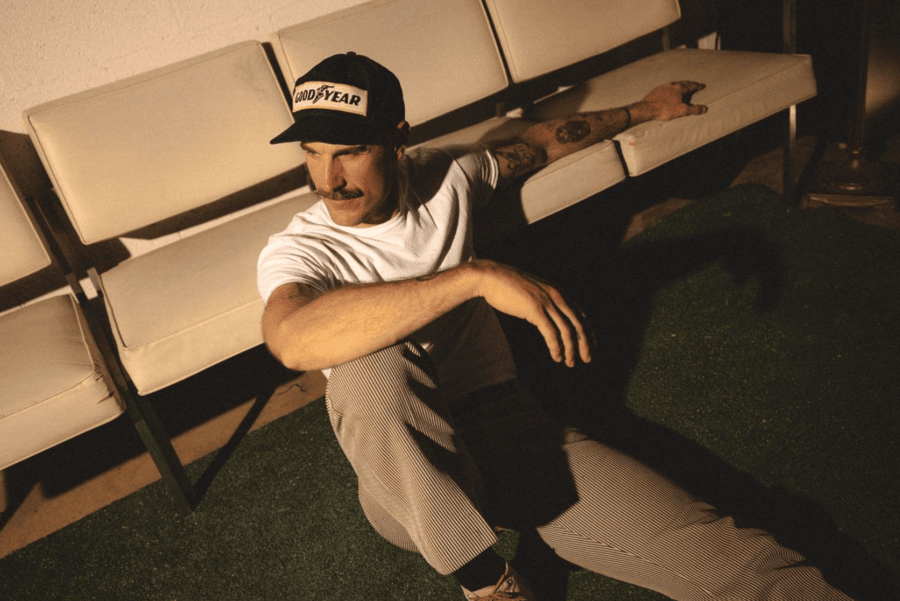
Photo by Rachel Deeb
After four albums, it took a rough stretch of life for Rayland Baxter to pull back the curtain, stop hiding behind characters, and write his most personal record to date. A writer who needs to constantly create, Baxter filled a notebook with 70 songs and whittled them down to the 11 that make up True Violet, his first release in four years. Most of the songs were written at home outside Nashville, in a cabin in the Tennessee hills, with a guitar and his dog, star of the “Bolly Plateau” video, faithfully by his side.
The songs reflect a life lived through hard circumstances, including the loss of his father, musician Bucky Baxter, and the end of a relationship. They gave him a way to work through it. Several were co-written with Tyler Ballgame, including the opener, “Better Man,” which Baxter’s friend, Shakey Graves, chose to lead off the album when offering a suggested sequence.
I caught up with Baxter over Zoom ahead of the album’s release to talk about the darkest stretch, how he picks songs from a pile of 70, and what comes next.
So you’re on the outskirts of Nashville, or you’re in Nashville proper?
RAYLAND: I live outside of Nashville, about 30 minutes.
In my head, I imagine that you have this community of songwriters that you’re just hanging out with. Is there any reality to that at all?
RAYLAND: There was when I lived in Nashville, between 2010 and 2020. We were all playing and hanging and going out together.
Did you have your own Traveling Wilburys? Was it a crew of four or five guys that you were always hanging out with?
RAYLAND: Not really for me. My best friends were a tour manager, an engineer, and a record producer. Another guy is in a rock band as a guitar player, so we weren’t all guitar players.
The press bio calls True Violet a “personal and bloody album,” with bruises and bite marks in the songs. Surely everything you’ve written has been personal in some way. Why is this record called out more than your past work?
RAYLAND: Because in my past, I’ve made up stuff for albums. I made up stories about characters, and I haven’t written from this place, in my spirit, in my heart, where I was existing for True Violet when I was writing those songs.
I experienced a lot of life from the beginning of COVID, like a lot of people, but this is my representation of it. From the beginning of COVID until today, I’ve gone through some chapters. There’s a lot that’s happened in these five years compared to the previous 15.
When you write from that place, is anything off-limits? Are there things you either can’t or won’t write about?
RAYLAND: I guess so. I do like to have my own personal feelings that I don’t share with anybody, or just with my friends on a couch, talking shit. So yes, there are things. I don’t want to be a living, breathing, 24-7 walking art piece for other people. I like to make music, and I want it to sound good, and I want it to be inspiring.
Is it difficult to perform songs that are this personal? Does it bring back those feelings, and you think, “I’m going down this road again”?
RAYLAND: Yes. When I listen to True Violet, I get sad. I experienced some stuff in 2024 that’s a big inspiration for a lot of these songs: the fallout of a toxic relationship. That was a hard time for me to be alive, man. However, I wrote most of the songs during that year, so this is why I want to get it out into the world, so that people can have their own ideas about what this music does for them. It can pull me out of this area I exist in with these songs, where it’s like, damn, that was really, really hard living.
I interviewed Ruston Kelly, who wrote an album about his drug addiction and coming out the other side. He told me that once he’s performing the songs, they sort of no longer belong to him. You hand them to the audience, and singing the darker material isn’t so tough, because it’s in his past. Does that ring true for you?
RAYLAND: What a glorious feeling. I’m looking forward to experiencing that with these songs. I also needed to get this record out of my system so that I can write the next record. I think this record will do what it needs to do, but I’m really excited to get into the one after it when the time comes.
The songs I’ve written, or the little ideas I have over the last seven months, have been light. They’ve been upbeat, and I really like the melodies I’m coming up with. Most of it’s just me mumbling into my phone, but I just gotta get this record out so I can get on to the next one.
Your bio mentions 70 songs. Were those written, or recorded?
RAYLAND: Seventy songs, seventy pieces of paper in a notebook, each with a song complete enough to take into a studio with musicians and bring it to life. I’ve been like that. For my last record, If I Were a Butterfly, I wrote like 120 songs. I went nuts. For Wide Awake, I wrote like 50. Sometimes two songs become one.
The way I write is, I need to write a bunch and then pick out what works. I’m sure a lot of people are like this as well, but I need a bunch of options. If a song I thought was going to go off in a great way in the studio doesn’t, I have something else: “Oh, what about this one? Or what about this one?” Because it’s kind of like shooting with your eyes closed in the studio sometimes.
I’m not a songwriter, so this fascinates me. How do you get from 70 songs to 11? And do the other 59 stay in the rearview mirror, or do you go back through them for the next record?
RAYLAND: I record a little version on my phone, and when I have five or six or seven, I send them to a couple of people I trust who have really great taste, my sister being one of them, and a couple of other people who wouldn’t give me bullshit. That helps a lot with narrowing down to whatever I can squeeze into an album. But once that album’s made, almost 100 percent of the time, those songs sit on a page and are not resurrected. That was their life. They were just a fruit on the tree that never got picked, which is fine.
Tell me about working with Tyler Ballgame. Is he a collaborator, a friend? Does he bring his own ideas, or help you pull out your best ones?
RAYLAND: It’s a new relationship for me. A friend of mine posted a video of his a couple of years ago, and it immediately caught my ear. I’m like, this guy is awesome. We linked up on Instagram and communicated a little bit, but I was watching from afar. The majority of this record was recorded in December of 2024 and then February of 2025. I thought I was done at that point. I sat on it, and I’m like, this is not done, I need more songs. But I was tired of writing by myself. So in May of 2025, I reached out to Tyler, and I’m like, “Hey, can you help me write some songs? I need some songs, I need help, man.” He’s like, “Yeah, let’s do it.”
I went out to LA to meet him, and we met in person for the first time that day, and we spent three days writing. We did some of his ideas, and we did some of my ideas that I had in a vault, little melodies I’d come up with, which was “Better Man.” “Better Man” was a voice memo of me picking up a guitar and mumbling some stuff, and I liked the melody a lot. We wrote that, and probably four more songs, some of his ideas and some more of mine. Once you put the idea on the table, it becomes a split. You’re like, “What do you want to do with this? What could you do with this?” And we help push it up the hill till we get to the top.
It’s a joy to write with Tyler. He’s full of ideas, which is a dream situation for me, because nobody wants a writing session or a collaborative session to go quiet. It never did with him. If I ran out of space, some air, he’d be like, “We’re always digging.” It was good, man. I hope to write more with him.
As a lyricist, do you consider every single word important?
RAYLAND: Oh, yeah.
One lyric grabs me every time I listen to the record, from “The Fool”: “Only the dead man knows where the rainbow grows.” Can you tell me about that line?
RAYLAND: My first question would be, can you tell me about that lyric? What does it do to you?
I don’t know. It catches my ear every time, and I’ve been trying to figure out what it means.
RAYLAND: I always like to ask other people what something means to them. What “Only the dead man knows where the rainbow grows” means to me is I needed to die to be born. I needed to go through some really hard times to see the light. I needed to lose to succeed. There’s no success like failure, and failure is no success at all. That’s Dylan. That vibe. I needed to be in the darkness to know. I needed to go to the darkest shadow in the end of my bedroom, and there, I started to dig back out and on my way to seeing and thinking much more clearly.
That makes total sense now. Maybe it grabbed me precisely because I didn’t quite know what it meant. When you write in batches, do you think of the songs as siblings, with one emotion running through each group?
RAYLAND: Not necessarily. Let me think about this. Siblings. I know my own style traits, so sometimes portions of songs sound like other songs. The ending of “Better Man” sounds like the ending of “Willy’s Song,” which is from my first record. But in terms of siblings, other than the ones I wrote with Tyler or my friend Kevin Rhodes, I wrote them all on this chair right here, with one or two guitars, on my bed right here. They’re all coming from this geographical location right here. Only I know that. That was kindergarten for them.
Then you bring them into a studio, and there are so many more memories associated with them. I remember, this is the drummer for that song, and I remember doing the vocal take in this area of the studio. But siblings? They all have the same mother.
“Better Man” opens the record, and it feels like a mission statement. Was that intentional? Did you want people to know right away what they were getting into?
RAYLAND: It seemed like that was the best fit. Honestly, it took me forever to figure out the sequencing of this record. I didn’t even figure it out. Shakey Graves sent me the initial sequence. I flip-flopped one song with another so that it could fit on the vinyl sides properly. With a lot of this record, I lost objectivity completely. I needed to play it for people so I could understand what they felt when listening.
When it came to the sequencing, I was like, “I have no idea. Shakey, can you help me?” He suggested it, I think. He said, “You want me to give it a shot?” I said, “Please.” Thirty minutes later, he sends back a really great sequence, and “Better Man” was the start. I’m like, okay, all right. I never thought about that, but yeah. Nice guitar line. “I don’t want to talk about it anymore, I’m free of the feeling.” That’s it, man.
I never thought about sequencing until a friend sent me a record that I loaded onto my iPod, where it played alphabetically. When I heard the official version, I almost didn’t recognize the songs, even though they were the same 10. It’s a craft, and you can get it wrong.
RAYLAND: I’ve experienced that. A friend of mine sent me his record back in, like, 2014, and it was just songs. When it came out, I didn’t want to listen to it anymore, because I had my own way of listening to it, which really worked for me. That goes to say how important sequencing is. Well, it’s important unless you let somebody sequence it themselves. If you want to make a playlist of my songs for you, all good, go ahead.
I always listen to a record start to finish. I don’t eat my appetizer today, my main course two days from now, and my dessert four days after that. I like the top half of this record, but I find myself excited to get to the last few songs, especially “Oh My Love,” which might be my favorite. I grew up in the CD era, when records ran 74 minutes and the last four songs were often filler. Here, I enjoy the end as much as the beginning.
RAYLAND: Cool to hear. I’m with you. I really like the sequencing. One of my favorite songs on the record is “Dreamin’ About.” There’s a nice mood to it. In my first two records, I ended the records with a bang. Then, with Wide Awake and the Butterfly record, I ended them on a quieter song. With this record, it was like, no, let’s put this *Paul McCartney*–style song at the very end. Did you make it to the hidden track?
Yes. In the download, it fades out, and then there’s a kind of gospel-y choir thing. And halfway through that song, the guitars sounded like the Beatles to me.
RAYLAND: That’s the hidden track. With the MP3, we had to attach it to “Oh My Love.” I thought that was a really awesome way to end the record. I don’t think I would have thought of it, so another nod to Shakey for figuring that one out for me.
Early on, people would always say, “You sound like Paul Simon.” Okay. Then, when I did the Wide Awake record, we tapped into some Beatles stuff, and I’m like, yeah, I like the Beatles. Not everybody loves the Beatles, though, and that’s fine.
You’re not rushing into a tour behind this record. Why wait until January?
RAYLAND: I’m excited not to rush into a tour as soon as a record comes out, because nobody knows what’s going on. The people who are just hearing the record don’t have time to get into their own relationship with the songs, which is so important. Same with me and the band. We won’t even rehearse until mid-December. We won’t play most of these songs for the first time until mid-December, so in January, when we’re preparing for the tour, we’ll need some time to understand which songs fit into the set, which songs should sound like they do on the record, and which songs are full band on the record that maybe I’ll play solo.
I’ve never been able to have the luxury of putting a record out and waiting three months to go on tour. Some of those shows will be October, November, December, January, February. The end of the second leg of that tour is in early March, which is four months. That’s cool. I like that.
David Ramirez told me he’s a touring musician who puts out records to support going on tour, so release timing barely matters to him. Where do you land?
RAYLAND: I get that, too. I also don’t want to over-tour. I love touring, and I’ve played really exciting shows. Wherever I’m at in the United States, let’s just go ahead and be safe: at least 75 people are going to show up somewhere. Hopefully that 75 isn’t in a 500-cap venue, which just happened. You live and you learn.
I hear David on that, but I want to do it right, and that can be a floating form. Because I haven’t put a record out in four years, my job as an entertainer is to have people leave every show thinking, “That might be the best show I’ve ever seen.” Whether that happens or not, that’s what I’m shooting for as an entertainer. That’s what I’m also shooting for as an artist. I don’t think I made the best record ever to exist. I probably never will, but as long as I’m reaching for that bucket, that’s fine with me.
How are the new songs working in the live set so far?
RAYLAND: As a song comes out, we’ll introduce it. When “The Fool” came out, we started playing it immediately. I was out with Houndmouth right when that came out, so that was a fun one. When “Better Man” came out, we tried it as a four-piece. I’ve been playing shows as a four-piece for the last three years. In January of next year, we’ll add my friend Aaron Embry on piano and keys. He’s a multi-instrumentalist who has played on my last three records, this one included. We’ll be able to play the songs with a bigger sound. Otherwise, I would play “Better Man” solo. I play “Bolly Plateau” solo. There are layers to it, and I want to respect the song as it exists. But the song was created with me and a guitar from the get-go, so I can always do that.
Songkick lists nearly 800 shows for you. Do you keep a road diary, or does it all blur together?
RAYLAND: I can remember a lot of them. I don’t keep a road journal of any kind where I would write about the show. I honestly had no idea I’d played that many shows.
If somebody comes up to you at the merch table and says, “Oh, I saw you in 2018 at this club in Denver,” will you remember it?
RAYLAND: Oh, yeah. Especially with a little help like that. I even remember gigs I did when I was driving around in my stick-shift Saab in 2010, when I had just made an EP where I burned CDs and sold them. I played bars and coffee shops. On the first tour I ever did, my buddy Jacob Thomas Jr. and I played a bunch of coffee shops and pizza shops in Colorado, and breweries. He schooled me on Wilco on the way out there, and we had the best time. I remember all of those shows.
Have there been shows that were especially tough, opening for someone when the crowd just wasn’t there for you?
RAYLAND: Not many. I’ve had the fortune of being in the proper places with my music. The weirdest one, though, was when I opened for Lauryn Hill for a few shows in 2015, 2016, maybe, and two of them were solo. I had to open for her solo in Charlotte, North Carolina, and I’m like, this is not going to go off well. But it did. I’m not saying people were standing up out of their seats, but I didn’t get booed off the stage.
I once watched a solo opener at a Band of Horses show struggle through a talking crowd, and I felt terrible for her. Has that happened to you?
RAYLAND: That should happen to everybody at least once in their life. It’s happened to me. I used to open for Grace Potter and the Nocturnals for a couple of years, and before I could bring my band, before I even had friends I could ask to be in my band, I played solo. Playing with her in Myrtle Beach, it’s like, all right, I’m going to prepare for war right now, because everyone’s drunk, they’re waiting for Grace to get on stage, and it’s me and my guitar. But through those experiences, and I’m probably forgetting a bunch, you learn what works and what doesn’t.
If you could hand someone 45 minutes of your music and tell them how to spend it, what would you have them doing?
RAYLAND: Definitely driving, right around this time of day, in Nebraska, where you’ve been driving for two days already, and it’s the golden hour. You can see the sun setting ahead of you, and you get to witness the sky turn from bright yellow to orange to purple, driving in a straight line. You can just sit back and turn it up. You’re kind of exhausted, and your guard’s down. I’ve experienced that.
I love that. I’m so intentional about road trip music. If I’m driving any distance where I could listen to a whole record, I don’t take that lightly. It’s the right time to listen. Last question, and it has nothing to do with your music: is there a song that instantly takes you back when you hear it, even in the grocery store?
RAYLAND: “The Man in Me” by Bob Dylan. That song makes me very happy. I love how it’s produced, I love how it sounds, everything about it. It’s like a key unlocking something in me. Another song is, I think, called “Watson’s Blues.” It’s an instrumental on Marty Stuart’s first album. It just starts off, and there’s some nice mandolin in it, and whenever I hear that, I go to a very happy place. There are a lot of songs, man.
As a songwriter, you’ll never know what your songs mean to people, because they attach their own feelings to them. Right now, there are hundreds of people who would name one of your songs as the one they remember and attach to something.
RAYLAND: I appreciate that a lot. Every day, I gotta be grateful that I’ve found music, or music has found me. I gotta thank God for giving me a voice, whatever is right here that vibrates the way it does, that people like to hear. That’s how I live, and that’s really, really cool and really fun.