
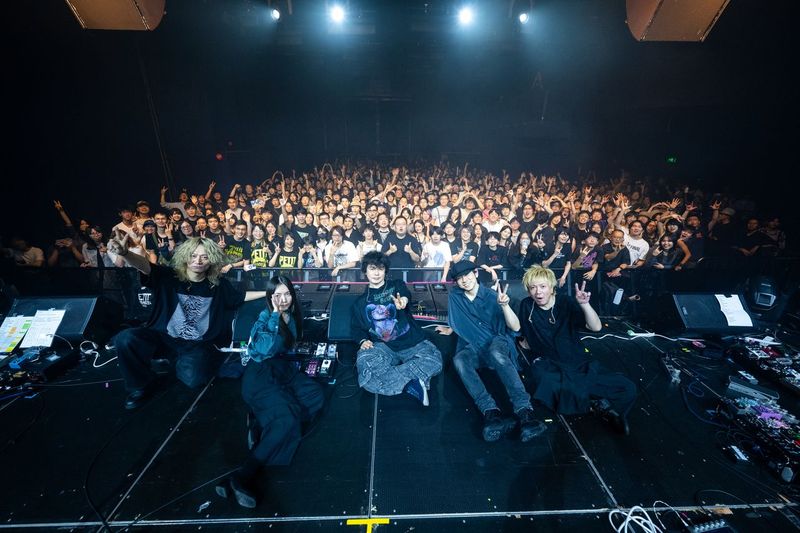
Photos by Sherwin Wong
Few bands embody the paradox of shoegaze quite like Tokyo Shoegazer. Emerging from Tokyo’s ever-evolving underground music landscape, the group (drummer Hiroshi Sasabuchi, guitarists Kiyomi Watanabe & Yoshitaka Sugahara, bassist Taizo Nakamura and vocalist/guitarist Kyoko Sahara), has built a legacy that feels both fleeting and enduring, as though existing in the space between memory and momentum. What began as a seemingly singular occasion, a one-off performance assembled for a birthday celebration, unexpectedly transformed into one of the most compelling voices in contemporary Japanese shoegaze, proving that some artistic journeys are born not from careful planning, but from creative chemistry that refuses to disappear.
Since their formation in 2010, Tokyo Shoegazer have cultivated a sound that transcends the conventions often associated with the genre. Their music inhabits a world where towering walls of guitar noise coexist with fragile emotional undercurrents, where distortion functions not as obscurity but as revelation. Across releases such as ‘Crystallize’ (299 Japan Records, 2011 and reissued by Graveface in 2019), and ‘Turnaround’ (299 Japan Records, 2013), the band has demonstrated an ability to balance intensity with introspection, crafting compositions that feel simultaneously expansive and intimate. Their work invites listeners into landscapes of blurred edges and shifting perspectives, where melody emerges from chaos and atmosphere becomes a form of storytelling.
The band’s history is equally compelling. Marked by lineup changes, international tours, disbandment, and eventual reunion, Tokyo Shoegazer’s trajectory reflects a deeper narrative about artistic resilience and the enduring power of connection. Rather than diminishing their impact, periods of absence seem to have amplified the significance of their return, reinforcing the emotional bond between the band and a devoted audience that continued to carry their music forward long after stages had gone dark.
More than a decade after their unexpected beginnings, Tokyo Shoegazer remain a fascinating presence within the global shoegaze conversation. Their story is not simply one of genre revival or cult acclaim, but of evolution; an ongoing exploration of sound, memory, and collective experience. As they continue to revisit their past while forging new creative paths, the band stands as a reminder that some music resonates most profoundly not because it seeks permanence, but because it captures the beauty of impermanence itself.
Special thanks to Kouichi “Coach” Minami for the coordination effort and to Tokyo Shoegazer for their time.
James Broscheid: ’Remains’ leans into a more forceful, rhythm-driven sound compared to ‘Moonworld Playground’. What prompted that shift in direction, and was it something that emerged naturally during writing or a conscious decision from the outset?
Hiroshi Sasabuchi: When people hear the term “shoegaze sound,” I think most of them imagine a soundscape with a lot of reverb. That is something this band has always been good at, and it has been part of what we have done up until now. But this time, we deliberately pushed ourselves in the opposite direction and steered the sound toward something drier. So yes, I would say it was intentional.
Kiyomi Watanabe: For me, the biggest thing was returning to the simple idea that shoegaze is not something we need to simply imitate or trace, but just one form of expression within alternative rock. Thinking that way allowed me to express myself more freely, without feeling strangely restricted by the genre. Hiroshi and I also shared the same vision of wanting to break, in a sense, the already established image of Tokyo Shoegazer. He had also been telling me for some time that he wanted the guitars to have more contrast and expression, and I think I was able to bring that into the songwriting and arrangements this time.
Yoshitaka Sugahara: For this album, we consciously reduced the amount of reverb on the guitars and kept the number of recorded guitar tracks to a minimum. We were aiming for a more solid guitar sound. As a result, I think the rhythm section became much more prominent in the overall sound.
JB: In wanting to break the established image of both shoegaze and Tokyo Shoegazer, was there ever a point during recording where you worried ‘Remains’ might alienate listeners who were attached to the more atmospheric side of the band or did that tension actually motivate you further?
HS: I don’t believe in repeating the same thing forever. Sometimes I think it’s necessary to challenge the listeners a little. Why? Because eventually people will get bored otherwise. I know there will be mixed reactions, but I think that’s how bands become stronger and expand the character of their music.
KW: A long time passed after the previous album, and before the listeners got bored, there was actually a possibility that we ourselves would get bored first. We could already see the limits of our live set with the existing songs, and simply repeating the methods we had used in the past no longer felt satisfying. Personally, I was searching for stimulation. It’s not that I completely ignored the listeners, but more than anything, I wanted us to move toward the direction we genuinely wanted to pursue, and I never felt anxious about that.
YS: There are many different kinds of listeners around the world, so I always assumed there would be both positive and negative reactions. That never worried me. Regardless of musical style or sonic approach, I believe that if we can create music that truly moves people emotionally, it will reach the listeners it’s meant to reach. We devoted ourselves completely to making this album, and I’m confident we created something we can fully stand behind.
JB: The drumming across the album is especially prominent. Hiroshi, how did your approach evolve for this record, and were there specific influences or techniques you wanted to bring forward in tracks like “Pulse” and “The Reckoning”?
HS: On “Pulse,” I brought the marching drum element to the forefront. I tried to play with the same pulse, or heartbeat, throughout the song, while thinking about how much of my own groove I could bring out within that. I also took inspiration from the way Yukihiro Takahashi of YMO (Yellow Magic Orchestra), approached drums. I tried shifting the placement of the snare and kick slightly and searched for the spots that felt the best. For “The Reckoning,” the focus was simply on momentum. I was thinking about the forward-driving feeling of Carl Palmer around the time of Emerson, Lake & Palmer’s ‘Tarkus’ (Island Records, 1971) and ‘Trilogy’ (Island Records, 1972), and Stewart Copeland from the early days of The Police. Rather than worrying about small details, I wanted the drums to pull the song forward. I aimed for a sound that feels good to listen to.
JB: Kiyomi and Yoshitaka, your songwriting is split across the album. How do your compositional styles differ, and how did that dynamic shape the contrast between songs like “Wisteria” and “Vega”?
KW: In terms of songwriting, I think both of us are similar in that we usually bring in demos that are already developed to some extent. But Yoshitaka is very much rooted in shoegaze and post-rock, whereas I listen to UK music as well, but I would say I’m more strongly influenced by American rock. I think those differences in our backgrounds naturally come out, even unconsciously.
YS: When I write songs, I don’t usually have a clear picture of the album as a whole or its overall direction yet. Each of us first writes the kind of song we want to express through this band. In my case, I often come up with guitar phrases while playing rhythm tracks, then develop the song from that motif. With “Wisteria,” in particular, I came up with the two guitar arpeggios in the intro. From there, I took an approach we had not really used before, pushing the song with guitar and bass riffs over a single chord in order to express both heaviness and emotion.
JB: The guitar sound feels denser and more physically present this time. What were the key ideas or experiments behind achieving that heavier, more rock-oriented tone without losing your identity?
KW: Even though it is one guitar, I record it by running a distortion pedal and a fuzz pedal through two different amps at the same time. Even with the same chord, the pedals and amp settings are different, so the frequency range and the way the sound is heard also change. In the mix, depending on the song, we intentionally pan them left and right or blend them together. We do the same thing live as well. I have been splitting the guitar sound into two for a while. In the past, it was more like adding another amp with the same sound just to make it louder. Then it became a matter of separating wet and dry sounds. Now, I’m starting to settle into a method of controlling two completely different settings at the same time. The root of this idea comes from the recording methods of hide from X JAPAN.
YS: There wasn’t a very detailed process of examining everything in advance. Rather, we set certain restrictions for the album as a whole, such as reducing reverb and cutting down the number of guitar tracks in the recording, and then thought about how to create a wall of sound within those limits. The parts that had previously been covered up by using many tracks became more solid, and I think that is what led to the stronger sense of presence.
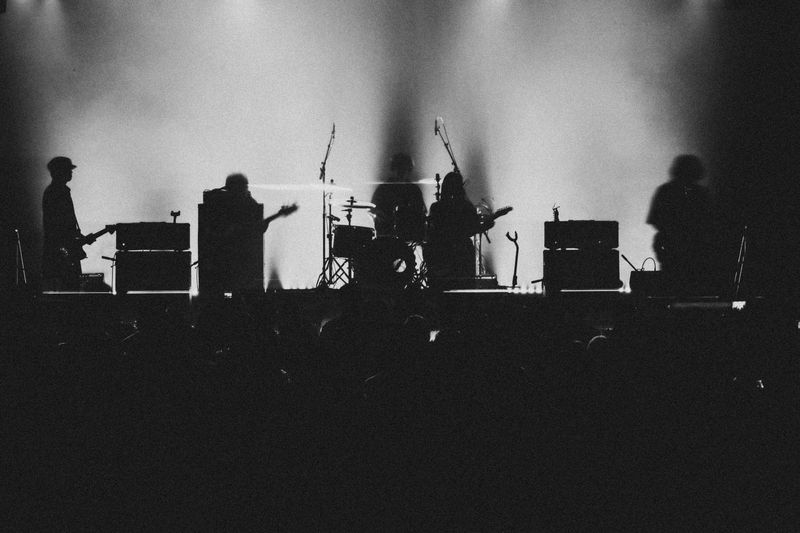
JB: Taizo, the bass plays a crucial role in anchoring the album’s weight. How did you approach locking in with the drums while still carving out your own melodic presence?
Taizo Nakamura: Even with a simple bass pattern, I try to create a slightly unusual impression by starting from different beats in each bar. For the more melodic parts, I use a lot of 6ths, 7ths, and 9ths from the chord tones, and build phrases in a way that makes them sound more memorable.
JB: Kyoko, your vocals often sit right at the edge of the mix, blending into the instrumentation rather than dominating it. How do you think about your voice in relation to the band’s overall sound, especially on tracks like “Missing” and “New Dawn”?
Kyoko Sahara: I try to make sure my voice is in harmony as part of the band’s sound, and that it resonates comfortably without disturbing the listener. I value the idea that the voice is also one instrument. Through words and expression, I want my voice to add emotional color to the songs, almost like an essence within the music.
JB: The title track “Remains” stretches into a more expansive, almost cinematic structure. Can you walk through how that piece came together and how you approached its pacing and dynamics?
KW: The song was inspired by classical music through Hiroshi’s idea, so in that sense I think describing it as cinematic is quite accurate.
YS: When I first wrote the song, I was aiming for a sense of eternity by repeating the chord progression in the first half. But during the arrangement process, Hiroshi suggested changing the chord development, and Kiyomi proposed the chord progression for the loud, distorted section. That gave the song a much larger sense of story. The final part, where the time signature changes, came to me almost miraculously during recording, inspired by classical music. I became convinced that we had created an arrangement worthy of closing the album.
HS: I’m very happy that you heard it that way. In my mind, “Remains” had the image of a song that would play during the end credits of a film. I think the sense of tempo in classical music is something that can only really be expressed by humans when they play together. I felt that adding those changes in pace could create an emotional impact.
I probably could have thought about many more things, but we ran out of time during recording, so we captured it in that form.
JB: The album was recorded over several sessions between late 2025 and early 2026. Did the time span influence the cohesion or emotional arc of the record?
HS: Because we did thorough pre-production, the final destination of this album was relatively clear, and each member was able to start moving toward that point. I was thinking about the overall concept of the album, so in this case I was also able to look back on my own emotions at the time, as well as the things I had seen and experienced, and turn them into sound. It took an enormous amount of time to get there, but I don’t think any of it was wasted. In the end, I think it became a good album.
KW: With our past releases, the period between deciding to make an album and actually releasing it was usually very short, so we were always fighting against time. There were many things we could achieve precisely because of that short time frame, but I had also started to feel that I wanted more time to properly face the material. This time, we were able to finish demos for the candidate songs within the period we had, and thanks to Hiroshi’s ability to coordinate everything, we were able to spend time on pre-production and preparation. Because of that, when we went into recording, I had a much clearer idea than before of what needed to be done.
JB: When working with Junichiro Ojima and Yosuke Maeda at Freedom Studio Infinity, what aspects of the recording and mixing process were most important in capturing the album’s scale and clarity?
HS: I have had a long working relationship with Freedom Studio Infinity. This is not limited to that studio, but what is absolutely necessary for our recordings is recording to tape. To me, analog sound feels like sound with human blood running through it. It also captures the atmosphere of the room very clearly. I always tell them that I do not want those two things to be lost. I think we were able to leave behind something that will remain properly as an object, even after we are gone.
KW: I think the most important thing was the mindset of trusting ourselves and the other members, and trying to eliminate compromise as much as possible. That creative spirit of not sparing time or effort in order to move toward something better was very important.
YS: For the recording, we were conscious of using analog recording, and of capturing the best possible sound from the tube amps that made the guitars and bass feel best to the members. The studio equipment was excellent, and it captured exactly the sound we wanted to make. The engineer’s skill was also very high, and the recording proceeded smoothly without our concentration ever being broken, thanks to Junichiro. Yosuke, who handled the mix, also had a deep understanding of the sound we wanted, and even at the rough mix stage he had already created something wonderful.
JB: The balance between distortion and melody is central to your sound. On ‘Remains,’ how did you decide when to let the noise take over and when to pull it back?
KW: The vocals are part of the instrumentation, and we are not a band where the melody is always the main focus. So in the mix, we are conscious of creating a sense of unity where the vocals blend in, rather than standing out in a special way. Because of that, I don’t really remember consciously thinking about when to push or pull back. Personally, I think the dynamics of the songs themselves naturally lead directly to the push and pull between distortion and melody.
YS: Basically, Hiroshi judges the overall balance, and the member who composed each song judges the guitar sound. That is how we usually work. In my case, I mostly decide based on whether it feels good to me. I don’t calculate it in a very precise way; it’s more instinctive (laughs).
HS: I don’t think about it in a particularly conscious way, but when sound comes into my ears, there are times when I feel, “This is getting in the way.” Also, if everything sounds too flat, I do very detailed work of adding and subtracting sounds in order to create a more three-dimensional sense of space. It is not based on any specific rule. I rely on my own instincts.
JB: Yoshitaka, you mentioned that many songs begin from instinct rather than calculation, and that some moments on ‘Remains’ arrived “miraculously” during recording. How much of the album do you feel was carefully constructed versus discovered in the moment?
YS: This album was recorded before we had performed the songs live. Kiyomi and I each had our own visions at the songwriting stage, and through pre-production and recording, we gradually built the sound together as a band. The final section of “Remains” was something that was truly “discovered” during the recording process. Looking at each individual song, it may not seem like there were many discoveries, but during mixing we were able to objectively understand the album as a whole and “discover” what the ideal sound should be for the rhythm section, guitars, and vocals. That was an incredibly interesting experience.
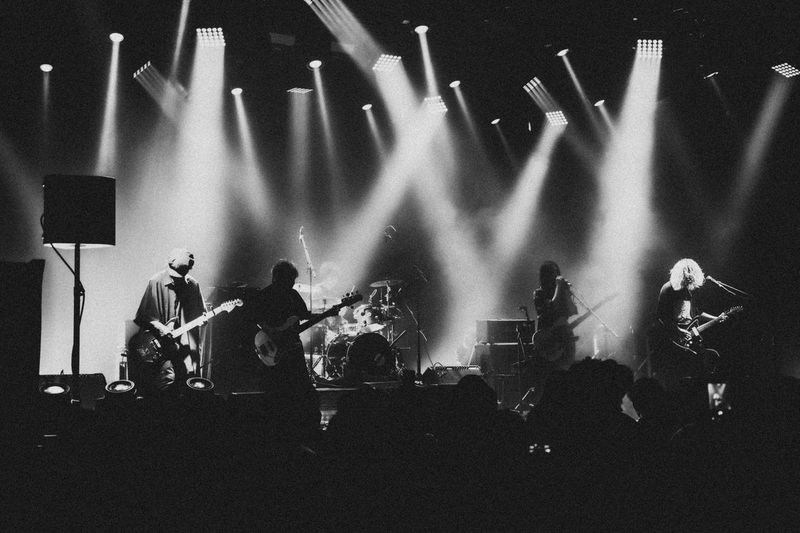
JB: Compared to your earlier work, this album feels more immediate and physical. How do you translate that intensity into a live setting?
HS: With this band, it is basic for all of us to go into the studio and record together at the same time. That has not changed at all since we recorded our first album, crystallize. But maybe because we made this album more groovy, it gives that kind of impression. We have only played these songs live once so far, so we are still figuring things out. But I do feel that they are much more difficult to perform than before (laughs).
KW: I wanted more songs where we could express ourselves the way we truly wanted to, without worrying about small details. We now have more songs where we can become more emotional, and where that emotion can naturally reach the people watching us. Because of that, I think we can play live with a high level of tension without having to force it. The tour has only just begun, so I think it will continue to get better and better.
YS: This album was not written with live performance in mind, so when we played the songs at our one-man show in April, we had quite a hard time reviewing our system and adjusting tunings. There are some parts where the nuance is slightly different from the recordings, but as you pointed out, the important thing is how directly we can deliver the physical aspects of the music. I think the live dynamics and sound quality will become more refined the more we perform these songs, so please look forward to that.
JB: “Haze” is one of the shorter tracks but leaves a strong impression in my opinion. What draws you to more concise songwriting within an album that also includes longer, more expansive pieces?
KW: This is not limited to “Haze,” but I wanted to make songs that were short yet condensed. With “Haze” in particular, I wanted to use a lot of 7th and 9th chords, which I often used in my band CQ but had not really done with Tokyo Shoegazer. For this song, we brushed it up even further, creating guitar parts and a mix where various chords intertwine with each other. Also, Taizo is such a good bass player that at times I actually wanted him to sound a little rougher, and I felt some frustration during the production process because of that. But those differences in each member’s personality and interpretation went beyond what I had imagined and became part of the originality of the music. Overall, I felt that this is how we end up with an expression that is different from other bands.
JB: Kyoko, your lyrics often feel impressionistic yet emotionally grounded. What themes or images were guiding your writing on this record?
KS: Actually, most of the lyrics, except for “Remains,” were almost finished before Hiroshi told me that the theme of this album was “anger.” The process of writing lyrics was like drawing up, one by one, the anxiety, impatience, and sadness inside me. Compared to the previous album, the atmosphere had become a little more internal and darker, so I did have some anxiety, wondering whether it was okay. But when Hiroshi told me that the theme was anger, I realized that it was not far from the image I had been carrying, and I felt very relieved. Where anger comes from and what people are angry at differs from person to person. But for me, putting into words those emotions inside myself that had nowhere to go inevitably led to anger. I shaped the images that came to me at different moments according to the atmosphere of each song. I was not writing from the beginning while being bound by the word “anger,” but in the end I think it was good that the lyrics converged into various forms of anger.
HS: When I thought about what remains beyond anger, I felt that, in a very broad sense, there are two possible outcomes: reconciliation or separation. For this work, I chose the latter. It is impossible for everything in life to go well, yet we often see stories that end happily. I have always thought that was ridiculous. So I wanted something more realistic. I chose the bitter option of a bad ending, and I asked Kyoko to follow that direction.
JB: Hiroshi, with wanting a more realistic, emotional direction for the album, did that darker philosophy influence the way you approached pacing and dynamics musically as well, beyond just the lyrical themes?
HS: It influenced the album a lot, especially the drum sound. This time I tuned the snare lower and thicker because I felt that truly strong anger isn’t just about screaming loudly. It’s heavier than that, almost like being unable to even raise your voice. On the other hand, the higher-pitched snare sounds represent moments where emotions explode outward. That said, I don’t personally think of it as a “dark philosophy.” Even if the themes are dark, I still wanted the music itself to sound beautiful. I think this album exists in that balance between the two.
JB: There’s a noticeable sense of momentum building in the latter half of the album. Was the track sequencing something you spent a lot of time refining?
HS: We had already been working out the structure to some extent during pre-production, and the purpose of the album was clear. Because of that, the sequencing did not take a particularly long time.
JB: How do you see ‘Remains’ fitting into Tokyo Shoegazer’s broader evolution as a band? Does it feel like a departure, a continuation, or something else entirely?
HS: For me, I think it falls under the category of an experiment. After going through this work, I want to explore what kind of presentation will be best for this band going forward.
KS: If I had to borrow one of those words, I would say it is a change. You could also call it an evolution, but I feel that many things will naturally begin to change from Remains, and personally, I want to change them.
YS: This is a band that truly does what it wants to do. Taking into account everything we have experienced so far, I think we were able to properly package the sound we wanted to make and the sound we wanted to deliver at this moment. There were also songs that did not make it onto this album, and as we perform on tour, we may discover new things we want to do. So the future development of the band is unpredictable.
JB: Looking back at the finished record, is there a particular moment or track that surprised you in how it turned out?
HS: I think the artwork turned out really well. I also choose the people involved in that side of things, and I have detailed meetings with them, presenting what I want to do and then moving forward from there. Whether it is engineers or designers, I think everyone has things they are good at and things they are not good at. So I try to speak with them about the broad direction and create an environment where the person in charge can work freely. I think both the songs and the artwork came together in a good way, with a unified worldview. As for the mix, we once had a completed version, but I destroyed all of it and started over again. It was not the sound direction I had in mind. I judged that, with that version, we would not be able to move people emotionally. The mix took far longer than the recording. I thought about it so much that I couldn’t sleep. In the end, I was able to bring it in a direction I was satisfied with, but even that was limited by time. If we had had more time, I might still have kept working on the mix.
KS: For me, it was when I held the CD in my hands. I was moved by the sense of unity of the whole work, including the artwork. As for the songs themselves, I had already listened to them dozens of times during the mixing process, so there were no particular surprises there. Haha.
YS: The songs I composed, “Wisteria” and “Remains,” both feel like they were significantly upgraded from the images I had when I first wrote them. I think that was thanks to the studio equipment and the work of the engineers.
JB: Shoegaze as a genre often emphasizes atmosphere over rhythm, yet this album feels rhythmically assertive. How do you see your place within that tradition?
HS: I think we have already made plenty of music that creates a sense of atmosphere. A lot of it had very strong reverb. This time, because we did not use reverb in the same way, the sound image definitely became drier. I feel like we have finally managed to make something with a dry sound, so there is still a long way to go. As for where we stand, maybe we are still like elementary school students (laughs)!
KW: If we wanted to, we could make music that emphasizes atmosphere. We could always get close to the kind of sound shoegaze fans imagine. But I don’t think that is what Tokyo Shoegazer should do. We want to continue searching for our own form of expression.
YS: The basic premise of this band is that we are not particularly attached to the genre of shoegaze itself, so I am simply looking forward to seeing how listeners who love the traditional sound of the genre receive this album. That said, my own roots are in post-rock and shoegaze, so I intend to continue taking a sonic and textural approach for the rest of my life. I’m looking forward to seeing how I resonate with the songs Kiyomi writes from here on (laughs)!
JB: Kiyomi, you described shoegaze as simply one expressive tool within alternative rock rather than something sacred to preserve. Do you feel the genre sometimes becomes creatively restrictive for bands, especially when audiences expect certain textures or aesthetics?
KW: I did wonder how people might react, but I never felt that audience expectations became a creative restriction. To begin with, I don’t think I completely understand what people expect from this band anyway. And honestly, once I understand exactly what people want, my personality probably makes me want to do something different instead. Maybe I’m just a bit twisted that way (laughs)!
JB: I particularly enjoy hearing the band bring up human elements in the recording process such as analog tape, live tracking, imperfections in tempo, emotional instinct over technical precision. In an era where so much music is heavily edited and quantized, was preserving that humanity almost a philosophical stance for this record?
HS: Nowadays, with just a computer, it’s easy to fix timing issues or fluctuations in performance and make everything perfectly precise with the click of a button. But even if something is technically perfect, it doesn’t necessarily move me very deeply. Human performances have slight imperfections and fluctuations, and I think that’s where emotion and individuality live. To me, a band is about imperfect people coming together to create sound. So what matters isn’t removing those imperfections, but figuring out how to make use of them within the music. Leaving that “humanity” in the recording isn’t just a production method, it’s a statement about what we want to preserve in music itself.
KW: Before DAWs became common, this was simply how everyone recorded music. Digital technology made many things easier and expanded what’s possible, but I also think we lost a lot along the way. Recording this way requires skill and discipline, and I like putting myself in that kind of environment and feeling that tension directly. But more than anything, I genuinely think this approach suits both this genre and this band best sonically. The unevenness, fluctuations, instability, and imperfections all accumulate into a kind of depth and richness that’s difficult to describe. Also, except for “New Dawn,” we didn’t use a click track this time, which was a first for us, and I think it really enhanced the live feeling of the album.
YS: I wasn’t consciously thinking in terms of a digital-versus-analog philosophy while making the album. But when I think about the music that truly moves me as a listener, it’s often music with a strong analog or live feeling. I personally love experiencing music live and being emotionally overwhelmed by it much more than simply listening through earphones. That feeling naturally shapes the way I approach songwriting, so I think an analog-like approach simply feels the most natural to me.
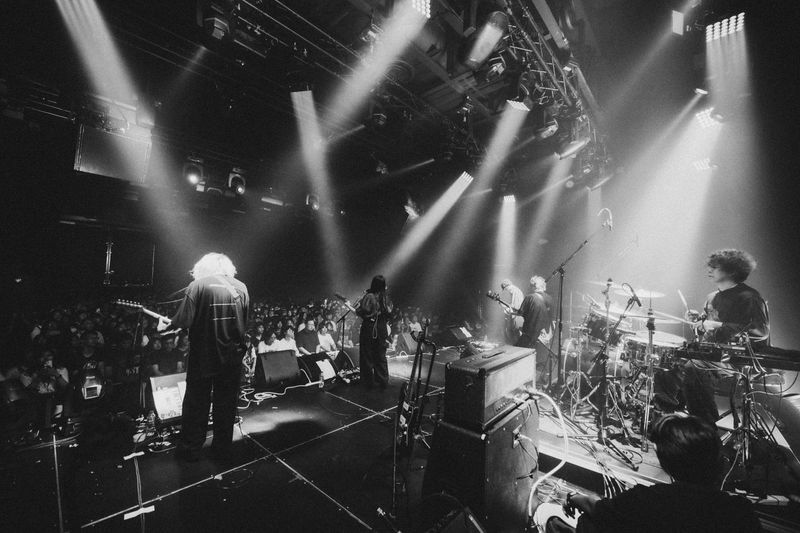
JB: Kyoko, your lyrics seem to frame anger less as an explosive emotion and more as something internalized and unresolved. Did writing ‘Remains’ change your relationship with those emotions in any way, or did it mainly help you articulate them?
KS: My way of dealing with those emotions hasn’t really changed. Even after finishing the lyrics, those unresolved feelings inside me didn’t disappear. They’re still there, lingering inside me, and they still hurt me from time to time. Maybe I was able to put them into words in some sense, but I don’t feel any distance from them. I’m glad I was able to express those emotions in such a raw and honest way within the songs. I wrote them exactly as I truly felt at the time, without hiding anything.
JB: There’s an interesting contrast throughout the album between control and collapse; very deliberate production choices, but also performances driven by instinct, momentum, and emotion. Do you see Remains as an album about trying to hold things together, or about letting them break apart naturally?
HS: I don’t really think this album is about trying to protect or preserve something. If anything, I think destruction and endings are unavoidable things that already exist from the beginning. But what this album is really looking at isn’t the destruction itself — it’s what remains afterward. So yes, I think there’s an aspect of accepting that things naturally fall apart. But it’s not about giving up. It’s more about searching for something that continues to remain even after everything has ended. That’s why I’m not afraid of things breaking apart. The title “Remains” represents exactly that idea.
JB: Looking ahead, now that ‘Remains’ has pushed the band toward a drier, heavier, more rhythmically physical sound, do you feel this album opened a door that can’t really be closed again or do you still see Tokyo Shoegazer as a project that could radically reinvent itself from record to record?
HS: I don’t think this album means there’s no turning back. Rather, I feel like we finally managed to achieve something we hadn’t been able to do before. If we make another album, I think we’ll once again approach it differently depending on what we want to express at that time. I don’t think this band is meant to stay in the same place forever, and honestly, if we kept doing the exact same thing repeatedly, we ourselves would get bored.
KW: I’m sure that after ‘Remains,’ new things we want to pursue will naturally emerge again. Personally, I already have several ideas forming in my head, and once the tour settles down, I’d like to gradually start shaping them into something real. Whatever path Tokyo Shoegazer wants to walk will become Tokyo Shoegazer’s path, so I don’t feel any hesitation or anxiety about the future.
YS: Through making this album, it’s true that the range of sounds and songs we can express has expanded significantly. But this band has always been about doing what feels exciting and meaningful “right now,” rather than focusing too much on the past or future. I’m confident that each member will continue using this album as a stepping stone to create even more exciting things in the present.
JB: Finally, thank you for releasing such a remarkably bold and fully realized record; not just sonically, but emotionally and conceptually as well. The way the album balances weight, atmosphere, melody, rhythm, and tension gives it a very distinct identity, even within your own discography.
HS: As a member of the band, there are moments where I honestly think, “I can’t believe we managed to make an album like this.” But more than that, what makes me happiest is knowing that people actually listened to it and felt something from it. As a band, that’s the greatest thing we could hope for. Maybe we created the album, but perhaps the three-eyed cat on the cover is the one that truly connected with everyone. That cat still doesn’t have a name, by the way. If you’d like, maybe you could give it one someday (laughs)!
KW: I’m very happy that “Remains” has been embraced by so many people. Through this experience, I personally gained new perspectives, and I hope to reflect those discoveries in future songwriting and future works.
YS: Since the album’s release, we’ve gradually started to truly feel the strong reaction coming from listeners all over the world. We’ve already performed these songs on tour in several places, and seeing the audience’s direct response has made us even more certain about the album. These songs continue to evolve through live performance, and that also gives us tremendous motivation toward creating new work in the future. So, please continue spreading the word and sending us live offers from all around the world (laughs)!
Upcoming live dates:
Jul 31: Tokyo, Japan – Koenji High w/ Nothing
Aug 7: Taipei, Taiwan – The Wall
For more information, please visit Tokyo Shoegazer | Higher Hell Records | Bandcamp | YouTube | Instagram | Facebook