Photo by Luke Rogers
Every band will say their most recent album is the best in their catalog. Sometimes that’s true; other times bands are just trying to convince themselves. For Nashville’s The Brook & The Bluff, recording most of the album live in the same room for the first time — bouncing off each other’s energy, watching reactions in real time and responding — the idea that Werewolf is the crown jewel is an easy sell.
Having traveled down the folk-rock pathway in the past, this time around the band leaned into ’70s classic and Southern rock. While nothing on Werewolf sounds like Lynyrd Skynyrd or the Allman Brothers, the influence of artists like Tom Petty, Bob (and Jakob) Dylan, and the Eagles can be heard throughout the album’s ten tracks.
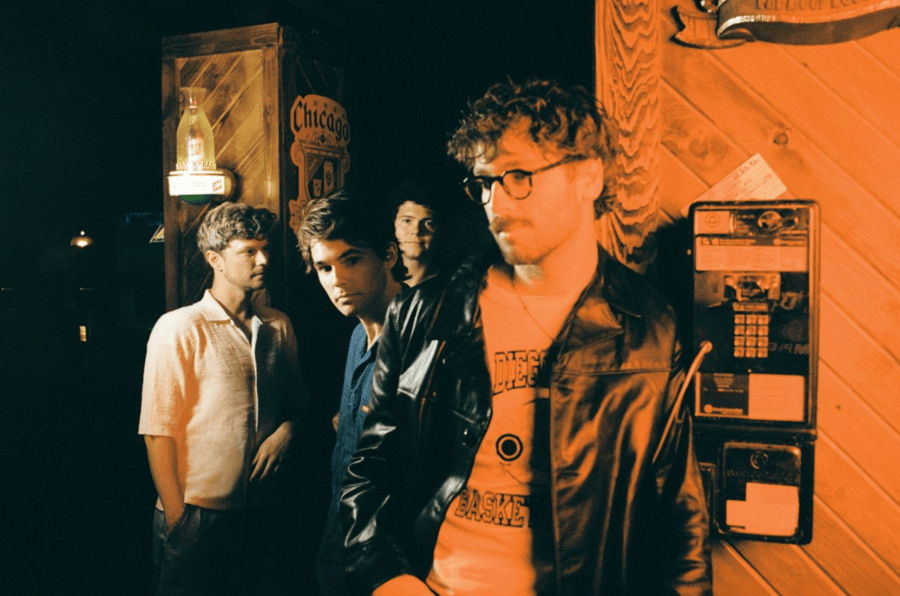
It’s a luxury to have an entire band join a call to talk about a new album, and I’m thankful that Joseph Settine (vocals/guitar), Alec Bolton (guitar), Kevin Canada (keyboards), and John Canada (drums) were able to offer their individual thoughts during this hour-long conversation. As we kicked things off, I checked in on something Settine told me when we spoke in 2023.
So I went back to our last interview. I had asked you about your wallet, and you had a Nobles Beer Kitchen gift card in there. I’m wondering if you still have that gift card.
JOSEPH: Maybe. Actually, I don’t know.
And you had a gas gift card from your mom as well. That was the other thing you said.
JOSEPH: That’s probably been used. The Nobles one? I don’t know. I think it’s probably still in there. I got a new wallet and downsized a little bit. I still have my old wallet in the drawer, and I definitely still have that gift card in there, for sure.
Werewolf being the album title and the first song, does that set a theme or is it just something that really worked as a title?
JOSEPH: Actually both. When we were talking about the sequencing, I was pretty adamant about “Werewolf” being number one and setting up the whole record — from it being a cool title, and from the lyrics of that song. I felt like it really distills the whole record into one thing. It’s such a good scene-setter. That song just feels like it really kicks it off, and it isn’t probably the most screaming song. It is definitely a rock and roll song and definitely has a nice, chunky groove to it. But you don’t start on 500 and have nowhere to go — whereas if you go in to “Get By,” there you are, ramped all the way up. So I think it’s a nice scene setter.
Do you consider this to be a series of short stories — an anthology — or is it sort of a complete story from start to end?
JOSEPH: Lyrically, it deals with some of the stuff I’ve always written about — just being generally anxious, generally kind of depressed. But I also went through a lot of life changes. I exited a really long-term relationship, and it was a little messy. There were things I regretted towards the end of it, and things both of us on both sides regretted. That’s a lot of the lyrical themes. But I actually think the theme of this album is more so about us as a group. What we were really trying to accomplish was to make an album that felt like one of our live sets and captured that energy because I feel like we’ve always felt that’s probably people’s favorite part of the Brook and the Bluff: coming to a live show and having that community experience, being in a room with a bunch of people getting to experience live music, which is one of the best things about being human. More than what I’m talking about lyrically, I think this album is more about the story of us as a group. We’re just some dudes sitting down playing songs together for the love of playing songs together.
ALEC: Getting back to our instincts, basically. Using our intuition. Instinct was a working title at one point, going with this general theme of, let’s get back to what we feel like we do best together, which is play music in a room and then really chase down the things that we naturally lean towards. Instinct and Werewolf and all that just had this general theme of being true to who you are as a person and as a band.
KEVIN: The title Werewolf fits more in line with the type of music on the album, because it kind of is just a rock and roll album at the end of the day. Werewolf paints a picture in your mind of something a little more gritty than Instinct. That’s kind of why we went that path with the name.
JOSEPH: I always felt like Instinct felt like an 80s synth-pop album for some reason. Which I wouldn’t complain about, but…
I interviewed David Ramirez, a songwriter out of maybe Austin, and he was coming to my city two months before his album came out. I’m like, “it doesn’t seem smart to tour before your new album is out because people won’t know the material”. His thing was: “first and foremost, I’m a live musician; putting records out lets me be on the road but I’d be touring either way.” Just based on what I know about you, you’re supporting an album. If this record wasn’t coming out until September, would you guys have hit the road next month?
JOSEPH: Oh, absolutely not. I think we would be hitting the road probably a few weeks to a month after whenever the album was gonna come out, because it had been a really long time since we had put music out. We went on the road this past fall in September and played kind of just to play, to be in front of people and just get out there. We were road testing a bunch of these songs, too. But I think it’s kind of a mixture. It depends on where you are in that river of process. For us, this was the first time where we actually took some time to not just continually tour, and to sit back and say, what’s the best album we can make this time? You can just get in that cycle of: put an album out, tour it for a year, put an album out, tour it for a year. So for the first time, we took a step back and said, let’s just live a little, write some songs, see what happens.
Were you road testing stuff that had already been recorded, or were you road testing to see if you wanted to make changes before you recorded?
JOSEPH: By the time we hit that tour, I think the whole album was recorded and done.
Did you come across anything live where you were like, oh man, we should have done this differently?
JOSEPH: What’s crazy is, I think we played those songs so many times in a room together trying to figure out the arrangements, because our goal was to walk into the room when we were going to record and just be able to hit play with all the arrangements ready. So we had done a lot of that work on the front end. Playing them live, it was more like, “thank God we made the right calls on almost every turn”.
JOHN: I remember the first time we played “Werewolf” live, it just felt like, this is great. This just rolls right off the fingers.
ALEC: The songs, they play themselves.
JOHN: But to your point, there is still something undeniably different when you get on a stage, whether it’s in front of 25 people or 500 people. There’s something about a show that will unlock things in your brain that just playing in a room together won’t. We did have the idea to go on a workshop tour before we recorded the album, and that didn’t come to fruition. But there is something about playing it in front of anybody that can help the process a lot. That’s something we hadn’t really been able to do since before COVID, when we were playing more in bars and 100-cap venues. Sometimes it’s easier to just pull out anything and test it there than it is at a ticketed show at Webster Hall, where you want to play the songs people came to see.
Was there a song on the album, or maybe one that didn’t make the record, that kicked off the process? Or did you pick a date and say, “We need to start writing on this day”?
JOSEPH: Some kind of combination of all of it. I feel like there was one day in June of 2024 where Alec and I were like, “what do you got?” and we wanted to sit down and really start being intentional about the album. I had started “Baby Blue” before that, but it wasn’t really a part of that day. The day we got together, I had written “Can’t Figure It Out” over the weekend, so those were kind of the two I brought. Alec was playing around with the riff of “Moving Along,” and we immediately sat down and started jamming on that. It was like, oh, this feels like it would be the outro, the last track of an album. Then I played “Can’t Figure It Out,” and I had just written it maybe a few days earlier. I was like, “I think this is the best chorus I’ve ever written. I think this could be a huge single.”
And then towards the end of that same day, Alec just started playing the “Werewolf” riff, and I started humming the melody, had that first line there, and we kind of hammered out the rest of that song. Those were just kind of the nucleus of what would become Werewolf the album.
ALEC: What I remember most about that day is just playing. “Moving Along” and “Werewolf” kind of came out, and we were like, “we don’t know what these are yet, but they’re so much fun to play together.” That felt important, walking away thinking, “I cannot wait to play these again”.
JOSEPH: We’ve been listening to a bunch of classic rock on the road, crushing CCR, always inspired by the Beatles, starting to listen to Little Feat. And then the idea of, what is our purest distillation as the Brook and the Bluff as a band? I think this is what happened.
You recorded mostly live, all of you in the same room at the same time? Is that the first time you’ve done it that way?
JOSEPH: Yes, actually. Since the first EP, or since Masks, I guess. We were laying stuff down, drum and bass, then go over with guitar. The vocals, we would go back and put on over the top. But everything else, it’s the vibe of us just going from start to finish. There are some layered guitars in “Super Bowl Sunday” and a few other songs where it needed to just get bigger. But for the most part, the bones of all the tracks are us just playing. We would do four or five takes and pick the best one.
ALEC: The connection in the room, in the moment, we were all looking at each other, listening to each other. There’s a synergy there that you just can’t recreate stacking stuff.
Do you see the next album following the same approach?
JOSEPH: For me, it’s a path forward. It was so fun. I feel like the next thing is to just maybe get in a bigger room. We were at Micah (Tawlks)’s house, which is incredible, and in the woods, secluded and amazing, but I think next time it’s like, let’s do it again together and go to one of these big Nashville studios, or somewhere we’ve seen online and really get in the space. For us it felt like a really refreshing thing.
ALEC: It’s the truest representation of who you are as a band. There’s nowhere to hide. And the connection in the room, when you’re all listening to each other, there is a synergy there that you just can’t recreate.
I’ve been interviewing bands since 1991, and I have never had a band say their new record is not the best thing they’ve ever done. So sell me on why this is the best thing you’ve ever done.
KEVIN: We’ve gotten feedback from fans that they love seeing us live because there’s just an extra element of energy to the performances. Since we really took that into the studio with us, all in the same room, locked in together, there is an extra element of elevation when you’re playing at the same time. We rehearsed these songs for a month and a half, maybe two months before we even got into the studio, so we were all familiar with the arrangements. It was almost muscle memory at that point, so we really got to just relax and not overthink anything. We were able to release and really form that connection in the studio, get into that headspace of being in front of a live audience. I think that took the energy to the next level.
ALEC: This is the most fun I’ve ever had recording. And I think it allowed us to utilize our strengths and express ourselves in the most complete way. We took everything we’ve learned in the last 10 years and put it towards making a record.
In 10 or 20 years, do you think there’s going to be one of your records that people are going to be demanding you go out and play?
JOSEPH: Probably this one or First Place. First Place is still very beloved among our fans. But with every album we’ve gotten a little bit more people, and this is the one we’re putting out with the most people that are interested, that are fans, that want to hear it. When I listen to it, I hear the most of us as a group, the level of collaboration, everyone kind of moving on this one vision for the whole record. I think you can always kind of tell when an artist gets to that point. Some bands and some artists are there from day one, but I think on this one we’ve grown up a little bit. We’ve all been able to settle into ourselves as adults, and I think that has really influenced what came out on the record. This is the truest expression of us as a group that we’ve had so far.
This album has a different energy than others in your catalog, and I appreciate that you haven’t just settled into, “last thing worked, let’s do it again”. Are you always trying to push yourself to try something different.
JOSEPH: Definitely always trying to push. And also, I think I’m too scatterbrained to be obsessed with one thing for longer than one record cycle. I think about all of our albums — First Place is very influenced by R&B, Frank Ocean, Bon Iver, that whole world. Then Yard Sale was Laurel Canyon, the Beatles, that kind of thing. And Bluebeard was this whole other thing, “we’re gonna make this record in the mountains,” and that is what happened. We’ve just been kind of pulled along by different things that are interesting to us at the time. But it always ends up being unique to us. It still always feels like the Brook and the Bluff.
Have you ever played a club where the power goes out? “Baby Blue” sounds to me like something you could pull off if the power went out. You guys could just sing it and play with an acoustic. It sounds great as a full thing, but it also sounds like when you get invited to a local radio station and you just bring an acoustic guitar. That song sells itself without needing anything extra. Was it written to be played that way?
JOSEPH: Yeah, for sure. When I was writing it and we were working on it, I brought it to everybody and said, “I’m working on this verse thing” — I had most of it — “but the whole idea is that we’ll sing three-part harmony for essentially the entire song”. Eventually I wrote the bridge, and I was like, “okay, not the bridge, but there is harmony in the bridge too, just not on the melody line”. The idea for that one was always pretty crystal clear. It’s like, what’s a song where we’ve never done this before, we’ve never sung three-part harmony through the verses before. Let’s do it.
Another song like that is “I’ll Have It Down”. It reminds me a little bit of the Eagles. There’s a multi-part harmony that I attribute to the Eagles kind of sound. I’m not going to confuse you with the Eagles, but that’s sort of what I hear when you all sing together.
JOHN: The Eagles were definitely an inspiration, for sure. We definitely reference them as a model of the kind of band we want to be.
ALEC: In the way they took such pride in how well they sang together. They’re a beacon of, like, who’s a band that really cares about the harmonies and singing together? They’re just a gold standard.
“105” is just a great driving song, and I think that’s probably what the song’s about. The intent is just, get in the car and cruise.
JOSEPH: Get yourself a speeding ticket.
ALEC: Away from all your problems. But also straight towards them.
“Gone for the Weekend,” guitar-wise, has a Tom Petty, Mike Campbell kind of thing going on.
JOSEPH: Tom Petty was huge for us across the whole record.
You mentioned CCR and Little Feat earlier, and hearing all these comparisons, it feels like that classic rock influence really informed how these songs were written.
JOSEPH: Yeah, a thousand percent. It was twofold. What feels like the most us right now, and what songs are going to be the most fun to play? And then there was this element of, “wow, nobody has” — at least we couldn’t think of anyone who had — “made an album like this in a while. A true rock and roll record.” Ours is probably more folk rock and roll, it’s got a little more of a folk bent to it. But we were also just asking: when is the last time you heard a record that reminded you of Creedence Clearwater Revival that was released in 2025 or 2026? We were kind of looking at it and being like, maybe there should be a band that is like that. And for me, as a songwriter, the older I’ve gotten, I like what I like and I’ve also gotten more comfortable with being a little more Southern. We all just kind of embraced all of those things about this record, and this is what came out.
ALEC: It kind of goes back to the Werewolf theme of, this is who we are, unfiltered. There is no good and bad, it’s just us.
JOSEPH: Little Feat, I will say, is the most underrated band of all time. I’ve planted my flag on that take, and I will die with my flag planted there. They are an incredible, incredible band.
KEVIN: They just get better the more you listen to them. I really just got into them in the last couple years and it’s mind-blowing. Particularly their first five or six albums, when they had Lowell George as their front man. Those are all so incredible.
I’ve been asking every band the same last question this past year. What’s a song that reminds you of something very specific from your life that, when you hear it, you’re transported back in time?
JOSEPH: There’s a song by Frightened Rabbit called “Old Old Fashioned.” Every time I hear that song, I’m back in Atlanta with my sister and my friend Dusty. We drove from Birmingham to Atlanta to see this show, this packed, sweaty, cramped 250-person room. Every time I hear that song, it’s like a memory takes over.
ALEC: There’s a song called “Sledgehammer” that used to be our walk-on song every night. There was a moment before a Denver show where we walked on to it, hit the downbeat, and something catastrophic didn’t work — the bass didn’t work — and we’re all sitting there on stage for a whole minute, then had to walk off and wait 30 minutes to start. It was just a disaster. We said, “guys, I think this song’s cursed, we gotta retire it”. And we did. Then a year or two later, we were like, “alright, we’re being superstitious, we should probably bring it back”. First song in, I break a string. Then I break a string on another guitar three songs in. So yeah, “Sledgehammer” will always remind me of a show going terribly.
KEVIN: Back towards the end of college in 2014, I was taking my first real road trip across the country to go backpacking out west with some buddies. Some of the music we were listening to then sticks with me. Specifically, the War on Drugs had this album, Lost in the Dream. That whole album just takes me right back to when we were driving through Utah; huge open vistas, crazy scenery with that music playing. It always transports me back to that time. Just a great band and a great album.
JOHN: “Every Teardrop Is a Waterfall” — Coldplay, on the Mylo Xyloto tour. Freshman year of college. We went to Music Midtown and they were the headliner, and I remember being on the fifth row. I had been to concerts before in high school, but not at the scale of a Coldplay show. And when that guitar riff dropped in — it was raining — and I was just like, “oh my gosh, this is it. This is the best it gets”. I just really remember that.
Those are great answers. I appreciate that yours are a little more current than the usual “sitting in the backseat of my parents’ car on the way to soccer practice” answers I usually get.
JOSEPH: I have one of those, too, actually. There’s a funk band called Mother’s Finest, and when I was 8 to 15, I was a diver. My mom was the dive team mom. We would listen to this song called “Baby Love” by Mother’s Finest, and every time I hear it, I’m back pulling up to a pool at 8 AM getting ready for a dive meet. My mom would always announce all the scores. We would sing this song, and there’s a lyric in it — “burn in for your love, oh baby love” — and my friend Griffin, who was on the dive team with us, always thought it said “bacon for your toast.”
ALEC: Mine was Boston’s Greatest Hits. My dad, in his little stick-shift Passat every single morning, driving me to school.