Photo by Claire Nichols
That The Family’s Delusions of Grandeur may have been, at best, a “long lost, never before heard” Record Store Day 2036 release or, at worst, something that never made it off a hard drive and into public hands, is criminal. With a talented pool of songwriters, songs that radiate warmth with an analog sound, and a producer who surfaced a ’70s pop aesthetic, Delusions of Grandeur’s path to distribution was spearheaded not by a traditional record label but, rather, by the brother-in-law of one of the band members, Jesse “Chunk” Walker, who released the album on his own label, Big Black Cow Records.
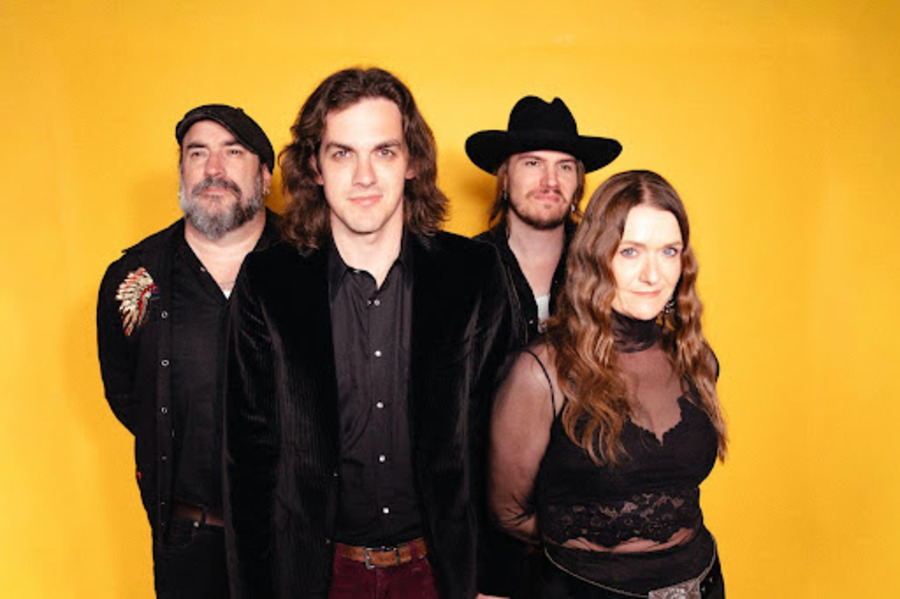
The Family is, in fact, a blended family: father James and son Dylan LeBlanc teamed up with James’s wife, Angela Hacker, and her son, Bay Simpson, at the suggestion of Rodney Hall, co-owner of Fame Recording Studios, to fill the downtime during the pandemic. Although the members had contributed to each other’s songs for many years, the four had never purposely set out to work on something as a collective unit. Each came into the project with accolades: James is a solo artist, studio/touring musician, and songwriter who has written songs recorded by the likes of Kenny Chesney, Rascal Flatts, and Travis Tritt; Dylan is an Americana artist who has released five solo albums and toured around the world; Angela is the winner of Nashville Star: Season 5, a songwriter, and studio singer; Bay is a singer/songwriter whose music has been covered by Kid Rock and who has performed with artists like Dwight Yoakam and Jamey Johnson. Collectively, they are The Family.
The members recently joined me to discuss their debut album, how they achieved their sound, and the artists that inspired them to be the musicians they are today.
Was this album really sitting on the shelf for five years with nobody interested in putting it out?
DYLAN: That’s actually true. Yeah, that’s very true. I submitted it to the label I was on, which was ATO, and they passed on it. I sent it to a few other people, so it just sat there for many years. It was almost forgotten about. But people kept coming back to it, because people we’d shared it with really enjoyed it. So we’d be like, “Man, it’d be cool if that could actually see the light of day somehow.”
That’s sort of wild to me, because it feels like everybody who’s heard it loves it. I guess I don’t understand the music industry.
DYLAN: They probably didn’t hear it, they probably just saw a link or something and didn’t even listen to it. You know how it is. It’s hard to get people to pay attention to something you’re excited about, even under the best of circumstances, especially in this day and age.
You’ve all got other stuff going on. Was this always front and center for you, or was it something you all kept coming back to when you had time? Were you actively making this your top priority?
DYLAN: We were not making this our top priority at first, because we all have our individual careers going on. Dad has lots of sessions, and he writes songs as a staff songwriter. Angela is constantly in the studio singing background vocals for people, and she’s also a writer and an artist herself. And Bay is a published writer who writes with a lot of people and has a career of his own under Bay Simpson. Collectively, we had a lot going on. I’ve been doing my own thing for 20 years now. But we only did this because of the pandemic, we had nothing else to do. Our friend Rodney said, “I wonder what would happen if y’all got together.”
As you were doing this during the pandemic, was it obvious from the get-go that this was going to come to fruition, or was it more like, “we’re all super bored, let’s just see what comes out of it”?
DYLAN: We weren’t bored, but we were worried. I remember, for me, I found out I was about to have a child, and all my shows got canceled. Not only that, I was about to have a child in another country, and I was like, “This is nerve-wracking, what am I gonna do?” And then Rodney Hall suggested, since we had all this time on our hands, that we make a record. He’s the son of Rick Hall, and runs Fame Recording Studio with his mother, Linda, now. It’s funny, because we’d all been on each other’s recordings, we’d written songs together, but we’d never conceived of actually getting into a studio and making an album together. It wasn’t until he mentioned it that we were like, “hmm…” And then Angela tells it better than I can, but they wrote a song called “Hammer,” and I’ll let Angela take it from there.
ANGELA: For years, I’d been a part of other people’s projects, and I did a few of my own. I kind of grew accustomed to doing stuff that I loved, and then, past the point of making the music, I don’t know what to do. But when we started making this thing, James and I wrote a song, it’s “Hammer,” one of the last songs on the record, and the flow of it started happening. We were throwing everything at this project in the beginning, just anything we’d already written. After “Hammer” got written, our friend Brad Chrisler got involved, and after he put his touch on it, everybody started gravitating toward that kind of sound. That’s kind of how the whole album, sonically, and just the atmosphere you hear on it, got going from that point on. Everybody was like, “I want my song to sound like that.” We’re all very artistic and creative, so it was fun to get in there and just do what we wanted to do. For me and James, who try to write for other people, and Bay, it’s like, “what would so-and-so want to hear?” We actually got to do something that we wanted to hear, which was really cool.
How soon did you decide to call it The Family?
DYLAN: We were in the studio, and I think you, Dad, had said something like, “What do we even call this project?” And I was like, “We should just call it the family.” And then I made our logo, remember?
JAMES: Yeah, I totally remember that. Man, the logo is totally you.
DYLAN: Then we needed something to put on the link, and I just remember wanting to put something cool on it, something we were gonna share with people. So I downloaded some app you can do graphic design on, and just made it. Then we had a guy actually sketch, for the record, what I’d designed by freehand. But it was really quickly, within the first three tracks or so that we had written, that we decided to call it The Family.
JAMES: And there was a little bit of talk of calling it the LeBlanc Family Band, and that just sounded totally goofy to me, like the Swiss Family Robinson, or the Partridge Family. And it’s only fifty percent LeBlanc anyway. I personally really dig it being called The Family. I’m glad that’s what it wound up being.
So, you start the album with a song called “The End.”
JAMES: Yeah, it’s funny, isn’t it? It’s funny how that worked out.
DYLAN: It wasn’t on purpose. That just felt like a really good opener, because of the way it comes in, and the sequence of the album, we thought about that pretty hard, actually. We were like, “How does this flow, in the best way?” I love that song, it’s one of my favorite songs on the whole album, it’s so groovy, and it sets the tone for the rest of the album.
I heard Paul Simon on a podcast and he said something along the lines of that the artists you are into between the ages of 11 and 14 are the artists that will stick with you for the rest of your life, regardless of how many different directions your musical tastes may go down the line. Is that true for all of you? Are the artists you liked when you were that age still artists you return to and love?
BAY: Absolutely. For me, it was Zeppelin, and the Stones, and all that rock stuff. That’s the basis of everything that’s cool in the world to me. When I first started hearing music like that, I just thought, “This is the coolest thing ever.” I’ll always see Jimi Hendrix as somebody who is, like, superhuman. When I think about Zeppelin, or Sabbath, that’s how I see them, and it’s always like that. That’s where it became cool. I hear one song, and I want to go listen to their whole catalog. That just doesn’t happen with any artist nowadays, that I hear. It’s a different thing.
JAMES: You nailed it with the question. Neil Young. Zeppelin. I also grew up on some classic country. I was between eleven and fourteen the same years you were, but the music I was listening to wasn’t necessarily current at that time. But then there was some new stuff too. “I’m on Fire” had just come out, in ’82 or ’83, and that was the first money I ever spent, allowance money, on a 45. “I’m on Fire” by Springsteen. That guy rubbed off on me hugely.
DYLAN: I’m so jealous of that era. I can’t imagine being a teenager and “Roxanne” coming on the radio, and it being of that quality. That never happened when I was growing up, except for Radiohead, and maybe a few other bands where I thought, “Wow, this broke through.” It just seemed like y’all’s era had so much more quality in what was on the radio, in popular music.
I’d say maybe MTV helped, but we also just didn’t have the volume of music coming out that is coming out today. I bought an album, and that was all I had to listen to. I couldn’t pull up my phone and listen to whatever I wanted. That Police Synchronicity record was all I listened to for like six months. That’s all I had.
ANGELA: We definitely got more quantity going on today than maybe quality.
DYLAN: I do think there are some modern artists I hold in high regard, guys like Michael Kiwanuka, Damien Jurado, Father John Misty. It’s hard to equate the old with the new, but Kiwanuka, as far as singer-songwriters of our era go, is the closest thing to being incredible all the way around: lyricist, singer, player. I was on a French show with him last year called Taratata, and it was just him, an acoustic guitar, two background singers, a bass player, and a drum machine and he blew my face off. I still listen to lots of modern stuff, and I get influenced by it when I write, because I want that to exist these days. I feel like we’re living in a world where everyone wants to be so original that they don’t sound derivative of anything, and back in the day, people really respected each other’s art to the point where they’d cut a modern song because they wanted to record their own version of it. That doesn’t happen much anymore, and it kind of makes me sad.
BAY: It goes back to what you were saying about how so much music comes out now, and everybody has to be so locked in to what they’re doing individually. There’s no break at all. If you’re gonna really do it properly, you’re gonna be making content in the morning, writing a song in the daytime, driving to a show, playing a show. Thanks to Spotify, anybody with GarageBand can put music out, and part of the culture now is just so different. I follow a lot of my friends, since we all work in music, but there are so many people doing the same thing, it’s hard to even keep up. I wouldn’t even know if somebody put out a cool song, because I’ve got thousands of artist friends in my feed and I’m not watching their content. Music is a full-time job, but my strong suit is not making content a full-time job, that’s just a culture thing now. It’s different.
When we were growing up, you’d buy a 45, and the B-side was always the song that obviously wasn’t the hit, but it wasn’t a bad song either. Now every band is just dropping five new songs on Spotify before the record even comes out. Nothing’s really considered a B-side anymore.
JAMES: No, that’s true. It’s a new world, for sure.
I think every review I’ve read reaches for that ’70s Fleetwood Mac comparison. Was that a touchstone as you were writing? Did you set out for a ’70s vibe? Or did you just chase a feeling, and the ingredients happened to be the same?
JAMES: I think once we honed in on what the deal was with us, yes, the aesthetic got established, and we wanted to move in that direction.
ANGELA: Absolutely.
DYLAN: Brad had a lot to do with it as well.
JAMES: He’s our X factor, isn’t he?
DYLAN: Everything I do, simply because I record it in Muscle Shoals, most of it at Fame, smells, looks, and feels like somebody’s basement from the 1970s. If you put the drums in the ISO booth and completely cut them off, so it’s just dead air in there, and a dry drum sound, it sounds like anything the engineers did in 1971, or Roger Hawkins, who recorded there. Those walls haven’t changed, that echo chamber hasn’t changed since it was built in 1962. The tape machine’s been there since the ’70s, the Neve console’s been there since Tom Dowd built it. It’s just got a ’70s vibe, and everyone I grew up around, and that you worked with, grew up in the era when people were making records that way, so it’s sort of in our DNA, whether we like it or not. That being said, hell yeah, we had an aesthetic going, and we liked the product we were getting.
ANGELA: It’s our natural thing to do, I think, along with the fact that we were definitely shooting for that sound.
DYLAN: When Brad produced it, he mixed it all, and all those textures you hear, that’s all him. He knows how to make it have that aesthetic without us really telling him what to do. When I mentioned “Hammer,” and I heard that, I immediately thought, “I want my song to sound sonically like that.” And Brad was like, “Alright, got it,” and he did. He’s a lot of the reason why the tone feels that way.
As much as nostalgia gives you that feeling when you’re in the studio, are there ever points where you think it would be so much easier to go into a modern studio? Or do you just love recording where you record?
DYLAN: I’ve never thought about how something could be easier. I love recording so much, and I like the challenge of it. I really feel like I’d be bored, and it would be so unfulfilling if the studio itself could do the job for me. Making a record is where you figure out whether or not you’re worth your salt as an artist, as a musician, not even in a live performance, because you sing off-key live, it’s okay, the audience isn’t gonna notice. But if you sing even a hair off-key into a microphone, I’m talking about a Neumann, a microphone from the ’60s that’s got a warm tube in it and picks up a mosquito a mile away, you’re gonna hear it, you’re gonna hear every imperfection. When people say “under a microscope,” it’s the perfect description. You can’t even play the same way live that you play in the studio, you have to pick your guitar a little lighter, or get a pick if you want it to sound brighter. I play with my fingers most of the time, because that’s just how I naturally started learning, but sometimes I have to play with a pick, even if I don’t want to, because that’s what it calls for. You really get a great education by simply doing it that way. The imperfections speak for themselves, and you go, “I’ve got a better one in me, I need to go back and redo that.” It’s really fun, and you get better the more you do it. It gets easier, and then it becomes second nature and then you hear it immediately when you did something right.
Did you all collaborate on all the songs, or did you each bring stuff in?
JAMES: It wasn’t a hundred percent collaboration. One of Bay’s songs is one he brought in that we all agreed was awesome. Probably a little more than half of it was pretty collaborative, and the actual making of the record was totally collaborative. “I’ll Take It” was brought in, it’s just a killer song that Bay wrote with a couple of other writers, and it’s incredible. I just personally love it, and so did everybody else, so it felt like a no-brainer.
DYLAN: And we needed it.
JAMES: It was just such a cool song. But mostly collaborative, I would say.
ANGELA: Absolutely.
For most artists, the single is deservedly the single, but I always look for the song that’s the B-side in my mind, the one I secretly hope you’ll play live because I’m not guaranteed to hear it. “I’ll Take It” and “The Dealer” are the two I’ve got written down. Is there a song like that for you, the one that’s hidden in plain sight, that people may not gravitate to right away?
ANGELA: I can’t really pick one. I think “The End” is probably my favorite overall, but there isn’t a song on the record that I don’t want to perform. It’s a pretty short album, and every time we do a Family thing, we do the whole record, so I don’t have that one for me. I like it all.
BAY: It’s hard for me to say too, because it is a short record, it’s only two songs per singer, really, so they all feel important. I will say a lot of people seem to comment on “History of Things to Come” as one of their favorites.
That one, to me, seems like the obvious single.
DYLAN: “I’ll Take It” always seemed like the obvious single to me.
Do any of you write for another person in the band? Or are the songs you’re singing your babies? Angela, do you ever write a song and think, “Dylan, this one’s for you”?
ANGELA: I would totally love it if I was writing something and somebody else in the band loved it enough to sing it. I was most proud of “The Dealer,” because I was a co-writer on that one with James, and I’ve recorded lots of songs that James and I have co-written together, but I don’t think he’s ever sung one, other than one we did as a duet years ago, that we wrote together. So I was really proud of that one, because I felt like a big part of it. I am a singer, so when I sit down, I tend to write myself into a bit of a corner, because of how I approach a melody or a lyric. But I love sitting down with all of us together. If Bay has an idea, or Dylan, or me, we can just approach it. We did that recently, and it was established pretty early on that Bay was gonna sing that one, so it made sense.
JAMES: I love that question. I’m a quote-unquote professional songwriter, so I write a lot of songs every year, and I don’t think much, other than male or female, about who’s gonna sing something. The parameters of being a professional songwriter for the genre of country music, I’ve got my parameters I can stay within, or push a little bit if I want to, but it doesn’t go much further than, “Is this a dude song or a girl song?” But yeah, absolutely, it’s part of the collaborative thinking of the project, thinking about these particular singers. It’s really fun for me to do that.
It took a long time for this record to come out. Do you have a second and third record in progress?
JAMES: Yes, the second studio album is currently in progress, and we’ve also got a live album that’s done. That has to be packaged and released, hopefully around the holidays.
Is there a live aspect to this? Are you all going to get in the bus and hit the road together?
JAMES: We’d love to. We’ve got quite a few shows booked in October, and the idea is to do more together, as much as possible.
*************************************************
For more information about The Family and to purchase Delusions of Grandeur, visit the Big Black Cow Records website.