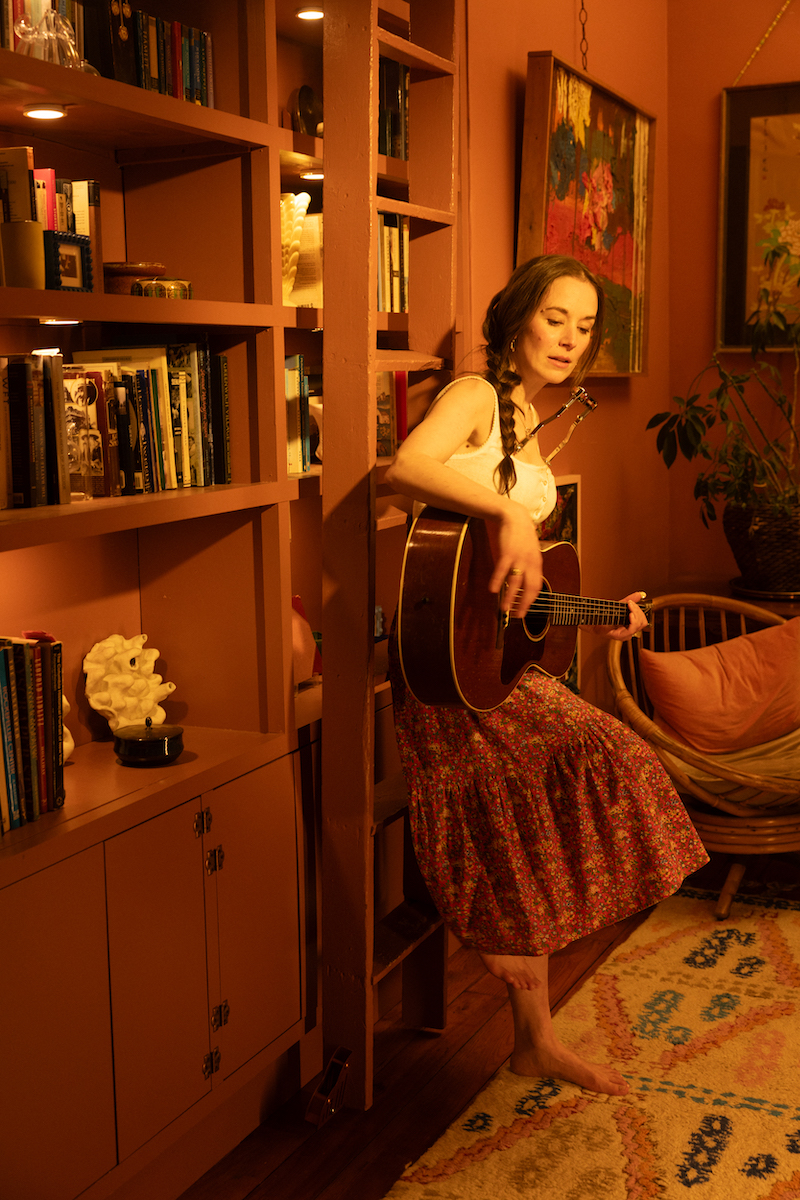
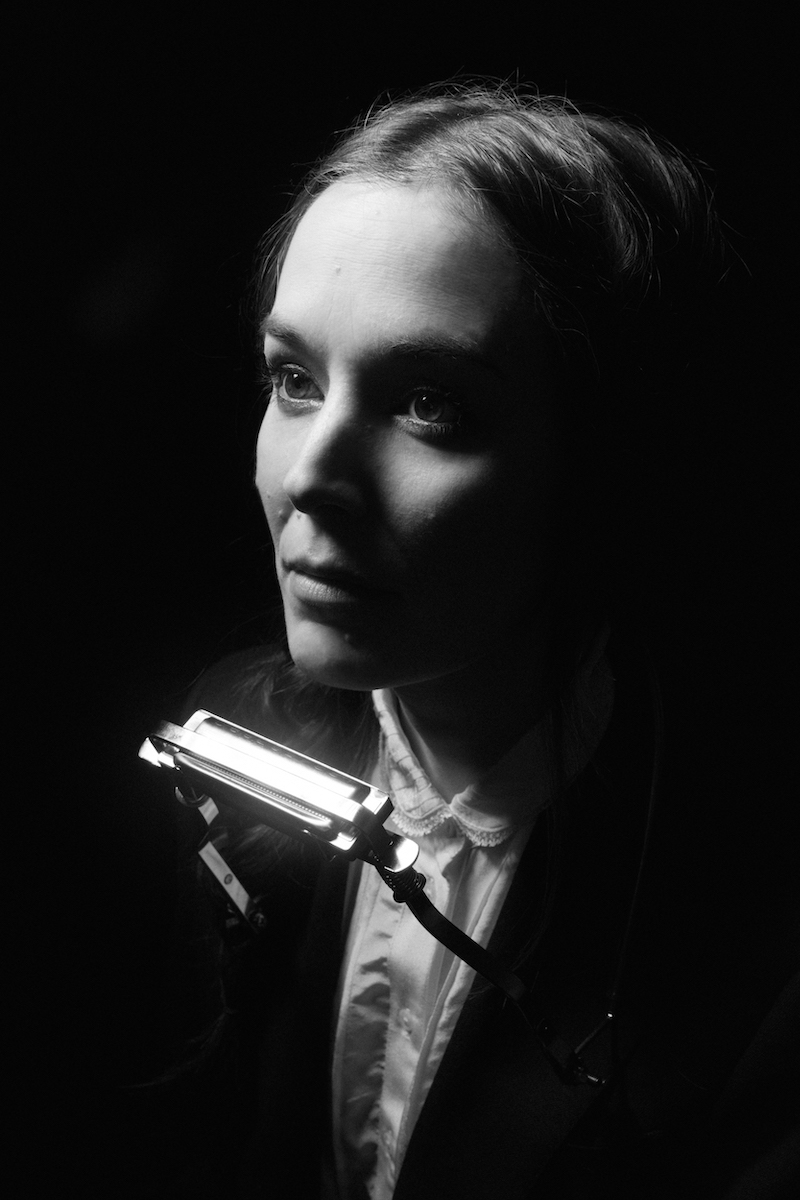
All photos by Ebru Yildiz
Some musicians spend their careers trying to define or reinvent themselves. Margaret Glaspy seems more interested in discovering how much room there is inside a definition before it starts to feel restrictive. Her music can be delicate without being fragile, cerebral without losing its pulse, and fiercely controlled while still leaving room for instinct to take over. With the release of ‘I Am Both,’ Glaspy invites us to reconsider everything we thought we knew about her.
That sense of movement has been central to Glaspy’s work from the beginning. A guitarist, singer, songwriter and producer with a musician’s ear for texture and an instinct for the unexpected, her songs can pivot from a seemingly simple melody into something harmonically unsettled, while her guitar playing has a physicality that gives even her quieter material that necessary intensity. There is always something slightly off, some detail that prevents the music from settling into predictability.
‘I Am Both’ was recorded live over three days in New York, and the circumstances matter. Rather than chipping away every rough edge, Glaspy allows the songs to retain the sense of musicians listening, reacting and making decisions in the moment. The arrangements are often spare, but the emotional landscape is dense. Space becomes part of the instrumentation. Silence has weight. Glaspy’s guitar playing can sound conversational one moment and almost confrontational the next.
The title itself offers a useful way into the record. ‘I Am Both’ suggests a reluctance to accept the familiar pressure to simplify: to be one thing rather than another, to choose certainty over ambiguity, or to separate the personal from the political as though the two exist in different rooms. Glaspy’s writing has increasingly reflected that complexity and ‘I Am Both’ looks inward without becoming insular, finding connections between private anxieties and the larger uncertainty of living through an era defined by distraction, instability and a relentless flow of information.
That perspective also informs her relationship with the culture surrounding music. Glaspy has spoken about pulling back from social media and reconsidering the way constant digital exposure shapes attention, creativity and a person’s sense of self. There is a palpable desire in her recent work to reclaim some of that attention—to slow down enough to notice what remains when the noise recedes.
‘I Am Both’ is searching but never staid, vulnerable without becoming a grand confessional, and musically adventurous without treating experimentation as the album’s theme. Beneath is a very human curiosity: Glaspy examines the expanse between opposing impulses and finding, there, a place where something honest and pure can happen. ‘I Am Both’ is the work of an artist comfortable enough with ambiguity to make it promising and brave enough to let the listener allow it to unfold.
Special thanks to Grandstand’s Molly Bandelli and Lisa Gottheil for the coordination and to Margaret for the thoughtful exchange.
James Broscheid: The title, ’I Am Both’ suggests deep interest in contradiction. Not just the coexistence of tenderness and anger, but intimacy and distance, personal responsibility, and political helplessness, which I can totally relate to these days. At what point did you realize that contradiction itself might be the connective tissue for this record rather than something you needed to resolve?
Margaret Glaspy: I don’t think I ever realized that to be honest with you. I don’t think that contradiction was necessarily on my mind. I think that in making it, maybe for the first time as a writer, I started to see that. Like everything was on the table, I guess that’s how it felt the contradiction wasn’t really on my mind, but the qualities of life that are actually true were on my mind. There’s a lot of things going on at once. And maybe it’s almost like the idea of contradiction is a man-made concept, just like everything else. That in itself, maybe would put it in categories and would be almost too much for me, so I just started to see a lot of characters.
In my mind, that felt like they just held a lot at once and that’s that! That really piqued my interest and still does. A lot of my favorite art and my favorite films and my favorite books and my favorite music holds a lot. It allows itself to encompass a lot of life at once. I’ve become passionate about that for sure. I’m entertained personally by that, so it makes me want to create it and makes me want to roll around in that dirt, you know?
JB: Yeah, absolutely. When I first read the record’s title in the press release, my mind defaulted to contradiction. That’s not to say it is a negative thing (Margaret agrees), but based on what is happening in our country and around the world right now, it seems plausible.
MG: What’s fascinating for me is to see what it sparks in other people? So, I think that’s rad.
JB: You’ve mentioned wanting to recover a sense of original thought and becoming more protective of your inner creative life. And after spending so much time making music in an environment where you know artists are constantly exposed to other people’s opinions and expectations, and of course interpretations, how do you determine which ideas genuinely belong to you and which ones have absorbed the culture around you?
MG: I don’t know. My best guess is that there’s steps I saw that I could take in order to not be subject to a certain amount of feedback, and I started to see for myself that that was pretty integral. To me, making anything that felt like it was from my observations and from my own lens and art and if I wanted it to be heavily influenced by other people or tech algorithms or whatever, I had that option. I have the choice, but I think for a little while it started to feel like I didn’t have a choice that I was a victim of 21st century technology and I started to see that I’m not.
I don’t have to participate in some of this stuff. Some of it is a little trickier to not participate in, my mind is dependent on GPS and things like that. I came to the realization that there are some lines. Like, “Okay, I’m living in 2026,” and there’s certain things that I have evolved with and then there are other things that I’ve seen where I realized I need to set boundaries for myself and I feel like I’m starting to see that you can. You’re allowed to create boundaries, you know? I started to see that I need to make a boundary because I’m having trouble being able to distinguish between is this something I actually care about or is it something I allowed myself to absorb passively for a little too long. When I created a boundary, I started to see that if I create boundaries, I’m just in an environment that is a little healthier for me in the first place.
Of course, I’m completely influenced by mankind in the world around me. We all are, and that’s why I make art is because I’m connected to it, and I’m fascinated by it. But I think that there was just a certain degree of unhealthy exposure that I couldn’t really participate in anymore. Now, because of the boundaries, I don’t have to ask that question quite as much of like, “Is this my idea? Is this someone else’s idea? Is this something that I’ve just absorbed, and I’m trying to be cool and catch up with the trend” or whatever.
Because of those boundaries, It’s helpful for me and I think it’s become a healthy one so, I don’t know how to decipher all the time. You know, “What’s my idea and what’s not?” I think our ideas are certainly collective in so many ways. It’s just a bit of quality control on some level is what I’m talking about. I’m still figuring it out in real time. I even think about libraries these days and how important they are. How special they are and nice it is to be able to go to the library. How important books are. I think that there is a certain quality and purity at times. To being able to read an untethered book, especially because you know when something goes through a publishing process like that.
There are a little bit more checks and balances to get to a book form. Not always, but there are a little more links in the chain that you have to go through in order to get to that spot. Also there’s a little more work you have to go through in order to open a book, you have to be genuinely curious to get to the library and open a book. There is not a lot of effort to get on the internet and so that pursuit and those buffers and those boundaries are helpful. In some ways, it is often seen as obsolete in a lot of ways, but I think that nature actually helps you evolve even more, your mind can evolve more because you are working. Here you’re at work and your brain is at work, which I think is a pleasant place to be for sure.
JB: Not to mention as much as online platforms and apps like to tout being “communities” and “bringing people together,” they are actually cutting people off from them. Like you were mentioning, why leave your house when you can just pull it up on the internet? What can you take with a grain of salt and what, at the end of the day, matters to you most?
MG: To be clear, my journey is very personal. It’s mine. Everyone goes through what they need to go through. There’s no part of me that’s trying to project onto others. You need to do it, too. It’s incredibly personal. What I need to do is what I’m going through right now. There are a lot of friends that reach out to me asking what are the building blocks to doing something. It’s really like support group stuff when you’re trying to find some way out of it because it’s so pervasive. I’m happy to be a sounding board but I also see that I’m not. There’s no soap box. I’m not telling people what to do yet, I know for a fact that my experience has been pretty life-changing in taking those steps for sure.
JB: I was thinking the same thing. It’s like someone with an addiction. It’s their personal journey, and they need to realize that, ultimately it is not good for them. Nobody can tell them or make them change (Margaret agrees). You mentioned it earlier about characters, so I want to ask you, does writing through another person actually allow you to become maybe more emotionally honest than writing directly from your own experience?
MG: Possibly. I find it more fascinating for sure. I find it to be a little bit more fun and interesting. I can’t tell if what I’m consciously doing is being more honest. That’s not my angle, but I’m sure there’s definitely artifacts that come out because it is on behalf of something else, someone else. I think it’s, to me as a writer, just interesting to put on someone else’s clothes and animate them. I can’t tell if I’m being more emotionally honest or if it’s just more entertaining. I think there’s something about me being entertained that comes up. I love film, and I really love watching movies and I think that there’s some part of me that make wants to make a movie! I like seeing these characters come to life and giving them traits that are interesting and either looking up to them or looking down on them and. It seems to be more rich than just speaking from my own perspective or my own voice. I think sometimes these days that I’m in a phase where I get slightly bored speaking from my own voice all the time, and I think I used to be more comfortable in that, and now I just have more fun making up people!
JB: What types of film do you enjoy?
MG: I am a Criterion collection addict for sure! I just watched ‘Breathless’ (1960) recently, the French / (Jean-Luc) Godard film. That was really cool. I just watched ‘Walkabout’ (1971), which is an Australian film that was really, really good. Um, I mean, I’m completely dedicated and have been such a devotee to the 90s version of ‘Little Women’ (1994) with Winona Ryder and Kirsten Dunst. Such an incredible cast of women. I grew up on it and I’m obsessed with it! That version of that film. I wanted to be (Josephine) Jo March with all my heart! That was who I was gonna be! What else? I love (Alfred) Hitchcock films.
My husband and I love watching Hitchcock together. I have the PBS app on my television. I was a PBS Kid growing up and have always really liked it. There’s a live TV portion of PBS, since it’s harder to get live TV these days and I love that because at night, we need it to wind down. We don’t want something overstimulating. We’ll watch a nature show or they have NHK, the Japanese channel. We love that channel! I just watched the Mary Oliver documentary that was so good (‘Mary Oliver: Saved by the Beauty of the World’, 2026). Beautiful, beautiful movie and such an amazing poet! So, yeah, those are some things that I have recently been watching.
JB: My wife and I have latched on to all the cult documentaries lately. That’s what we use to unwind! Podcasts and films that study narcissism too.
MG: We got into Wild Wild Country (2018 Mini series).
JB: Back to the record (both laugh). A number of the songs seem interested in morally complicated people rather than typically clean-cut heroes or villains. You can understand why someone behaves badly without necessarily excusing the behavior. Has becoming more interested in kind of those gray areas changed the way you maybe judge yourself as well as the way you write about other people?
MG: I think it was maybe the reverse. I learn that for myself and then I think I started to write it. There was a version of my thinking earlier in my life and that was also really affected by social media. That there was extremes of only zero or 100 all the time in terms of judgment or bad and good. Just a lot of judgment. I think I was experiencing a lot of judgment on behalf of other people and looking, pointing my finger usually at systems that felt wrong or politicians. All these things that come up in life.
I think it’s obvious that you know there’s a lot of bad that’s done in the world on behalf of good people, which is unfortunate, but I think I started to realize that, mostly through studying Buddhism – I studied Buddhism at an amazing place called the Tibet Center that’s really cool. They have a hub in New York City – shout out to the Tibet Center! (Both laugh) In my studies there and elsewhere, it started to permeate my mind that I can only point my finger at myself on any given day.
JB: Very Buddhist.
MG: Yes. But sometimes, it’s kind of a rude awakening to realize it on a daily basis, that I’m shaking my fists at the sky. Why is it all happening this way? They’re all doing it wrong and then realizing, like, what are you doing? What is your mindset? What is your mentality? What can you do in the world? How can you be one less person who is angry, you know? That is kind of what shapes our world in so many ways. So I started to see that and then it helped me explore and embrace everything in a lot of ways. I think it made me less fearful too.
It made me feel like there’s still good in someone who does bad things or people that wrangle other people to do bad things for them. We are the people that are being wrangled. They don’t live in a vacuum, right? So, I started to see that, too. I realized, “Wow, my decisions add up to something bigger—the humanity of it all.” We all contribute to what we create together. And that made me step back and ask myself: What am I doing? What’s my mindset? Where’s my mind at? How am I being flighty or short-fused and how is that helping or harming? And then beyond that, looking at everyone around me and not judging so much, but seeing, “Oh, it’s interesting what you have on your plate. You’re really dealing with some interesting things.”
Then look at my own plate and see what I can do with the food on it, you know? Um, that that’s, that’s. That’s like a life’s worth of inspection for me, what’s on my plate right now, those things. I’m beginning to have the slightest understanding that I have to be responsible for myself. It made me be able to embrace the good and the bad more willingly, and then I think it started to affect everything I do, including my writing.
JB: You have described that an initial spark of a song is something that can arrive very quickly while the process of refining the lyrics and the words can take weeks or even months. What exactly are you trying to preserve during that long editing process?
MG: Well, it’s not always long. Sometimes it can be very short. It really depends. It just really varies. I have a rinse and repeat kind of approach to writing. Then there’s the organic side of it, where you are hit with things in broad daylight when you think, “Whoa! Okay, where’s the nearest pen and paper?” The editing process is really just trying to stay as close to the source as possible. Sometimes you can wander into the woods of the original intention and then you don’t remember why. Sometimes the attention changes for the better. I think for me it’s all about trying to find the purity of intent with the message, and I don’t mean like an altruistic message, or something that is good for humanity.
I mean, what is the story you’re trying to tell and how can you stay as close to that piece of humanity or that nugget of a heartbeat as possible. And so, I start to feel like a little bit of an usher or something, like a guard of that attention and that’s the editing process. To me, I’m often trying to find what is this actually about? Where is the bottom of this? Who are the characters? Would they really do that? It’s a lot of gut checks and a lot of checking to see if this still what I want it to be or does this want to be something different and I’m trying to put it in a box or whatever.
It’s not really guarding because that’s too defensive, but there is some kind of ushering to the editing process in that you’re just trying to get it to the place that it needs to be in order for it to tell the story that was intended or the story that it wants to become for sure.
JB: Does an idea for a character pop in your head and then you build up that character from there through the songwriting process?
MG: I never have ideas before I write. I usually start writing and let the idea become something as I’m writing. Rarely do I think, “I’m gonna make a song about X-Y-Z” and then go write it. It’s usually I’m gonna write, and that’s more my methodical daily practice; I’m gonna write and these things will come up.
And then an idea will show up and I’ll usher that around. See where that goes. And through that more methodical process, I start to have these experiences of seeing characters come out. Once in a while, things will hit me where I do have ideas, but I don’t methodically makeup ideas in order to write about them. I write and let them come out in that process. I don’t know if that makes sense.
JB: Is it more like a stream of consciousness?
MG: Sort of, if stream of consciousness felt like everything under the sun usually. I write before I write, which is kind of a free-writing exercise to get the dust off my brain. Then, after that, I’ll start writing with more intent. I’ll usually write for about 15 minutes straight, and then I’ll see what comes out of that experience.
There’s this feeling of pretending that I know the song already. I’m playing and writing in real time, singing and finding the chords as I go. I’m completely making it up, but I act like I know exactly where the song is going for about 15 minutes. And usually, something interesting is born out of that.
JB: Do you think the change in your relationship with the guitar reflects a larger change in the way you relate to yourself and the world around you? I know you mentioned that your relationship with the guitar has evolved from something described as almost defensive or combative into something that feels much more like a companion now.
MG: That’s true, I do feel that way. I do feel like sometimes an electric guitar almost felt like armor or something that can keep me safe. It also felt like a weapon sometimes. I don’t feel that way about the acoustic guitar or at least my use of guitar right now. It did feel like a weapon at times, something that I could defend myself with or guard myself with. I don’t want to say hurt others with, but there was something about it that did feel like I could inflict pain and I enjoyed it. I really enjoyed that feeling of feeling big and capable with an electric guitar. There’s something about it that makes me feel empowered. I know that’s not necessarily how everyone thinks about the electric guitar, but that’s what it does for me. However, I’ve had an acoustic guitar in my hands all my life.
I didn’t have an electric guitar in my hands, all my life that that was kind of a conscious decision made. I was probably about 22 years old when I moved to New York City and I thought, “I’m going to play electric now.” It was a kind of a functional thing to do, too, because it was just hard to get like a good acoustic sound in venues. In a little bar, it just didn’t make sense. So an electric guitar made sense, it demanded attention in a certain way. With the acoustic and in particular with the way that I play, there’s something about that and it’s a relationship we’re speaking to one another and I’m able to do it anywhere. I love that I can play an acoustic guitar in a field and it’s fully formed. There’s no electricity needed and I think there’s something that’s translated to the music of feeling, light on my feet. It feels right now, for whatever reason.
JB: Have you always been an East coaster?
MG: No, I’m from Northern California originally. I was born in Sacramento and then raised two hours north of it.
JB: Okay, so near Mount Shasta and all that?
MG: Yeah, I grew up climbing around Mount Shasta, Lassen Peak and stuff.
JB: Nice! Very beautiful up there. Speaking of guitar, the acoustic became such an important part of the language on ‘I Am Both.’ What did the acoustic guitar allow you to express that maybe an electric guitar couldn’t and did returning to a more exposed relationship with the instrument change the way you approached the songs themselves?
MG: I think so. I mean, there’s an interesting part of it in that when I’m at home and I play acoustic guitar, it feels like … well, there’s just a quality to, like I was saying before, playing an acoustic guitar that, for me, feels so complete. It’s already fully formed. When I’m at home and I play through an amp, it’s so close to your body that it feels louder than it does on stage, and so it feels centrally not as satisfying to me at times to play an electric guitar.
At home or even in a small studio, you have to wrangle it, and you have to put it in a place that is a bit removed from your natural environment. Whether you’re putting an amp in a cabinet so that you can hear it through your headphones or you’re baffling it, you know, because there’s going to be too much bleed or whatever. So I think with the acoustic guitar I was playing it so much in my writing room and working on it with these songs, was it was going to be exactly the same in the studio?
There wasn’t this, “Now, I’m going to translate it to something else.” Usually when I made records before I would write most of it on acoustic, and then I would cover it. It felt like I was covering my own songs with electric guitar. And now, It’s all kind of equal, you know? I wrote it on acoustic, I recorded it on acoustic, and I feel like, I’m writing and now performing in a very similar vocabulary. It created more of a seamless feeling for me and a consistency that feels fun to live in because I feel like I’m living in a world of that guitar in particular. I guess there’s less separation between the writing process and performance, maybe?
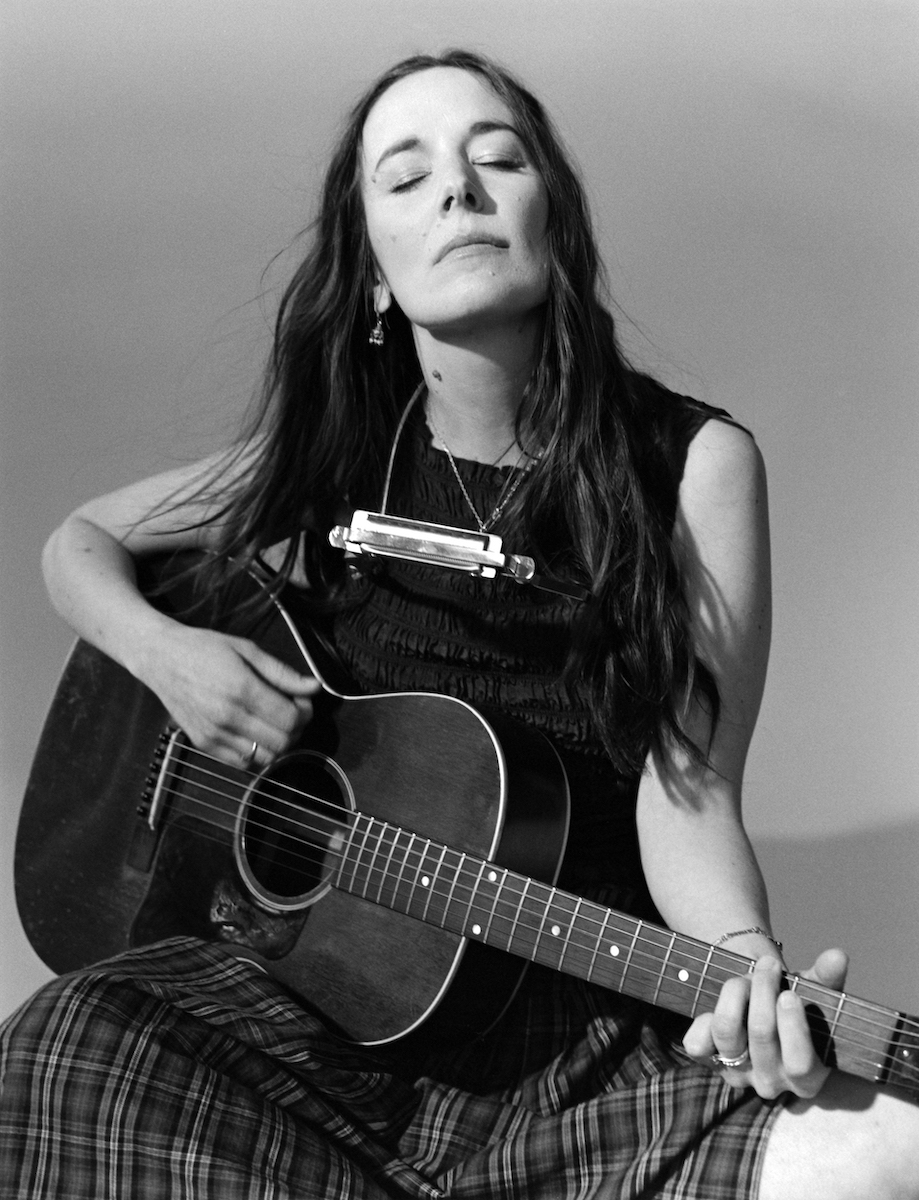
JB: I love the intimacy that an acoustic performance provides in live settings.
And the one thing that drives me absolutely insane are people talking through an acoustic performance? People talking over any performance drives me nuts. But how do you navigate that as an artist on stage performing in such an intimate way?
MG: It evolves over time, um. You know, the times that I have played an acoustic guitar on stage, people don’t talk, really?
JB: That’s good to hear.
MG: So, there’s something to that. I think that there’s also something about the way that we miked the guitar on the last smaller tour that we did because we were workshopping the acoustic show, there were no monitors. There’s no pickup in my guitar or DI (direct input), so you’re really hearing a guitar. Just go through a microphone and I think that sometimes people aren’t quite as used to that in an audience because they’re usually used to hearing a guitar that has a DI or a guitar that has some kind of pickup or amplification other than a microphone. That can create a feeling that has a little less air through it. But when you have just a microphone on a guitar, I think sometimes people are reminded of the air in the room because you realize that it’s just an acoustic instrument.
There’s no electronics at play with the instrument and then sometimes people are a little more present because they are contributing to the air in the room. Or they are contributing to the sound in the room because they see that the guitar is contributing to the sound in the room rather than it just being as kind of direct feeling of going through, like an amplifier or going through a DI. That’s my best guess, but there’s something about it that locks people in a little bit more quickly. So, that’s been a fortuitous thing, but I’ve played in every situation and had people talk through things I’ve done. I’ve had people get in fights in the audience or say terrible things to one another. I’ve had wild things happen at shows before, but overall, usually, people sort things out. Kindness prevails. It’s all okay.
People have medical situations, people talk … it’s always interesting live. I think live music is one of the best socialization tools on the planet because we all have to be together and deal with one another in a room. So, I think it’s poetic when people talk. I think as a performer, you learn how to be on stage, you learn how to handle energy in a certain way and you learn your lessons. You learn how to have a thick skin in the right ways. Sometimes you learn how to have a thick skin in the wrong ways. Sometimes your thin skinned, and it gets to you, it’s just really depends. But I think at this point now, usually if someone’s talking it really works itself out in kind of a beautiful way, because it’s just so not the environment for it. People seem to get it really quickly. Like, “Oh, I’m sorry!” It’s okay, I’ve talked at shows before accidentally. We’ve all done it and I think the point is that you just you learn from it, and you kind of learn to read the room.
JB: Plus, there’s that dimension of people being uncomfortable with silence and staying still.
MG: Yeah, people are uncomfortable in situations where they are just present, you know. You have to be there and just and just take it in and I think sometimes too, by Design, there’s certain music that provokes that more than others. I haven’t always made music that provokes that. Sometimes I’ve made music that makes people want to be a little louder or have a good time with their friends or whatever. I’ve been at shows that are like that, too. I’ve been at shows that I was bored at and wanted to leave. We’ve all been in those situations and sometimes certain things provoke and make you want to lock in and other things make you uncomfortable in ways that make you detach. There’s everything under the sun so we’ll see what this provokes in people. This tour will be interesting.
JB: Along those lines of provocation, does songwriting end when you finish the composition, or does the song continue being written by anyone who interprets it.
MG: Yeah, I think it’s everybody’s. It’s not really mine. I mean, I have my own experiences with them, but ultimately it’s for everyone to get. Well, that sounds a little controlling, but I think sometimes if I’ve done my job, people usually get similar things to what I intended. But there’s always this total life of its own quality to songs, which I think is really cool.
There’s also a kind of a karmic quality to songs, mythology, storytelling, film, songwriting, whatever. People have their own experiences, and those experiences are so personal and then those experiences become intertwined with the writing and then they become something completely different. Because everyone’s experiences are different. If I said, “Bob goes to the store,” people have their own Bobs, they know a Bob. They have their own version of who Bob is. Also, everybody has their own references for what a store looks like. It’s not the same for everyone.
Like someone living in Nigeria is going to have a different store possibly than someone living in Hawaii or someone living in Ohio. Everything is the same but very different, and so that’s what is so interesting with storytelling. It’s tapping into something interesting about song. Also, since it’s often more of a short form medium, you can say a lot, but you only have so much time and so it can be slightly abstract at times. That is what’s so cool about song is that it permeates your subconscious and then you get to bake up your own treats in your mind. I think that that’s a pretty cool. A by-product of the medium is you’re having your own experience. I think that’s really poetic.
JB: Yeah, and everything you mentioned as far as artistic outlets like film, music and creative writing, are all steeped in so much history. What turned you on to music in the first place and who do you really revel in?
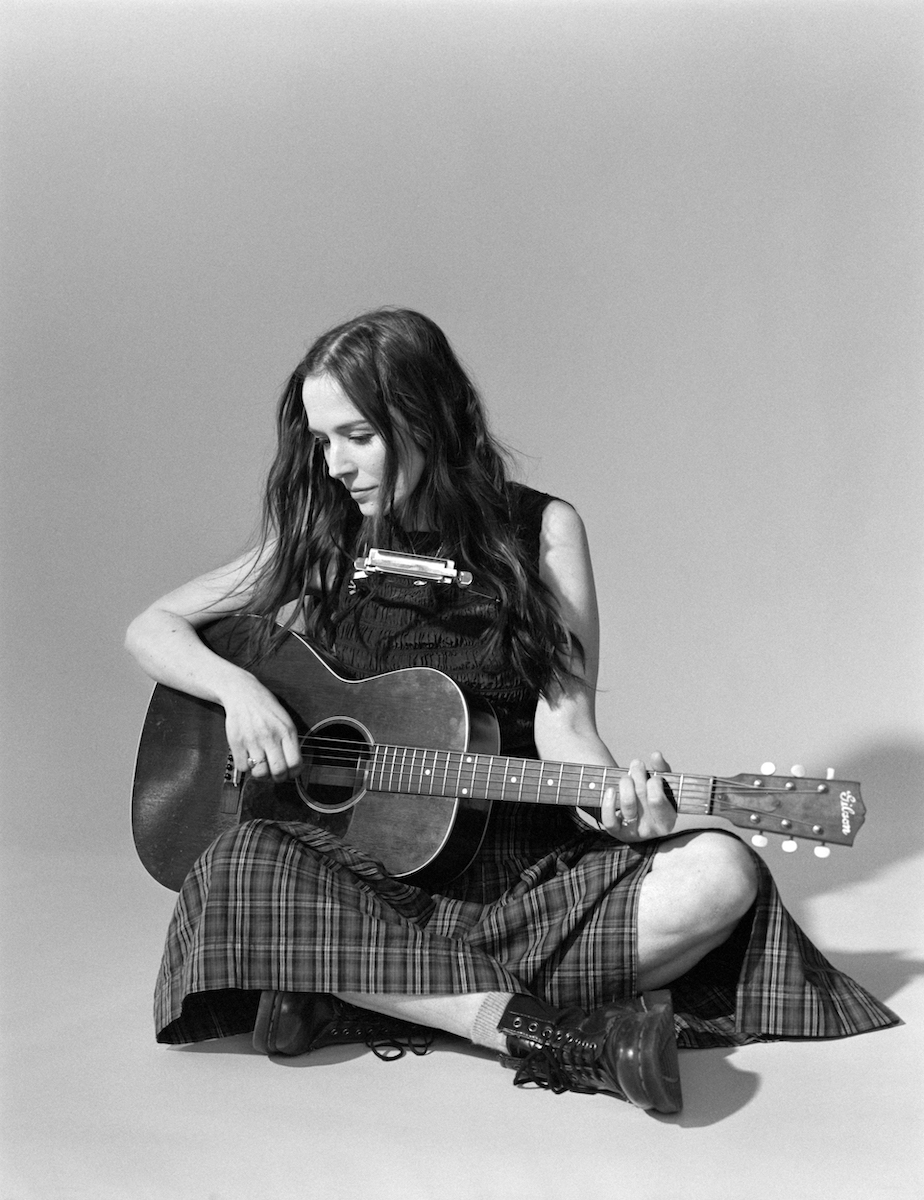
MG: Wow, yeah, the list is long! For me these days, that has been, I don’t know about revelation, but I think there’s been a returning to my own lineage as a musician. My life in general, where I have been able to reflect on the people that have so influenced me so deeply and be proud of it and want to talk about it more. I was a fiddle player when I was young, and so when I was in the third grade, I started to play the fiddle. I played the fiddle until I was about 16 or 17.
I got plugged into a very specific acoustic music scene that was not your average musicians, they were all professional musicians. Speaking of Mount Shasta, I would go to this musical gathering in in Mount Shasta every year with all these really prolific, amazing musicians, and it was led by some friends of mine, Tristan and Tashina Clarridge (Shasta String Summit).
They would hold these gatherings that are like a music camp, essentially. It’s not enough to say it was a camp, I don’t know how to describe it, but musicians like Edgar Meyer and Tim O’Brien and Aoife O’Donovan (The Bee Eaters) was a big part of it. Sara Watkins, Abigail Washburn … there were a lot of these acoustic musicians that were touring professional musicians and they would gather together and then teach younger people how to play. I got to do that for most of my life. I was 13 when I started going to those camps and I went to them until I was like 19 or 20. That was just a hugely impactful time in my life. It also felt like I was put into the belly of the beast really early on. So, I think there was a really high standard for music and sensitivity because all those musicians, they’re all acoustic musicians and they were really sensitive to dynamics, inflections, sound improvisation, and listening. Listening was a big priority, and no one plugged anything into anything, it was completely acoustic. I was doing that as a fiddle player, but really, kind of trying to claw my way toward what I really wanted to do, which was songwriting and singing. Through that whole experience, I was a Texas style fiddle player. That was my focus for a long time when I was a kid.
JB: Like Texas swing?
MG: Not Texas swing, more Texas-style fiddle playing. It was this kind of very particular genre of fiddle playing that was plugged into competition, so you would go to these competitions and play. You had to play a hoedown, a waltz, and a tune of choice. They, would judge you on things like bowing, danceability and intonation, I think, those were like the criteria. But it wasn’t totally swing. It was a more even and more driving, derivative of Texas style swing in a way, but really, it was like taking what was originally like old time tunes that were often kind of bluegrass-ified and we’re getting a little nerdy here, but in the accompaniment in the accompaniment it added a jazz influence where it was now passing chords but in the actual playing, it was really ornate.
Very even, playing from the fiddle and pretty driving, forward and in front of the beat. That’s what that was. I was never really a bluegrass player, but I was surrounded by Bluegrass musicians, and I know that world pretty well. I loved old time music. I had an ear for it and a love of that. I love Celtic music, Irish music, and jazz was a big for me. When I was young, my dad was a really big listener of jazz. My mom was a listener of a lot of rock music, but then also liked Laurel Canyon-era songwriters for sure. She gave me that more. These days it is Sister Rosetta Tharpe (1915 – 1973), I’m so plugged into her right now. Bob Dylan is a massive influence on me and has always been. I’ve been listening to a lot of Lonnie Johnson (1899 – 1970).
JB: He’s amazing!.
MG: Yes! I just saw Bonnie Raitt the other night.She’s on fire and is one of my biggest influences, and I love her. I have always listened to Lucinda Williams. I’ve also seen her a few times in the last months, and she just sounds amazing. She’s so great love! Karen Dalton (1937 – 1993) has always been like a big influence on me. Judie Sill (1944 – 1979) was always a big influence on me.
JB: I love her record ‘Heart Flood’, (Asylum Records, 1973)!
MG: Yes! We could talk for a very, very long time! Before I was under my own name, I was in a band that was a tribute to Alan Lomax’s field recordings, and so I got a big download of all that music, and that was really interesting. My friend Jayme Stone had that band (Jayme Stone’s Lomax Project in 2015), and I sang in it for a little while, and that was really cool because I was getting more of these primitive folk recordings. When I was 24 or so and that affected me in a really big way, just to see where the lineage was coming from.
And what is American folk music? It’s everyone. It’s world music really and what makes it American folk music? It’s an interesting conversation because it cracks a lot of things open. To see all these songs that I thought were these Bluegrass songs, or that I thought were just old time songs or Appalachian ballads, a lot of these things are coming from England and Scotland and Ireland, and then we’re made up of a lot of those people who immigrated to the United States and landed in the South and all these things. And then, all those families started playing those songs and the blues coming from Africa and all these musicians, giving this huge download of all this music. It’s pretty wild when you start tracing all of it back. I think music is such a beautiful reflection of what America is—it comes from everywhere, from all over the world.
2026 Tour Dates
September 14: The Ark – Ann Arbor, MI w/ Anna Tivel
September 16: The Mod Club – Toronto, ON w/ Anna Tivel
September 17: Beachland Ballroom & Tavern – Cleveland, OH w/ Anna Tivel
September 18: The Funhouse at Mr. Smalls – Pittsburgh, PA w/ Anna Tivel
September 20: The Blue Room – Nashville, TN w/ Anna Tivel
September 21: Eddie’s Attic – Decatur, GA w/ Anna Tivel
September 22: Cat’s Cradle – Carrboro, NC w/ Anna Tivel
September 24: Iron Horse Music Hall – Northampton, MA w/ Anna Tivel
September 25: Brighton Music Hall – Boston, MA w/ Anna Tivel
September 26: Music Hall of Williamsburg – Brooklyn, NY w/ Anna Tivel
October 3: Assembly – Kingston, NY
October 9: Prachtwerk – Berlin, Germany
October 11: TivoliVredenburg – Utrecht, Netherlands
October 12: Witloof Bar – Brussels, Belgium
October 14: L’archipel – Paris, France
October 16: St Matthias Church – London, UK
October 17: Halle St Michael’s – Manchester, UK
October 18: Saint Luke’s – Glasgow, UK
October 20: Lantern Hall – Bristol, UK
October 21: Howard Assembly Room – Leeds, UK
October 22: Kitchen Garden Café – Birmingham, UK
October 23: Bola Festival @ Tabernacl – St Davids, UK
October 25: Knocknarea Arena – Sligo, Ireland w/ Rosanne Cash
October 26: Cyprus Avenue – Cork, Ireland
October 27: Dolan’s Pub and Restaurant – Limerick, Ireland
October 28: The Deer’s Head – Belfast, Ireland
November 4: Off Broadway – St. Louis, MO w/ Olive Klug
November 5: The Bottleneck – Lawrence, KS w/ Olive Klug
November 6: eTown Hall – Boulder, CO
November 7: Ophelia’s Electric Soapbox – Denver, CO w/ Olive Klug
November 8: The Arts Campus At Willits – Basalt, CO w/ Olive Klug
November 9: Urban Lounge – Salt Lake City, UT w/ Olive Klug
November 10: Shrine Social Club – Boise, ID w/ Olive Klug
November 12: Tractor Tavern – Seattle, WA w/ Anna Tivel
November 13: Biltmore Cabaret – Vancouver, BC w/ Anna Tivel
November 14: Mississippi Studios – Portland, OR w/ Anna Tivel
November 16: The Chapel – San Francisco, CA w/ Anna Tivel
November 17: Troubadour – Los Angeles, CA w/ Anna Tivel
November 18: Musical Instrument Museum – Phoenix, AZ w/ Anna Kivel
November 20: 04 Center – Austin, TX w/ Olive Klug
November 21: The Kessler Theater – Dallas, TX w/ Olive Klug
December 11: The Atlantis – Washington, DC
December 12: Sellersville Theater – Sellersville, PA
For more information, please visit: