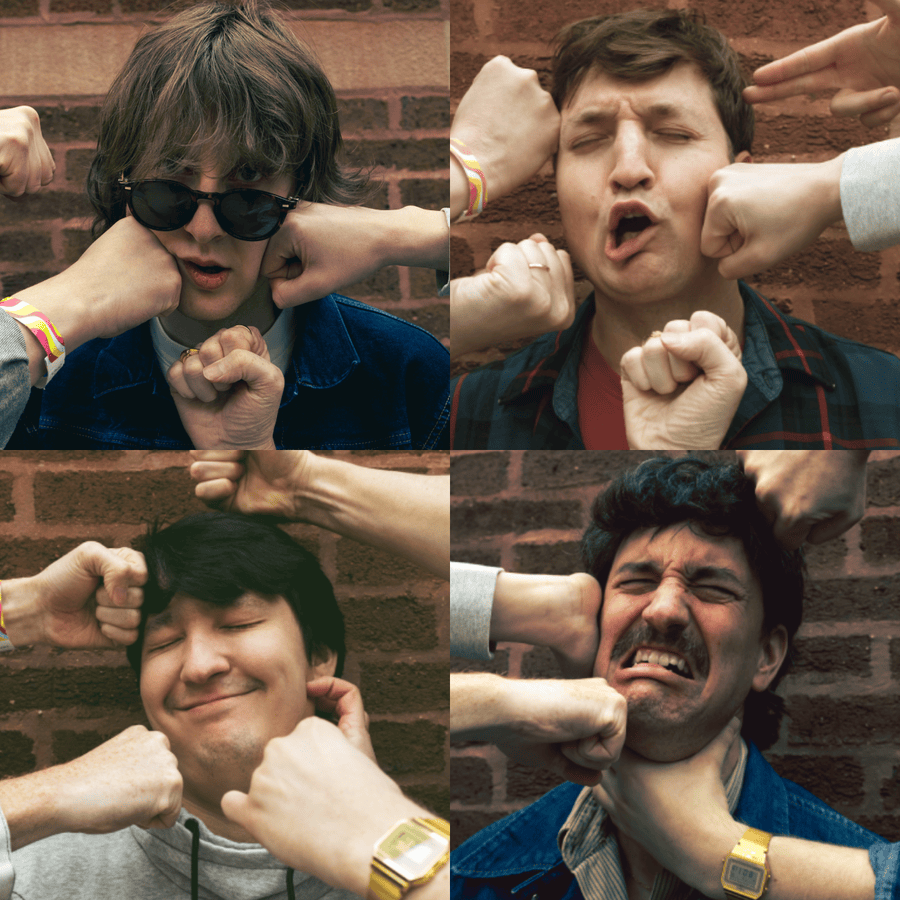
Sounding like 27 minutes of commercial-free alternative rock radio, The Silkies have made a debut album that feels immediately familiar without owing too obvious a debt to any single influence. There You Have It, Lasting Peace is nine songs, no filler, and no single lane. Gothic post-punk sits next to mid-‘90s new wave with a Brit-rock flair, psychedelic pop bleeds into warped disco, and somehow it all holds together. Part of that cohesion comes from shared DNA; part of it comes from the tension of three songwriters, Jacob Merritt (drums/vocals), Pierce Geary (bass/vocals), and Joe Pruitt (guitars/vocals), each bringing different reference points to the table. Add in the fact that the songs were written over several years, and you get an album that moves around without ever losing itself.
Merritt and Geary go back further than The Silkies. The two have been playing music together since they were 19, and after college, where they also played alongside John Rice, they helped form Pomegranates, a Cincinnati band that built real regional momentum between 2007 and 2013. After a hiatus, some reunion shows, and the occasional one-off, Merritt and Geary are back at it, this time with Pruitt and Rice rounding out the lineup.
Cincinnati-based and unbothered by it, The Silkies are equally determined not to be pigeonholed as a local band. Over the last two years they’ve put in serious road time across the Midwest, sharing stages with artists like Bartees Strange, Illiterate Light, Coyote Island, and Mike Viola. Those shows have served as a proving ground, letting the band road-test material, figure out what lands, and keep pushing in new directions.
Merritt, Geary, and Pruitt joined me a week before There You Have It, Lasting Peace’s release to talk about the band’s origins, how their shared history shaped the album, and what it’s taken to build something beyond the city limits.
Jacob, you and Pierce played in the band Pomegranates. I read that COVID essentially put an end to that band.
JACOB: That band ended in probably 2013-ish, and we did nothing for several years. Then some opportunities for shows came up, and we started being like, “Oh, why not do that?” So we started playing some shows again, and we were like, maybe we should do some new music. We started working on some new music. We were gonna go on tour with Band of Horses, and then the pandemic hit like a week before that tour started, so that pretty much settled it.
I, maybe perversely, would scroll through Instagram in late 2020 and see all these bands who posted in, like, February 2020 and were like, “Getting ready to hit the road” or “Tour has been great so far.” And then the next post would be, “Got word the next show has been postponed due to this Covid thing.” Had you been posting about the Band of Horses tour before it got cancelled? Were you filled with excitement only to have the balloon popped?
JACOB: Very much so, yes. I was gonna get to play a show — I’m from Richmond, Virginia, and there was this venue called The National. We were finally gonna get to play there with that tour, and it never happened. So now it’s still a bucket list. Maybe someday.
So Pomegranates fizzled out. Did The Silkies start because you were tired of sitting around and wanted to get back to playing in a band?
JACOB: More or less. The band was in Cincinnati, and I have a recording studio there. I was working with a lot of Cincinnati bands and different projects from around the country — people would come in and record. I worked on The National’s last couple records, and with a guy named Michael Marcagi, and a band from Grand Rapids called Phabies that we really like.
It’s fun producing records, but eventually I was like, I really want to write my own songs and have more ownership over the creative vision. Meanwhile, Pierce had been playing in projects with Joey from Pomegranates, and they were doing a band called Joseph together. Then he started playing with another really amazing band in town called Zoo. You know Carriers, right? Curt Kiser? Curt was playing in Zoo off and on as well.
After several years, after the pandemic, I couldn’t fight the impulse to play music from the ground up, rather than producing and jumping into songs and helping other people shape their vision. So I was like, “hey, Pierce — what do you think?” And we just started talking about it, giving it another go with an original project, writing our own songs from scratch. That’s kind of how the beginning of the band started. Joe here had been working on an EP with Joey from Joseph. I saw Joey post an Instagram of, like, “I mixed this guy’s EP, you should check it out,” and we were looking for more people to play with. We just could not find anybody. It was really tough. I was like, “Oh cool, a person I’ve never heard of in town — let’s reach out,” because his music is really cool. So he showed up.
We’d been texting and messaging back and forth, and he had heard some of the little scraps of ideas that we had, and maybe even laid down some tracks on top from home, just to get an idea of what he would bring to the table. Then there was a guy who had done like two or three practices with us, and a couple hours before one practice, he was like, “Hey guys, based on the ambition that you have and what you want to do, I just don’t think I can do this band,” which I appreciated. So then we’re like, “Well, alright, back to square two.”
I texted Joe and was like, “Hey dude, do you want to come over in like two hours?” And he did, and he jumped in, and that’s kind of how the three of us have really been working on it for a long time. The three of us are the core, I guess you could say. And then there’s another guy, John, who lives in Columbus, who comes and works in the studio on songs. We’ll send him ideas and bounce those off of him, and he’s actually been playing shows with us live lately as he’s available, which has been fun.
Did this feel like a continuation of your musical journey or did it feel like you were starting all over from scratch?
PIERCE: A little column A, a little column B. We had a foundation of experience that we were building off of, and networks that kind of existed from that. But in terms of the songs themselves and what the band was going to be, that felt completely new and exciting, something very novel from Pomegranates and the other projects that we had been floating in and out of for several years. It definitely didn’t feel like we’re starting at absolute zero, but it also had all the butterflies of a brand new thing, a brand new relationship with something where we don’t know what this is going to blossom into — what the songs are gonna sound like, even. We had our mood board or whatever, and hopes and dreams. We were gonna be open to whoever joins later, and that would influence the sound as well. All of that has had a massive influence and taken things in directions that are completely different than if we had truly just been like, this is Pomegranates 2.0.
By the time The Silkies started, I imagine there was enough distance between bands that it wasn’t like you were getting on stage and looking around and wondering who these new guys were.
JACOB: Yeah, pretty much. Pomegranates played the BLINK festival in 2019, and some other shows. We did a show with Phantogram. But I personally don’t see The Silkies as Pomegranates 2.0, other than it’s Pierce and me, and we’ve been playing music together since we were like 19 years old. We went to college, and John, who I just mentioned, the three of us were in a band in college together, so there’s a lot of rapport between us and a lot of history.
PIERCE: That was like 2004, so it’s been a minute that we’ve been together.
Joe, do you have another thing besides this? Are you still making your own music?
JOE: Yeah, right now I’ve been recording with the aforementioned Joey Joseph at his studio. I’m still doing some solo stuff, but no other bands or anything.
Did you feel like an outsider when they called you and asked you to play with them considering they had all known each other since college?
JOE: Not necessarily. I think I was at a point in my life where I was learning to value new experiences. I remember when they texted me, they’re like, “Maybe you can come up and play with us sometime.” I remember talking to a friend about it, and I was like, “I’ll probably tell them no.” And he was like, “That’s dumb, you should at least try.” I was like, “I don’t know if I can hang in a live band,” because I’m the youngest in the group by a good amount. I was in college during COVID, and that’s when they started playing music seriously, and I sort of felt like I had missed out on that because bands and music stuff I was a part of during COVID all kind of fizzled out. So, once I met them, I felt like Jake and Pierce made sure it was fun. We were hanging out, and I’ve met so many cool people and had so many cool experiences because of the band. It all felt very natural.
Is everything you’re putting out stuff that was from scratch or did you any of you bring stuff you had been working on in the past?
JOE: Some of the songs — like “Happier” and “Lies” — were from music I recorded on my own. But a lot of the other songs were complete originals. “Milkman” was a song — I think that was the first song you guys did, and I kind of joined halfway through.
A lot of the songs we’ve recorded are out of necessity. It’s like, we played a 25-minute set, next week we need to play a 30-minute set, then a 35-minute, then a 45-minute set, then we need an hour set. So it’s like, “I guess we’ll write a new song or find a song.” It’s been a bunch of different ways — we need more music, so we’ll make more music. Which is kind of a fun way to record. I think oftentimes, if I’m left to my own devices, I procrastinate a lot, but in these situations, it’s like, we’re not gonna be able to play the set next week if we don’t figure out a song.
JACOB: There’s certainly nothing wrong with taking plenty of time. A song is gonna be done when it’s done, sometimes that’s two days, sometimes it’s an hour, sometimes it’s two months or two years. You just let it be what it is. But it is fun when it’s also a stress reliever, a depressurizer, when you’re just like, “This isn’t gonna be the last song we ever write.” We have ideas, we’re creative, we can come up with something — play it for two months, and if we’re not feeling it, we just move on. It’s not a big deal. But so far, it feels like every time we have a new song, we’re like, this is our new favorite. That’s a good feeling.
PIERCE: Piggybacking off that, and also coming back to something you were talking about, when we started playing shows, was it wholly new, or was it kind of playing to a fan base that already existed in certain ways? One thing that helped differentiate the experience is the songs themselves and letting them organically show up and be worked out as a group. But also, our very first show was in Davenport, Iowa. There was somebody there that we knew who had moved to Wisconsin, but there was no chance we were going to have the Cincinnati base present there. We are a Cincinnati band, without a doubt, however, there is this wider regional area that we are in love with. The Midwest and all of its expansiveness, that is kind of our territory. And it was immediately evident that we were going to be able to grow something with individual people in all these different cities all over the Midwest in a really tangible, one-on-one way. Not just through the internet, but oh, we can do what most bands do in a hometown in this whole region. That really set it apart from what the Pomegranates experience was, too.
A lot of the bands that I knew when I was in college, or just out of college, they didn’t have any interest in playing shows outside of town. They sort of had dreams of being big, but they couldn’t be bothered to book a show 2 hours away.
JACOB: We just came out of the gate purposefully and intentionally trying to make a bunch of places feel like home. Not trick the people, but like, “Oh, this band’s played here every two months, are they from Indianapolis?” That kind of thing. Our third show was our first Cincinnati show — we didn’t even play Cincinnati until show three. We’re just pretty intentional about trying to make it realistic — Cleveland, Indianapolis, Detroit, Chicago, Davenport — just trying to make it work with day jobs and play as many shows as we can in the region.
When I talked to Curt, he told me he’s always chasing shows — always calling and being like, “Hey, if you need an opener, I’d love to do it.” Is that what you guys are doing to get on some of these bills, especially out of state?
JACOB: I do all the booking for us. I’m doing what a booking agent would be doing, just submitting us when I see tour dates pop up, and basically trying to pitch why we’re worth it — worth taking a flyer on, this new band. Then we work pretty hard to promote the shows. Sometimes bands just want to get on the show and play for the other band’s fans, but I feel compelled to promote and put some effort into it. If you trust us to play a show, I want it to be not just respectful of the venue and respectful of the band’s trust in us and respectful of the sound guy, we want to try to get some people out as well. I think that goes a long way with other agents who are offering us shows and venues who are like, “Oh, we have this show, you’d be a great fit,” because we’ve earned some trust. They know that we follow through on what we said.
And then on top of that, it’s just better, you’re investing in yourself. So then you get more cool shows, or better cool shows. The whole point of it is to play music for people. So then we’re connecting with actual human beings who found our music and came to this show. I do the booking and networking, and for every 35 emails, I get a lot of no’s and maybe one yes. At one point I remember sending out like 120 emails, and I’m just like, I need a win here. And then finally something came through. It’s a sales job, almost.
Are you playing Tuesday nights, Saturday nights — pretty much whatever you can — or are you trying to make the Cincinnati shows a little less frequent? And are you having people at your Cincinnati shows come up to you asking where you’re from? Like, do people know you’re a Cincinnati band?
JACOB: 100% less frequent. I would say both, because we’re so fresh — there are people who do know, like, they see a flyer or find us online, but then there are people, especially when you’re opening for a bigger band that has an audience, who have no clue who you are. They’re like, “Where are you from?” I’m like, “We’re literally from here.” They came for the bigger band which is cool, that’s fine by me. We were talking about that on the way home from our last show — being kind of reminded that we’ve been playing these shows live for over a year now, and 90% of the people in the room have never heard us. Like, we just played with Cloud Nothings — that band from Cleveland — in St. Louis and there was a handful of people there from our previous shows in St. Louis and some people we knew were coming, but most people have no clue. And so we’ve played this song like 70 times or whatever, but for them, it’s the first time they’ve even heard our band. So it’s a challenge, and you want to make that connection. It’s just a cool experience.
PIERCE: I just wanted to build off the idea of playing fewer shows in Cincinnati. It is not to distance ourselves from the city. We literally have a shirt that says “Cincinnati” on it, and we very much love our city. That’s honestly one of the reasons we play fewer shows — so that each show we play in our hometown can feel really exciting, like an event, like something where all of our friends get together and say, “We’re gonna go to a Silkies show, and it’s gonna be awesome because it doesn’t happen all the time, so it’s special.” Having that feeling of specialness of a local band show in your hometown feels really nice, and it felt like something that was easier to achieve a long time ago. In high school, it’s easy, because it’s the same 30 people going to every show and it’s just a party. But trying to get something close to that party feel of, “We’re all here together, let’s celebrate” — that’s a little bit of the intention behind it, too. Cincinnati’s kind of become a difficult town in that way, to have shows feel special, because there are so many. And it’s mostly a free experience, which is unusual for most cities. So there is a devaluing of live music — people don’t feel the need to pay $10 to see a band, because they know they’re gonna play at MOTR on Tuesday next week, so “I’ll just go to that, or maybe I won’t, who cares, because it’s free.” All that to say, we’re trying to do something a little bit different and serve Cincinnati in a way that feels win-win.
JACOB: There’s so many ways to be a band — that’s kind of the magic and fun of it. Some people just love playing live shows, so they’re happy to play as many shows as they can. They play three shows in a month and they’re having a great time. It’s just different people will have different desires for how they want to go about playing live music. That’s just been our approach, like what Pierce was saying, let’s stagger it out. I’ve certainly been in bands where, you know, like young high school punk bands or anybody who’s just like, I need to get experience and play residency, play a bunch of shows just to get that experience. Whereas, at this point in my life, I’ve probably played a thousand shows or something. So that part was already kind of nurtured within most everybody in the band. That was one factor, just dialing back how many Tuesday night shows. Not just Tuesday, but Tuesday, and Friday, and Wednesday.
The Silkies are relatively new, all things considered, but you guys have been doing this for a long time. Is there a club you sort of consider your home club, your favorite place to play?
JOE: We really haven’t played here enough to have a spot like that, to be honest. How many venues did we play in Cincinnati, like three? We’ve been at a lot of places once, but we’ve probably only played like six or seven shows in Cincinnati over a year. I would say if anything it’s Northside Tavern, but we’ve only played there twice. I guess that’s the only place we’ve played twice here. Cincinnati’s also a weird city because, for whatever reason, a lot of bands don’t roll through Cincinnati. So the opportunities to play here are also slim compared to even Indianapolis, or especially Chicago or Detroit.
JACOB: There are some very cool venues in Cincinnati, for sure. I just don’t know if we’ve had the one that feels like, oh, this is our spot. I think in the wider Midwest, where we’ve played, Hi-Fi feels very sentimental, because our second show ever was there, and we’ve been back. We love the Hi-Fi in Indianapolis. And Raccoon Motel, a weird home base, in Davenport.
JOE: Beachland in Cleveland is an all-time great spot to me. We’ve only played the tavern, hopefully we’ll get to the ballroom soon.
JACOB: There’s so many good venues. The Magic Bag in Detroit, where we just played, was phenomenal — phenomenal staff, so well cared for. There are just so many great spots around.
What is your strategy on promoting the record or the songs? Are you doing anything out of the ordinary besides social media posts? Are you using TikTok and those tools? Are you trying to think outside the box at all, or are you trying to figure out how to get your music to people?
JOE: It’s tough, because none of us are willing to put out scheduled TikToks and do little sketches and stuff, because it’s just not us. I also think, making the singles thing — we didn’t want to put out just singles as we recorded them, because I want to slow down with art and not make it so consumable. Maybe that probably inhibits our ability to promote via social media.
JACOB: There’s only so much capacity to do all of that stuff and be authentic to who we are. The old-school mentality we have collectively is — I don’t really care about having 100,000 Spotify streams on a single. I’d rather go play a show and connect with people in person. We just played a really fun show in Pittsburgh for probably 15 people while we played, but it was really cool, because you could see some people singing the words. They had heard the song and were excited we were there and put the show together for us.
And the organic word-of-mouth thing is still the best way for bands to truly create a tangible impact and know that their music is reaching folks. So far it seems to be working fairly well, rather than trying to have something go viral, because you just can’t predict that. Do we want to spend hours and hours putting all these posts out, hoping something goes viral, or just work on our live set and work on music and do it that way?
PIERCE: Yeah, if that “Milkman” promo didn’t go viral, nothing’s going to.
That’s a good lead-in. The only rule here is you can’t repeat a song — you each have to pick your own unique one. What is the one song that each of you individually hopes that, if people only listen to one Silkies song, it’s this one?
PIERCE: Probably “Digital Soo.” I think it bridges the gap between the earliest written songs and the later ones, and it’s one that — if people aren’t on board with our show by the time we play that song, they will be. Whatever happens within the first few minutes of that song, they’re like, “Okay, I didn’t know if these guys were legit, but now I’m in.” I think the lyrics are really clever, but not overly clever — they’re really honest. There’s a good attitude, but it’s also a little goofy at the same time, which is something we want to maintain. We definitely don’t take ourselves too seriously. I just think that song kind of captures everything.
JACOB: For me, I think “Rat.” It was the last song we recorded, and when Pierce and I first started playing, I thought we were gonna be a gothy dance punk band with some shoegaze influence, and then it didn’t work out that way. Along the way, as we’ve grown and evolved, “Rat” feels like 20 years from now, some guy who’s a music nerd in his parents’ basement would be like, “Oh yeah, quintessential Silkies track, ‘Rat’. Really tells you where they were finding their voice or something.” So at least for now, I feel like “Rat” is the song I feel very excited about and that captures a lot of the stuff I was hoping we would capture as a band.
JOE: Mine would be “Golden Arrow.” It has really great melodies, and I like the lyrics in that one a lot. It’s just a fun song for me, and I think I learned a lot of lessons from writing it — as that song was being made. It’s one I’m super proud we got out there. Playing it live for the first time felt powerful to me for some reason, more than any other song we’ve ever played live. I remember when we figured it out — because that was the song we wrote so we could have more minutes in the set. And I remember playing it live and being like, “Oh, this is exactly what I wanted the song to be.”
I’m not necessarily going to ask you who your influences are, but I interviewed someone who said he labeled his demos by the artist that influenced the song. So, on his hard drive, he had songs titled “Oasis Song” and “Strokes Song”. Did you do any of that when you were writing and recording?
JOE: Yeah. I mean, “Rat” was like my The Horrors song. And “IDK,” the way that song was constructed, I was like, “Let me try to make a Strokes song.” I don’t think it ended up being a Strokes song, but in my brain, that’s what it was at one point.
I grew up on Mac DeMarco, and all of his super famous songs are kind of him emulating something — poorly, in his words — but it ended up being his own thing, because he couldn’t quite emulate it.
Is there anything we didn’t talk about that you’re like, “Man, we should’ve talked about this thing”?
PIERCE: All the single artwork and the cover of the forthcoming album is by a local cartoonist, Joe Walsh, local to Cincinnati, who is just a phenomenal artist. He captured exactly the vibe that we wanted from the very beginning without a lot of handholding. He was so in sync with us, and we absolutely adore all the art that he’s made. I hope it leads people who wouldn’t have otherwise found his stuff to find it. Being able to collaborate with him has been such a joy, and I love that we’re getting some of his original stuff out there.
Tell me about the record label involvement.
JACOB: There’s a little record label from Nashville that’s putting this out — Like You Mean It. We’re doing all the digital distribution management and handling all that, but they’re handling the physical stuff, the mail orders and everything. They’re doing vinyl and CD for this. United is pressing it, if you’re a vinyl nerd — United in Nashville is really good. That’s who Jack White used to use before he had his own company. The album will be available for pre-order on the 26th. We got the test pressings of the vinyl, listened to that, and it sounds really good.
You mentioned working with The National. What was your involvement?
JACOB: Bryan Devendorf, the drummer, came in, and we recorded drums for a bunch of songs, and then Curt from Carriers was there. We were basically doing some post-production type stuff — adding some bass tracks, a bunch of synths. Bryan was playing some synths, Curt was playing synth stuff, drum machines, auxiliary percussion, guitar parts, synth parts. There’s a really melodic part in the Taylor Swift song that they did — I can’t remember the name of that song — but I remember we used a Casio SK1 into these specific pedals, based on the sound they were getting. I remember doing that and being like, “Oh, that’s cool, that it’s a big part of this song.” That was by far the biggest project I’ve worked on at my studio.
I’ve been asking every band the same question to close things out. What song, as soon as you hear it, transports you back to something very specific?
JACOB: I thought of a song immediately. These guys probably already know what it is. When I was probably 14 or 15, I grew up very evangelical, Christian, conservative — not really allowed to listen to secular music very much. I had a summer job with a guy, and his cousin had let him borrow a bunch of alternative music CDs, and he had 13 Songs by Fugazi, the classic DC punk band. Just hearing that album — I think “Waiting Room”, their big signature song, was the first song on that — hearing that, I was like, “Oh my gosh, this is so outside of what my expectations were for music.” It’s like, you don’t have to be a good singer to be the singer in a band. You can just be noisy and do things that feel cool. Doesn’t have to be right, you just do something cool, and it’s awesome and compelling. I can remember sitting in his Jeep Cherokee with no air conditioning, listening to that all summer, every day.
PIERCE: Mine doesn’t necessarily take me back to a specific moment, but more like a feeling and an era. I was 18 or 19 and basically only listening to hardcore, metal, and punk — almost exclusively. But I started dating somebody who made a mixtape for me and put “Our Way to Fall” by Yo La Tengo on it. I was aware of that band, but I knew so little about them. When I heard that, I was very in love, and this song was like, “this is what it feels like to be in love.” It’s not a song that I hear all the time, but it kind of sneaks onto things in coffee shops. You’ll just hear it in semi, like, muzak places, and just that little melody, that really sweet, gentle melody just kind of comes on, and I’m just 18 again, just being like, I just want to be held by somebody I love. It’s a great feeling.
JOE: When I was like 8 or 9, for Christmas I got a little device that could hold MP3s. It also had this feature where you could turn the radio on — and you could record the radio on it too, so you could just pull stuff straight off the radio. A song came on, and I was very captivated by it. I caught like the last 20 seconds of it and would just listen to it over and over. It was “Should I Stay or Should I Go” by The Clash. I was an 8 or 9-year-old obsessed with this little loop of music. I tried to explain what the song was and showed it to my parents. They were like, “I don’t know, Joe.” But my grandma was like, “Oh, that’s ‘Should I Stay or Should I Go.’ And she played the whole song for me. I was like, “Whoa, it’s more than 20 seconds, and it’s even better than the last 20 seconds.” That was always a fun moment for me, because I think back in the day, that’s how most people found music — we just get little pieces of it. It kind of made me fall in love with music. It felt like that’s where everything kind of started for me. So that song always brings me back to being a kid in the back of my parents’ car, finding this thing that was thrilling, and that no one else felt like they understood.