
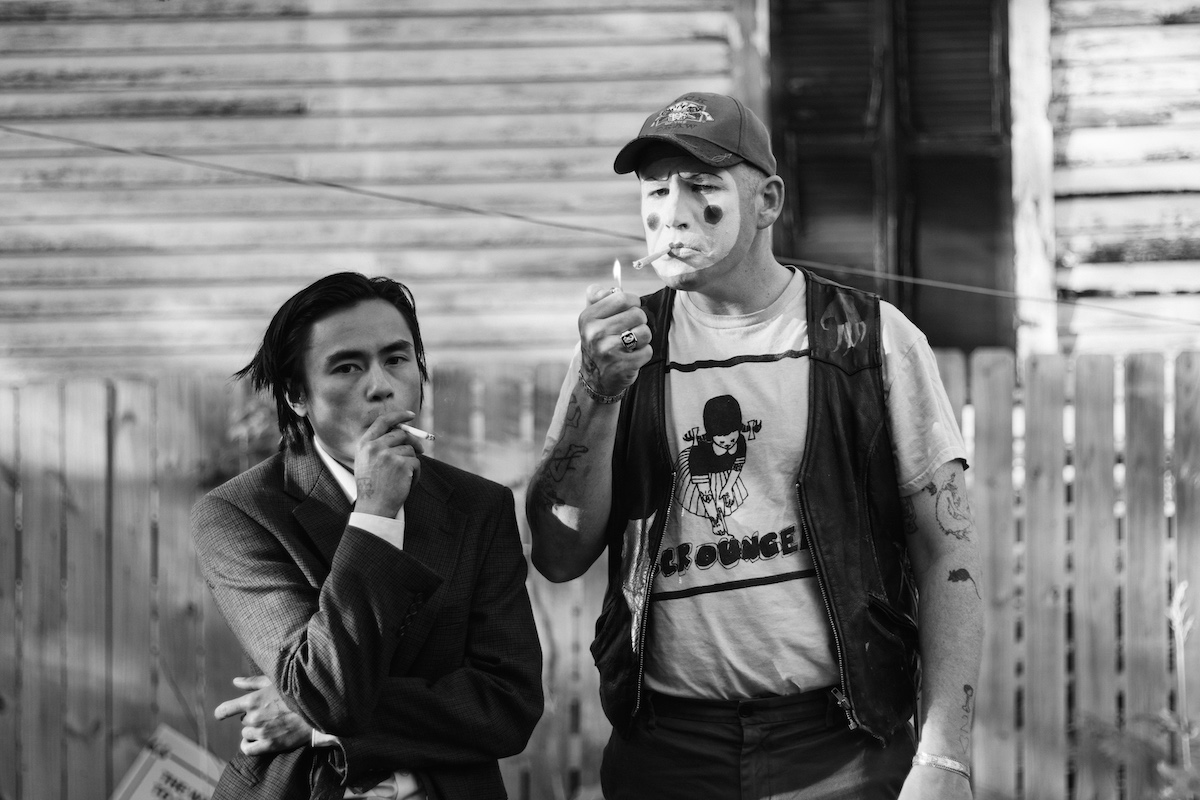
All photos courtesy of Ground Control Touring
Some bands blur genres. Twisted Teens seem intent on blowing them up altogether. Emerging from New Orleans with a sound that is equal parts punk-rock urgency, back-porch country soul, garage-rock grit, and cosmic outsider philosophy, the band occupies a space entirely its own. Their songs feel both familiar and disorienting, rooted in American musical traditions while constantly bending expectations in unexpected directions.
At the center of Twisted Teens is songwriter and vocalist Caspian Hollywell, whose work across multiple underground and folk-punk projects has earned a reputation for sharp storytelling and fearless experimentation. Alongside him, Ramon “RJ” Santos brings a distinctive steel guitar presence that adds texture, tension, and atmosphere, helping shape the band’s singular sonic identity. Together, they create music that can be rowdy and reflective, abrasive and beautiful, often within the same song.
What makes Twisted Teens especially unique is their ability to channel big ideas through memorable hooks and lived-in narratives. Their music explores faith, obsession, longing, alienation, and redemption with a sense of humor and a willingness to embrace contradiction. The result is a catalog that reveals new layers with every listen, rewarding audiences who are willing to follow the band wherever the songs lead.
As their reputation continues to grow beyond the DIY circuits that first embraced them, Twisted Teens sound like a band following their own internal compass, unconcerned with trends and committed to exploring wherever the songs lead. Both Caspian and RJ talk about the origins of Twisted Teens, their creative partnership, the stories behind the music, and how they’ve crafted a sound that refuses to fit neatly into any one category.
Many thanks to Sonya Badigian for the coordination and to Caspian and RJ for the great, often hilarious, conversation.
Caspian Hollywell: (Discussing Twisted Teens’ self-titled LP) It’s a little more rootsy or something.
James Broscheid: I think that vibe carries through on ‘Blame The Clown,’ too.
CH: That’s just kind of the vibe we were on at that moment. Our next record is really all over the place. It’s not as power pop as ‘Blame The Clown.’
JB: When do you think that’ll be out?
CH: Sometime this summer and then we have another one in the fall.
JB: Damn! Keep them coming!
CH: Well, the studio is right there (points to next room).
Ramon “RJ” Santos: Yeah, we recorded a new one.
CH: (All laugh) And we’re recording another one right now.
JB: That is awesome. You’re in New Orleans right?
RJ: Yeah.
CH: Where are you at?
JB: I’m out in Tucson.
CH: Oh, nice, I love it there.
JB: Did you guys come through earlier in the year?
CH: No, we’ve never played in the southwest at all. We just played in Los Angeles. We just flew out there basically to do a gig with Mike Krol and Shannon Shaw. And then we just added a couple more dates, so it paid for itself.
JB: I would have been really pissed if you guys came through here and I missed you.
CH: (Laughs) It’s a different thing live. It’s no frills. Like when we make a record, I’m more on like Lee “Scratch” Perry shit, making it crazy. Live we’re just a real old school rock and roll band.
JB: I would be really curious to see how you guys are live compared to what I’ve heard on the two albums so far.
RJ: We don’t use any pedals or effects.
CH: No effects pedals. I don’t even have a tuner. I plug straight into the amp.
JB: No kidding?
CH: I tune by ear. There’s not a single effect pedal on our stage.
JB: How refreshing is that?
CH: Well, there’s such a subculture now of musicians that come up and they don’t have access to older people who can guide them. They just go on YouTube and there’s an incentive to try to push people towards buying stuff. It’s kind of sad to watch it happen. The guy that made the most money during the gold rush was the guy selling pickaxes, you know? It’s wild these guitar players, I’ve been seeing them at gigs for years, this new generation, they literally can’t play a lick and they have like $1,200 worth of pedals in front of them. Take that money, and instead of giving it to a man to make pedals, give it to a man to teach guitar!
JB: I agree.
CH: We need to help give the teachers money and honor for sharing their knowledge with us (laughs).
JB: Yeah, well, education and learning is not very valued these days.
CH: The traditional education system was never the thing that conveyed music as an apprenticeship model that has carried mankind through the last 10,000 years. Until a hundred years ago when they industrialized schooling. Think about it this way. If you’re a blacksmith and you’re training a young blacksmith, he’s going to come work for you a decade after that. So, you’re highly incentivized to make sure he’s very skilled.
You open a school, your job is to make sure 25, 30% of those people don’t graduate. So, you go from conveying information to weeding people out.
JB: Yeah, that is interesting. Going back to what you both were saying about effects pedals, it definitely speaks to the trend. We’re losing the craft of musicianship these days in a lot of genres. How many effects can you throw on the floor in front of you?
CH: And (Kevin) Shields didn’t use any of that shit. He didn’t use a single effects pedal. He ran amp distortion. But that’s what technology does, it comes in to replace lost skill sets. RJ is a really great painter, but if they’re not sharing the skill of paint, people are attracted to using AI or some garbage. They spend money on technology and use electricity to make something happen. It’s the same thing with our food system, childbirth … same thing with everything. Technology comes in to mediate the relationship instead of the teachers and the community passing down things.
JB: Speaking to that regarding music, do you think that’s killing the DIY and underground scenes? I came up in the days of college radio and magazines, you know?
CH: The Hüsker Dü / Replacements era!
JB: Yeah, you had to go out and find things. It wasn’t just thrown in your lap. Based on what you two are seeing, do you think that kind of ethos/community approach to music is being steamrolled with what’s going on now?
CH: Well, it’s just been destroyed. Just like any other thing relating to cultural memory. It’s the same thing with healers and midwives and things like that. The cultural memories are destroyed and the new people that come, they don’t even know what they’re missing. They’re depressed, they don’t dance and they don’t realize that for the last million years, us monkeys have been dancing to make ourselves happy. They don’t even know or don’t understand why they’re sad. But yeah, exactly, they don’t want us having skills. They don’t want us being capable and competent. That’s one other facet to all that.
JB: I think one of the takeaways from the Woodstock ’99 debacle was that people didn’t know what they’re angry about.
CH: Well, they’re allowed to be angry about certain things. And their job is to channel that anger somewhere useless. Usually towards self-destruction. Jim Morrison’s dad in the fucking CIA man (George Stephen Morrison was a decorated career officer in the U.S. Navy who ultimately reached the rank of Rear Admiral. He was commander of U.S. forces in the Gulf of Tonkin incident that jumpstarted America’s involvement in the Vietnam War). There’s a big list of questions right there. And why, in the 90s, did they start making rap music just about people shooting each other. I don’t know. Somebody would like to promote the idea that the coolest thing you could do is destroy yourself and the people around you. Someone’s going to benefit from that concept I want. I wonder who that might be?
JB: There’s money to be made (Caspian laughs). I was reading about your record, ‘Blame The Clown’ and how it differed from the first record in that you guys were kind of pressed for time on it and even then, it was only available on tour. Did I read that right?
CH: Nah, man! We just make shit really quick. Both of those records took a few weeks each. Most of the vocal takes are one take on both records. It’s really just the vibe we were on that week when we made it.
RJ: Yeah, we don’t even know how to play that record. Like, why, because we just recorded it on the spot, and we really don’t know those songs. We’re starting to learn some of them now.
CH: Well, same thing with our first record. We made the record, and then we had to go learn the songs. When we played Blame The Clown’ for some of our friends, they think it isn’t as good as the first one, so we didn’t think it was going to go anywhere.
That album wasn’t even supposed to be our follow-up album, our follow-up album is coming out this summer, but that was originally supposed to be a seven inch. Then we just kept adding songs to it, and then eventually I kind of just collated all our power pop material to the green record (‘Blame The Clown’). There’s a song on there called, “Not Real.” That’s one of my favorite songs that we’ve done but I don’t even know how it goes. I mean, I played it. The guitar riffs on there, you’re listening to the one time I ever played that. I improvised the song. There’s a point in the song towards later on where you can hear my phone alarm, go off. But that’s not because I sampled it, my phone just went off while I was doing my vocal take. So, you hear that “It’s time to wake the fuck up” alarm. It’s because my alarm was just going off. Like, everything we do is like Carl Jung with the beetle out the window (The foundational anecdote for his concept of synchronicity: meaningful coincidences that occur without a causal connection but share deep psychological significance. – JB).
JB: So, you just rip these songs, record them, put them on an album, and then must revisit them to even consider playing them live?
RJ: Pretty much, yeah.
CH: There’s a lot of subtle and different processes. Like, right now, we’re writing stuff up to record as a whole band. We’re going to record today the song we wrote yesterday. And some of the songs they’ll develop on acoustic guitar. But I would say 80% of the material, we sit down and it’s either me by myself, and then everyone gets on it afterwards, or me and RJ or RJ brings me a riff and I’ll fuck with it, but we’ll knock it out, boom, boom, boom, boom! I think that’s why our music is exciting to people is because we’re excited about it when we make it. We’re having fun, so I think people have fun when they’re listening to it. It’s like when you look at a picture of people laughing as opposed to people posing with smiles. It’s a different feeling.
JB: I’m already excited to hear there might be two more albums coming out this year. We were listening to ‘Blame The Clowns’ the other day and my wife looked at me and said, “This stuff is great number one and number two, it reminds me of growing up and being in a basement with wood paneling on the walls with maybe a pool table and the smell of stale beer and cigarettes.” There’s just something gritty and swampy about it.
She added, “I definitely love it, but it’s making me feel different.” That’s what she came up with.
RJ: That’s accurate in a way.
CH: That’s what we’re trying to do. That’s what it’s supposed to feel like. I think most art, most bands now, people are really trying to hide who they are and where they’re from. Think about a genre like shoegaze. I love My Bloody Valentine and The Swirlies and all that but now, most of the bands are playing, and I’m not knocking them directly, but the whole aesthetic of it is that there’s nobody there doing this and a lot of music feels like that. I think it’s changing now, there’s some people who are really getting out there in the world of rock and roll, and stuff like that, putting themselves out there a little bit more. We’re playing kind of old school music, but that’s because we’re talking about a living tradition. There’s nothing nostalgic about it. We are in that smoky room, that’s where we’re at. We’re still there. We were there last night at the Saturn Bar down the block (all laugh). We are playing pool at the St Roch Tavern.
JB: There is an old-timey feeling to your music yet it’s fresh because there’s something different about it. You’re not repeating it which I think goes back to your point about shoegaze. You’re not reinventing anything, but you’re doing something different with it.
CH: I mean, how else could they do it? They had no culture. They have to read about it on the fucking internet, bro. I feel bad when I hear that music, because I’m like, “Damn, this is a symptom of someone with no culture.” If you want to have a big individual personality, you get that from a culture. Think about the early days of punk. They were all down at CBGB’s, or the early days of disco. They’re all down at Studio 54. They’re all down there, making a fucking vibe together and out of that came Talking Heads, Dead Boys, Ramones, Television … all these bands that don’t sound anything like each other, but they are on a vibe, and that’s what’s happening with us down in New Orleans, because you know two blocks away The Deslondes live down there, and there’s all that Americana stuff on Mashed Potato Records. Our friends are playing in hardcore bands, surf, old time, music, and we play all of that. It’s just us, not really filtering anything. It sounds new because those are the sounds that are coming through our window. Trap music, Cajun music, punk, it all, just comes through, literally. Yesterday, I was in the backyard and there was a Balkan band playing next door, a Cajun band playing next door and punk music two doors down.
JB: Nice.
CH: We don’t have to try to be different. We just have to not put up too many barriers between what we’re doing and where we’re from.
JB: I would love some recommendations on what’s going on in New Orleans now. I love the Balfa Brothers but as far as what’s current I’m not sure where to start.
RJ: Yeah, there’s a great Cajun band that’s our neighbor. You should check them out.
The band’s name is Beau Cheval.
CH: They’re like us, but they’re playing really old school music. It’s from the perspective of it being a living tradition and not from the perspective of this is some shit we’re reviving off folkways.com. They are part of it and it’s not just their music like they’re down at the Boucherie. We’re down at the parade, we’re in it. There’s The Holiday Playgirls. That’s a really good Cajun band. Half of these bands don’t even have fucking records, man. They don’t do anything. Daiquiri Queens was a great band for a long time. There’s a whole subculture of DIY Cajun music, and it’s of course not separated from the currents of that tradition. They have their own Mardi Gras runs and stuff.
JB: We talked about the spontaneity of Twisted Teens. Do you actually structure songs when writing or is it just let’s meet record a melody or riff in our head and go from there?
RJ: I think it varies depending on what situation it is, you know?
CH: A lot of them are literally just like I make a guitar loop, and then I’ll make a guitar loop for the chorus, and then I’ve cut and pasted them, something like A-B-A-B-A-B. Other times we’ll write stuff in the room. But we try to keep it simple, you know, stupid. We have a lot of interesting, weird modern influences, like Wipers, I mean, that’s a 30- or 40-year-old band now, but, you know, Replacements and Sonic Youth and all that shit. In the end, for me, my favorite band is The Coasters or old Excello Records sides and stuff like that. I love Bo Diddley. We are always going to keep those roots. We might go art-y for a second, but we’re always going to bring you back down to earth. We’re trying to move your body and just say some simple stupid shit!
JB: Cas, I love the weathered, gritty quality of your vocals. It perfectly matches the tone of your music and the raw stories you tell. Are you consciously shaping a narrative voice, or are those songs closer to unfiltered personal reflections, that take on a broader meeting?
CH: It’s crazy because “Is It Real?” is about getting put into a psych ward. When I was put in one against my will, I felt very betrayed, but I knew that I had to pay close attention to what was happening, because something significant was going on around me. And then, three years later, our band blows up off that song. You don’t really know? I’m not like spinning tales of steampunk allegories. It doesn’t mean that every word is exactly true. But no, I mean, it’s just the situations in life, and it’s oftentimes a take that’s rougher. Not all the feelings people have are really pretty to talk about. I think being willing to make yourself look like a little bit of an asshole is powerful because everyone
has dark sides. They just won’t admit it. So, someone who’s like, “I’m like this…” is telling on themselves, but other times, they’re actually telling you, “Hey, I’m comfortable with that side of myself.” I’m not trying to sit here and paint some picture of like a swampy … last thing I want to do is produce some swamp-kitch Americana for the State of Louisiana. If that shit is there, it’s because it’s just another piece of our lives. I’m not here to tell some steampunk-ass story, you know? That’s not what we’re trying to do at all.

JB: I think that’s where music sometimes loses its way, regardless of whether you’re exploring darker themes or not. The problem is when we try to bury our experiences, forgetting the lessons they’ve learned or hiding the wisdom that could help others. When you bury your truth, you’re not giving people the chance to learn from what you’ve been through. Ultimately, it all comes down to a deeper cultural issue.
CH: Well, they just don’t know any better and it’s the same problem with culture. I mean, if you don’t have people to show you how to sing? How are you going to sing, especially if you have a fear around that or think it’s separate from life in some way. I feel like I would relate better to people from fucking Türkiye, singing Turkish music. When I first went to Ireland, it was amazing because people would just make up ballads. and sing them alongside 2,000-year-old ballads. They weren’t presenting this museum piece. They’re Irish people, and they can write a fucking Irish song if they want, and no one can tell them it’s not Irish. When I think about how younger people can sing nowadays, I feel bad for them and not having older people in their life carry them into human culture. Because if you look across every culture in the history of the world, a certain number of people in each culture will sing. Except for now, people think it’s a specialized skill instead of something human, like cooking. So, it’s just like. Of course, then people have to solve this problem as an “artiste.” “Oh well, I got this delay panel for my voice,” but really, they’re just telling you they can’t fucking sing and the and when they tell you they can’t sing, all they’re really telling you is, “No one was there to show me.”
JB: That’s actually one of the main reasons I love long-distance driving. I do a lot of cross-country road trips and one of my favorites is driving down through the South. My goal for that trip was to pay homage to the old-school blues greats. The whole experience felt like stepping into a bygone era. It made me think about what you said regarding culture and singing. Back then, it was this tight-knit community of musicians. They had this rich, authentic culture of making music, whether the rest of the world noticed them or not.
RJ: Exactly what we are talking about. That’s what’s happening right here on our block in this neighborhood. People are living and breathing the arts every day, it’s not pretend you know? Whereas most bands probably or most people have to go and contain themselves in another area to do that.
CH: And it’s like you say, we have friends out here living and dying, like really talented musicians. Like, we’re getting attention by you talking to us now. That’s beautiful and we’re very thankful for that but it’s also funny because it’s almost alien to like the way a lot of people in New Orleans operate. Where so many talented people are just creating something for an ephemeral moment and that, in a way, is even more authentic than us. I don’t know. We have our own way of doing things.
JB: That’s exactly why I love connecting with groups like you and meeting people who share this passion. I’m always chasing that next musical discovery, and I want to share those hidden gems because great music deserves to be heard. It’s all about tracing those roots and keeping the stories alive. Take an artist like Huddie Ledbetter, for example. I always wonder what music originally inspired him, and in turn, how many generations he inspired after his work with Alan Lomax.
CH: Well, people don’t even know what music those guys were playing, because that’s how genres and music was created with the concept of the blues. Those guys back in the day, blues musicians like Robert Johnson played square dances and light classical music. These guys could play every genre, was not a real concept until a hundred years ago. Genres were dances. Can you Waltz? Can you square dance? Can you Virginia Reel? Can you two step? So, then we created a genre of music called Blues. The blues was just a dance but now it’s been racialized. So you hear 26 Robert Johnson sides and every single one of them is a slow drag blues, but that man could play probably 20 different styles of music. We’ll never know. Only one you hear is the Ragtime tune “Hot Tamales.” (In 1936, the iconic Delta bluesman recorded his most famous outlier track, “They’re Red Hot,” frequently referred to simply as “Hot Tamales” for the Vocalion Records label – JB). You know. So, this is how these things get created. You get people that are playing music at dance halls and juke joints for cultural happenings, and then it gets racialized, and that’s where we get the concept of a music genre. You can literally chart the course from these blues guys who were playing everything, but they got boxed up in that because of their race. Now, you can extrapolate that to the entire concept of fucking shoegaze 80 years later. It’s always racialized; it’s always a marketing distinction. It’s always got class indicators for these genres of music. In the old days, they were just playing for dancers. The musicians were not blues musicians. Musicians were trying to get another bottle of liquor and another sandwich to get through the next day. If that meant playing opera at a fucking Italian wedding, you did it.
JB: I try not to subscribe to genres or try to put artists in a box, claiming they fit a specific mold. Especially if it’s a mold they’re trying to break out of.
CH: Do you know who Robert Christgau is?
JB: I’ve heard the name.
CH: He just reviewed us. He gave us a really nice review on his Substack. He ran the Village Voice for a long time; I had to look him up. Apparently, he’s a bit of a big shot in the whole history of music reviewing, but he gave us a nice review that I thought was really thoughtful and it didn’t have a lot of hyphenations. It sounded like he was just listening to the vibe of our music. He used words like “punk.” I would take punk because punk is not just a genre, it’s a culture. I’m not going to argue with anyone calling us punks like. I’ve been a punk since I was a kid, so I’m not going to argue with that. I have a punk community (laughs).
JB: That goes back to what you were saying about the early days and CBGB’s.
None of those bands sounded similar, but they were all lumped into punk.
CH: Yeah, what I always think about are corvids and grackles (bird species) in a Walmart parking lot. Over time, their calls will start sounding like car alarms and that’s kind of what people were doing in the late 70s and early 80s. Bringing in the harsher textures of the sounds that we absorb as animals in urban environment.
So, in a way, you’re hearing noise pollution.
JB: RJ, I’ve got to ask about the pedal steel because it’s one of the things I love about Twisted Teens. I wanted to bring up “Circus Clown” specifically and how you’re playing feels almost disruptive in the best possible way to the tracks because it bends the song’s direction rather than supporting it. What do you think about that role and your role in shaping the identity of a song with not only a minimal lineup, but with the instrument itself?
RJ: It’s not actually a pedal steel. It’s a non-pedal steel. A lot of the papers got that wrong. I also do play the pedal steel, but for Twisted Teens, it’s just the console steel.
CH: There’s no foot pedals.
RJ: There’s actually no paddles or knee levers like a petal steel would have.
CH: So, the old Hawaiian way.
RJ: Yeah, it’s essentially a guitar on your lap.
JB: So, everybody’s getting it wrong out there!
CH: They’ve been saying all types of crazy shit in reviews and interviews. Saying my name weird … I’ve been enjoying it, I’m not offended at all, but it is really funny. I’ve had so many different names and they’re really saying all type of stuff (all laugh). Saying what our songs are about when that’s not what they’re about, but I just appreciate the attention, at least they’re listening.
JB: Well, I’ve seen both of you guys have different names in print. I’m not sure what to call you guys because of how many different names you guys have in the press.
RJ: He’s probably got five and I think I have three or something (all laugh).
JB: What do you prefer to go by?
CH: My name is Caspian, so you can call me that, but also on the albums, I’m called C-Bird or CPN. Those are just different names I’ve been using forever in bands. On the first record, I just listed them all as different instruments because I thought it was funny, and then it just completely confused people!
JB: RJ, what’s the instrument you play again?
RJ: It all goes into the family of steel guitar. It’s just a steel guitar. If you want to be specific about it, it’s a console steal because it’s got legs. It doesn’t sit on your lap, so it’s not a lap steel and it doesn’t have pedals, so it isn’t a pedal steel. But if you see anybody playing a guitar with a bar, a steel bar, it’s a steel guitar.
JB: And that’s different from a slide, right?
RJ: You’re talking about something like a bottleneck or finger slide?
JB: Yeah.
RJ: Yes, it’s different.
CH: It’s got eight strings per neck, and it’s tuned and a real interesting way. What is the main tuning that you use for it? It kind of implies seventh chords a lot, right?
RJ: Sixth. The bottom is on C6 or sometimes I tune it to A6, and then the top neck is open G.
JB: When you are recording, do you mess with tunings per song? Do you mix it up that way?
RJ: Yeah, it depends on the song. If it needs big, open chords then I would go to the open G but a lot of the times I just use the C6.
CH: Yeah, it has the two necks on it. Just two eight string necks next to each other with different tunings. What year is your Fender?
RJ: 1953.
CH: He’s got a 1953. If you bought a Telecaster from that year, it’d be like $78,000. But he bought the steel guitar and it’s like a couple grand (all laugh).
RJ: I think when people see it, they see a volume pedal, and then they immediately associate it with the pedal steel.
CH: Do steel players use that volume pedal much?
RJ: Yeah, they do.
CH: Damn, that’s a lot of coordination.
RJ: They’re constantly moving.
CH: A lot of stuff … stop me if I’m wrong here RJ, but a lot of stuff is more automatic on the pedal steel. You can just do these licks that are a little bit like, I don’t know, using the pedals a lot. I mean, you still have to know how to play it, but when there’s no pedals, he really has to work it all out melodically.
RJ: Yeah, there’s less movement on the pedal steel because the pedals are either tuning it up or down, so you’re not moving your bar hand so much as you would with a non-pedal steel because you’re constantly trying to find your notes. You certainly don’t use any bar slants on the pedal steel because the pedals will do that for you.
CH: So, turn it sideways, and it’s hard to keep it in tune, but you can play different chords at a certain angle. It’s crazy. It’s a super watercolor-y vibe instrument.
JB: Is it more difficult to play than a pedal steel?
RJ: So, I started off with a pedal steel, and then, when I switched to the non-pedals, I did find it a little more challenging. You’re just constantly invested in trying to find your notes. So, in that way, it is more difficult.
JB: I’ve heard playing the pedal steel is incredibly difficult because you have to memorize your parts. Since the music usually isn’t written down, you must rely entirely on memory to recreate what you played on a song.
RJ: Yeah. It’s also an expensive instrument, like a mediocre to professional model can run $5K. So, it deters a lot of people from getting one.
CH: You can get one of those little lap steels and learn on that. You can find them cheap all the time, so people can learn on those.
RJ: Yeah, a non-pedal steel guitar.
CH: Pedal steels are always expensive. It’s real interesting because it’s got no high pitch. It’s got high pitch, but it doesn’t have high harmonics. It’s not very harmonically dense. Which is awesome because I can make like a whole song and then be like “RJ, get on here!” It sits in a totally different spot in the mix than everything else because it doesn’t have any attack. There’s no, what they call, transient. and there’s also no high harmonics. It only works because of the beautiful melodic lines that RJ plays. Also, just the tonality of the instrument, like, if I added another guitar on top of it, you’d be hearing all this pick attack and all that other stuff. I would have to leave way more room in the music but because it’s so watery, I can play really pointy shit.
JB: Do you spend more time mixing than you actually do playing?
CH: We do everything quick man (James laughs). We work really hard, but we’re very lazy, so we don’t want to do too much practicing and too much mixing and all that. Look, most of the best songs use a rough mix so over mixing is a way bigger danger than dropping your roughies, a WAY bigger danger than dropping your roughies. Musicians pay attention: drop your rough mixes and don’t leave these poured over mixes for some fucking famous guy’s eighth album. You don’t need to do all that.
JB: Is it because you can get lost in the weeds mixing?
CH: Well, people don’t know. It goes back to this question of the education system. They don’t want to fail. That’s their model of understanding. I don’t want to fuck up and get kicked out of the class, so they go through their mixes trying to find the failures and removing them. Whereas we’re taking a photograph of the fun we’re having and as soon as we stop having fun, we stop rolling the camera. We’ll wait until we’re having fun again, and that way, when we capture it, it’s fun. As opposed to capturing our own process of going through the weeds to discover what we might have made a mistake on. Having fun, you don’t care if you fall on the floor or you don’t care if you make a mistake. Now, if something’s distracting from the vibe, I’ll get rid of it. One point we always make in these interviews is part of the reason we can work this fast is because we’ve been out on the street corner playing five hours a day for like decades. RJ practices four hours a day sometimes. We’re just practicing. We don’t have day jobs, we’ve been out here in the streets. Playing music for people, whether it’s old blues and old time or punk music at a generator show, like, we’ll be doing that all damn day. All our friends, when we go to bullshit stuff, it already sounds pretty good because we already know how to play, you know?
JB: And that’s pretty rare because a lot of musicians have to hold down day jobs.
CH: Well, this is the result of when the ruling class is able to capture music. Which is a fundamental piece of people’s lives, and then they reify it using technology. Take it out of people’s hands and sell it back to them. That’s what they do with your fucking water supply. Like, it’s so wild. Think of how radical it is. You’re like, “It’s amazing that you, as a musician, play music all day.” (James laughs) That feels radical for you to say. How insane is that? (More laughter) Imagine if you were like “Oh, you’re a really good cook. It’s so crazy that you cook all day!” Do you hear how crazy it sounds when you move it around like that.
JB: You’re musicians. What a revelation that you play music all day! My son wants to get into music after he graduates high school.
CH: No. If he wants to get into music, do not graduate high school. Actually, develop alcoholism (RJ laughs). And the only way you can get a bottle is if you play guitar on the street. He’ll get really good, really quick, as long as he’s got one person that actually shows him licks. If he doesn’t, then he’s fucked. You get a bottle of liquor on one hand and an older person who knows licks on the other hand, that’s how you create someone like Robert Johnson or any of these people. When I first came to New Orleans, if I did not bust up money, I literally went to bed without food. I remember one time I was homeless on the streets in New Orleans, and I didn’t know what a praline was because I was a Bay Area punk kid and I’m in the South. I thought it was nuts. I didn’t know it was all sugar, and I was so hungry, I ran into a tourist place where they sold all this shit and I grabbed two boxes and put them under my shirt and I ran out. Then I sat on a curb and opened the box, and I took a bite, and I realized it was only sugar and one piece of pecan. I started crying. I ate three or four of them because I was so hungry. You best believe I was out there the next day strumming my fucking heart out, so if your child wants to be good musician, the best thing you can do is get him a couple lessons and then encourage him to follow a lifestyle of homeless destitution. That day job will ruin you! You need to be practicing during that time, not washing dishes.
RJ: Tell him to get out of the house and move to New Orleans.
CH: No! Not here (laughs). We’ve already got too many people. He’s got to go to Tempe, Arizona and play on the street (all laugh). He has to go to Tempe.
JB: I’d rather send him to New Orleans (all laugh).
CH: No, we’re full up around here, man (more laughter).
JB: He can do all the running for you guys (all laugh). What took you from the Bay Area to New Orleans?
CH: Well, RJ had been living in the Yukon. He’s a whole Arctic-Filipino. It is a rare type of Pokémon (uproarious laughter). I came here when I was 19. I was hopping trains. There was a crew of people that were going to come down here and busk. So, I went with them and we hopped on trains. When we got to Laramie, Wyoming, our train died and we were freezing. So, we got the Greyhound down here. I was not prepared for this place. This is before Hurricane Katrina. At first, I was living on the roof of a Rally’s burger place. I broke the lock to get where I could get up a ladder and so I was sleeping up there. Maybe it was me being paranoid but I left there and started sleeping in the graveyard where I was eaten alive by red ants, and then we moved into this abandoned building off Rosalie Alley in the Bywater, which, at the time, was called murder alley. We found a building and just moved into it, and eventually the landlord came by like three weeks later was said, “Hey, you fuckers can’t squat here. This is going to be 150 bucks a month.” He was a really old man and 150 bucks in his mind is a lot of phosphates to bring to the box, you know? He’s thinking when a hamburger was 10 cents type of thing (laughs). I just lived there and was busking down the street for beer and food every day with a group of people playing old Holy Modal Rounders songs and jugband music. RJ’s probably got his own story about he ended up down here.
RJ: I was just bumming around and ended up here about 10 years ago.
CH: That’s when I moved back around the same time.
JB: What’s that from the Yukon?
RJ: Yeah, from the Yukon.
CH: RJ is a sign painter so if you go to his town where he lives in the summer, almost every business is covered in, like old-time signs that he made.
RJ: Yeah, I’m the town sign painter up there.
JB: How did you end up in New Orleans? Was it random?
RJ: I was just bumming around in the states and ended up here.
JB: Jace Lasek of Montréal band The Besnard Lakes travels above the Arctic Circle to record Inuit music in the town of Iqaluit. Working unpaid in a studio he helped build with Aakuluk Music, he aims to expose more people to underappreciated Indigenous music, specifically the overlooked music of the Inuit people.
CH: Very underrated contribution to American music especially the fiddle dance tradition. You know, people like to talk about the Irish influence on American fiddle music, but the native people also really influenced it. You can hear it in the structures because the structures are way cut up and crooked. When you listen to Michael Hurley (American folk singer-songwriter, 1941 – 2025), and the weird way he moves his bars around, you could make an argument that that’s connecting native musical traditions to contemporary music. So, they have an influence on us, and we have an influence on them too because in Dawson (City, Yukon) there are the Guisachan people (the Tr’ondëk Hwëch’in) and they play fiddle music. They play it up there and it’s amazing. The last time I was up there, we went out and saw the native people play square dance music and do all their step dances to it. It was amazing.
JB: And in your area, you find Cajun music. It’s got a bit of a square dance vibe, blending French roots and various other cultures, a true melting pot.
CH: Well, yeah, absolutely. I mean, you take this Acadian French music (French folk ballads with Celtic and bluegrass instrumentation – JB), and mix it with black people, you get Cajun music. You can hear all these European dance traditions. That’s not any different from what we do. European and African influences, some native … I mean, that’s what the United States is. You have German tradition, Irish tradition, the various African Traditions. They all come together like a Galapagos effect in old American music and that’s what we have here, you know? That’s what they were doing. Just listening to what comes in through their window, talking to people they meet and that’s their musical process. Not like today where they go, “Oh, now I go to the shoegaze convention and make sure I only talk to other shoegaze guys,” or whatever. Sorry, I feel like we’re being really cruel to the shoegaze guys (RJ laughs). Well, I don’t know if they have a community (all laugh), but by the way, I love My Bloody Valentine (more laughing).
JB: Well, that tag seems to be more universal these days.
CH: Well, you’d almost listen to modern Indie music and wonder if these people ever fart or get angry or calm or getting in conflict with people or flirt with anyone. Especially with the singing style in a lot of modern Indie music, it’s all dissociated. I’d rather hear a Turkish woman sounding like she’s going to cry when she sings. Actually, there’s this famous Turkish singer, I can’t pronounce the lady’s name otherwise I’d say it, but it was like one of the biggest hits of the ’60s (“Burçak Tarlası” by Tülay German, released in 1964 – JB). The reason that the song was so popular is because she’s singing about her ex, and she literally starts crying on the track, and you can hear her gasp.
JB: Can’t get any rawer than that.
CH: Yeah, and when we were in Germany, there is so much good Turkish music and Turkish culture there. I found it very inspiring in the same way. I’d rather hear this fucking Turkish lady rip her throat out than hear another coffee shop band not tell me anything. Not give me anything of themselves.
RJ: Yeah, most of that stuff really doesn’t do it for me. I just don’t even hear music in it. It’s just seems flat to me. Garbage. Modern indie bands anyway.
CH: Yeah, and people don’t know that when My Bloody Valentine dropped ‘You Made Me Realize’ (Creation Records, 1988), they were living in a squat. Like, they were actual punks. That’s the thing people don’t know about. A lot of the indie music that’s really made an impact was made by people that were coming from a punk subculture. Kim Gordon (Sonic Youth) has said it many times. She’ll be talking about some old band she doesn’t like, and she’s, like, “Oh, they weren’t any type of punks.” And she means they weren’t really connected to the community, they’re just aesthetic.
JB: No soul.
CH: That’s what it is.
JB: We got a couple minutes left, but RJ, I wanted to ask what drew you to play steel guitar?
RJ: I was in this country band, and they didn’t have a steel guitar. I decided to try to get one, but it took me a while to get one.
CH: RJ, tell him about your dream.
RJ: Oh, it wasn’t a dream. Before me and Caspian started the band, this was pre-pandemic, I got to New Orleans on Christmas day, and I had nowhere to go. So, I called up my buddy, asking him if he knew a place, and he said he was house sitting for someone. I drove over there after driving three days from Calgary, Canada and I ended up in this house, and he gave me a couch.
CH: When he says, “ended up in this house,” he means THIS house we’re in now.
RJ: Yeah, we didn’t know each other.
CH: He showed up at my house. I wasn’t here because it was Christmas!
JB: Wow! How auspicious!
CH: He was already in here before we ever met!
RJ: And I slept right here on this, where the old couch used to be. Then the very next morning I drove to North Carolina to pick up my very first pedal steel. I found it in a Craigslist ad and then drove out the next morning.
CH: Yeah, Craigslist … no strings attached pedal steel (all laugh).
JB: You came up in a country band with no pedal steel in the band?
RJ: No, there wasn’t any.
JB: I’ve always loved that instrument. So soulful.
RJ: Well, it’s the instrument that sounds more like a voice to me. Some say the fiddle, but I really think the steel guitar can really mimic a voice. I don’t know. It has the ability to sound like a lot of things. To me, it sounds like molten lava flowing, and then it can simultaneously sound like water freezing into ice, you know?
CH: It flows, it’s yin yang. Have you ever heard of kiki and bouba (The bouba–kiki effect or takete–maluma phenomenon – JB)?
JB: No.
CH: It’s two shapes, one’s called kiki, and it goes like this, (imitates a bell ringing) and one’s called bouba (mimics the noise of a soft, shapeless, gooey substance). If you go to any human being on the planet and you say, “Which one of these shapes is kiki and which one’s bouba?” They always say that the round one is bouba, and the pointy one is kiki because it’s built into human language. It’s also a yin yang type of thing. Like, I’ll make a kiki guitar riff, and then he makes a bouba steel riff, and then we get fire and water together.
JB: How did that initial coming together happen? How did the idea for the band come about?
CH: It’s not an idea, RJ just lived next door. That being said, I actually thought of it when I was a kid. I was like, “Man, how come no one ever uses this steel shit anywhere?” I remember being 17 years old, and when I first heard My Bloody Valentine, I thought, “There should be a steel guitar in this,” because at the time I was also listening to old country music, so I think that idea has been kicking around for a long time, but it really would have never happened as some “thing” you know? “Let’s go get a steel guitar, that’ll be our gimmick!” Literally, like it just came from RJ living next door to me and then him smoking outside and me chatting him up in the morning. Once we recorded the first one or two songs, and I turned to RJ and said, “Bro, we need to start a touring band.” And RJ, being crazy as shit, was like, “Yes” (all laugh).
He actually meant it, which is why this whole band exists. I wouldn’t have done this by myself at all, but I would say the locality of having RJ next door. We’re a punk band, and of course we’ve all, at least me, RJ, and Mel (Melrose “Mel” Billiard), the other guitar player, we’ve all hopped trains and have lived on the outside fringes of life in that way.
But at the same time, I’m a fiddle teacher. We’re all traditional musicians. We play really, really traditional music so even if we go to play more modern music., it’s going to sound like our main influences from older music, and that’s why I really like working with the two of them and our touring bass player too, Sonya (Badigian). She’s a well-known fiddle teacher too, so everyone in our band is respected in the world of traditional music.
JB: The recorded output is primarily you two or only you two and then you have a touring band?
CH: First album was just the two of us. Then Mel started playing with us. He’s on half of ‘Blame The Clown’ and he’s on a bunch of the blue record that’s going to come out this summer but not so much on the one after that. Now, we’re recording one where he’s writing a ton of shit. RJ writes really good licks, too. He’s got a classic guitar he uses. We just wrote a song together that we were just working on today. So, we’re always writing! And if the fans like it, then we’ll go back and learn it.
JB: You’re going to open for Kurt Vile on some dates too?
CH: He’s taking our asses on tour!
JB: But you guys aren’t coming out west (RJ laughs)!
CH: We will, though. But right now, we must take these big opportunities when they come up.
JB: Absolutely.
CH: We burned ourselves out last year, touring for no fucking money, and now they want to actually hire us to do decent tours, and we’re too burned out to take them! (Laughs) Next year, I think we’re just trying to rest up right now because we’re going to have to do a national tour. The Kurt Vile tour is an amazing opportunity, but we need to get out there and headline too, so we can have a relationship with our own fans.
JB: Well, if I have to interview you guys every album I will.
CH: You’ll be interviewing us three times this year (all laugh). I got a lot of buds in Tucson. I actually lived there for a little bit, like probably 15-20 years ago. On my way out to New Orleans, I ended up living in Tucson for two months. Do you remember The Grill (24-7 downtown diner – JB)?
JB: Yeah.
CH: I lived on the roof of that place. I literally lived on the roof of it, and they were so nice to me. I would go down there, I was vegetarian at the time, but I was freaking hungry all the time, I would eat meat if I found it. I had never had biscuits and gravy in my whole life. I went in there and I would find biscuits and gravy on the table. This is when I was a runaway and I thought, “Oh my God! This is the best thing I’ve ever eaten!” So, I would stand outside, plinking on my mandolin and run in there every 15 minutes to try to get someone’s biscuits and gravy and would wolf it down! There’s no way to finish a whole plate of biscuits and gravy. If you do that, they’re rolling you to the ER man.
JB: Well, I’d just be curious to get your take on Tucson now vs. your time here.
CH: Everything’s more expensive and fucked up now. But you gotta shout out No Más Muertes, (No More Deaths) for doing work at the border to save people’s lives. (No More Deaths maintains a year-round humanitarian presence in the deserts of southwestern Arizona and leave clothes/food/water for migrants traversing the Sonoran Desert – JB). Every animal migrates and humans do too. Shout out all those damn good taquerias.
Upcoming live dates:
Jul 17 – Chicago, IL – Sleeping Village
Jul 18 – Detroit, MI – Third Man Records
Jul 19 – Toronto, CAN – The Garrison
Jul 21 – Montreal, CAN – Les Foufounes Électriques
Jul 22 – Brattleboro, VT – The Stone Church
Jul 23 – Cambridge, MA – The Sinclair
Jul 24 – Garwood, NJ – Crossroads
Jul 25 – Philadelphia, PA – The Dell Music Center
Aug 24 – Los Angeles, CA – Hollywood Palladium w/ The Breeders
Aug 25 – Del Mar, CA – The Sound w/ The Breeders
Nov 4 – Buffalo, NY – Asbury Hall w/ Kurt Vile
Nov 5 – Columbus, OH – Newport Music Hall w/ Kurt Vile
Nov 7 – St. Louis, MO – The Sovereign w/ Kurt Vile
Nov 8 – Milwaukee, WI – Turner Hall w/ Kurt Vile
Nov 10 – Des Moines, IA – Wooly’s w/ Kurt Vile
Nov 11 – Lawrence, KS – Liberty Hall w/ Kurt Vile
Nov 12 – Omaha, NE – The Waiting Room w/ Kurt Vile
Nov 13 – Fort Collins, CO – Washington’s w/ Kurt Vile
Nov 14 – Denver, CO – Summit Music Hall w/ Kurt Vile
Nov 16 – Fayetteville, AR – George’s Majestic Lounge w/ Kurt Vile
Nov 17 – Memphis, TN – Minglewood Hall w/ Kurt Vile
Nov 18 – New Orleans, LA – Joy Theatre w/ Kurt Vile
Nov 20 – Athens, GA – 40 Watt Club w/ Kurt Vile
Nov 21 – Charleston, SC – The Music Farm w/ Kurt Vile
Nov 22 – Charlotte, NC – Neighborhood Theatre w/ Kurt Vile
Nov 23 – Richmond, VA – The National w/ Kurt Vile
Nov 24 – Baltimore, MD – Ottobar w/ Kurt Vile
Listen and Learn here: Chain Smoking Records | CPNPC