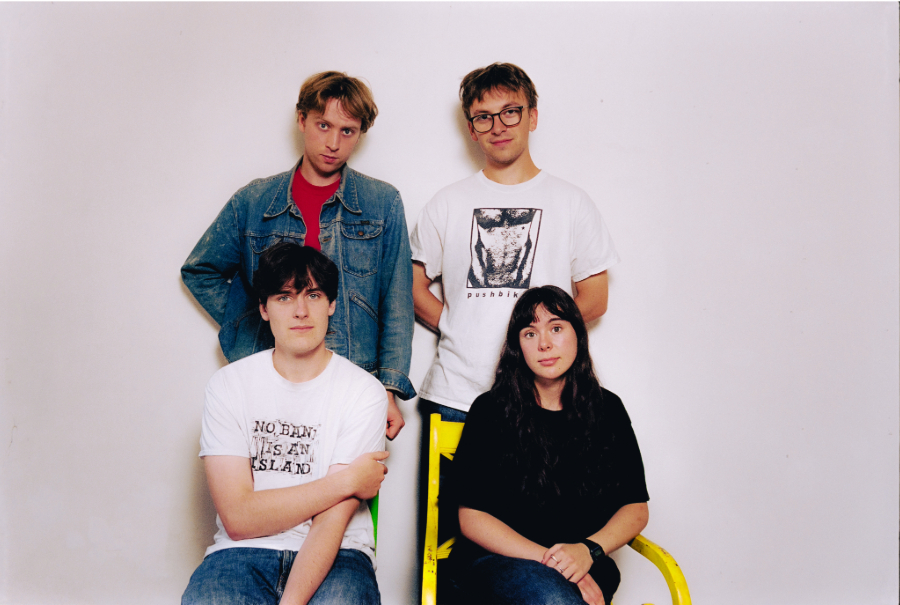
Photo by Charlie Barclay Harris
Westside Cowboy are a decidedly young, and unmistakably British, band, and they’ve proven themselves worthy of the hype that’s followed the quartet since their formation in 2023. With three of the four members finishing college—or, in their case, uni—in 2025, the future looks especially bright now that the band no longer has to work around academic calendars.
Their debut EP, This Better Be Something Great, was a straightforward, plug-and-play affair that I described in Big Takeover issue #97 as bursting with youthful, invigorating energy, unencumbered by fads or excessive technology. The new EP, So Much Country ’Till We Get There, builds confidently on that foundation, revealing a band with more experience under its collective belt and a clearer, more focused sense of intent. Together, the two EPs don’t even reach the 30-minute mark, yet nothing feels lacking, the songs are lean, pure, and satisfying, free of bloat or filler.
Before the holidays, three of the four members (Reuben Haycocks, Paddy Murphy, and Aofie Anson-O’Connell) joined me for a transatlantic Zoom call to discuss their rapidly blossoming career, the freedom to experiment without falling in step with their peers, a truly pinch-me 2025, and what lies ahead
Greetings from Columbus, Ohio.
PADDY: There’s a load of great Ohio bands from that sort of 90s, 2000s time.
AOIFE: I love Brainiac.
PADDY: They, weirdly enough, opened for Mogwai on a European run. They basically made them reform or something, and it was a show I never thought I’d get to see. I think it was their guitarist singing because Tim died, but it was amazing. They played all the classics, they played “Hot Metal Doberman’s” and all that stuff.
I haven’t seen them since they reformed but it sounds like they’re going to keep going.
PADDY: I would really hope so. They felt like they still had a load of that energy. I remember watching old VHS videos of their performances uploaded to YouTube. I loved it. This is something that we’ll never quite get used to: the idea of distance in America. How can you still be in your state and drive two hours just to be in the state? No one can be asked to do that in England most of the time. It’s a hassle getting a 20-minute train.
In my review of your This Better Be Something Great EP from earlier this year, I praised the diversity. You’re a hard pin to pigeonhole and pin down. And, it doesn’t sound like you’re trying to follow current fads, you’re just making the Westside Cowboy sound. While many bands rely on technology while recording, it sounds to me like you just plug in and go.
REUBEN: That’s the truth, 100%. Before this band, we used to be in other bands that definitely did that. We really wanted to be like a crank wave band, which was a genre that happened when we were in first year of uni, and we wanted to be involved in that scene. It’s funny that you say that because we get both sides of the coin. Some people think that we are just recycling old things. I read a review of us the other day where this person was trying to say that we were trying to be 2010s nostalgia. Which is fair enough. I wasn’t that salty about it, but we do just want to sit in a room and be able to play songs in any format, and they sound like songs still. The idea that without a certain pedal or synth we are then half a band is not very appealing to us. If you can play it on a guitar, then we’ll like it.
Somewhere you said, “we found that if we pretend to be different people when writing songs, we can never go wrong.” Are you pretending to be other bands, like, “If we were (insert band name), here’s how we’d write this song” or you are taking on different personas, like, “If we had 15 years of experience as a touring band, here’s how this song might sound”?
REUBEN: It’s a bit of everything, and that was something that from the very start started Westside Cowboy. We had been in these other bands and found it very difficult to write with the pressure of people knowing that it’s coming from you. A way for us to manipulate our minds into being less worried about that sort of stuff is to write songs as if you were other people. Whenever I read lyrics to a song in my own voice, like Jeff Tweedy’s lyrics, they instantly sound worse just because they’re coming out of my mouth into my head. If in your mind you can have Jeff Tweedy’s voice singing your lyrics, you can trick yourself for just about long enough to be able to write a song. My personal best ones come when I pretend that I’m Stephen Merritt in my mind. That’s when my personal favorite songs come out.
PADDY: It was also maybe a little more abstract at first. We just liked the idea of a guy unencumbered by trend, you sit down at a bar next to him and he’s just got a guitar and he goes, “hey, can I play you a song?” The type of person who would do that only really knows G, C, and D. There’s no stupid different tunings, or influence from clever internet music. It’s just like, “here, let me play you this song.”
I love that idea of someone who has never turned on the radio.
PADDY: It’s like, I’m just gonna sing something. It can be super corny or cheesy, at least when you’re thinking about it through a 2025 lens, but it’s very genuine to that person. It was always like, well, maybe this song is kind of cringey or a bit corny, but it’s not us that wrote it, it’s “the guy.” It’s this fella somewhere by a campfire. It definitely feels liberating when you find that different headspace.
Should your lyrics be taken literally, or are they looked at as fiction or nonfiction? How do you perceive your lyrics and how people should take them?
REUBEN: There’s been a boom in very “nailed-on” lyrics that just mean exactly what they say. Like the Black Country, New Road thing, where it’s like, “I went to the shop at 7 o’clock and bought X thing.” I think that’s really cool. The Lily Allen thing is probably what it actually is, it’s like reading out text messages. I think that’s a very interesting way of doing it, but I personally am too embarrassed to do that sort of stuff and have people know shit about my life. I like to have the original thing that I want to write the song about and cover it with as much extra stuff as possible so that if you really wanted to, you could probably find out what it was personally about. But hopefully it will be so masked in other things that you won’t be able to pinpoint it directly to my life if you knew me.
AOIFE: By leaving this hyper-specific type of lyrics behind, as long as the situation that you are writing about is hyper-personal, whatever words you use, no matter how vague you make it, it then becomes suddenly universal. You’re not reading out a diary, but whenever you hear that song or sing it back, that’s what you have. Someone else will have completely the opposite thing in mind. Not that we’re ever writing to make things really connect with people, but it’s always a massive bonus because everyone has the same emotions. Everyone feels the same things and has this palette of ways to feel about various different circumstances.
That makes a lot of sense to me. I’ve interviewed a ton of bands and so many of them say, “I wrote this song about X, and somebody came up to me after a show and said they thought it was about Y.” It impacted their life; they used it as a wedding song and it’s really about heartache, or they listen to it after somebody passed away but it’s really a happy song. It’s the interpretation of the listener. As long as people connect to it and make their own meaning, the song works.
REUBEN: I really like that. Wilco’s “Jesus, Etc.” wasn’t written for any reason. Apparently, Jeff Tweedy just had words that came out of him. He said he only realized what the meaning of the song was after he’d written it and played it live for the first time because somebody had spoken to him about it. Only Jeff Tweedy can write a song like “Jesus, Etc.” by accident, but it’s a beautiful thing about music. None of our songs have to mean anything in their beginning; it’s the context that changes it for other people. It’s always got something for us, or at least we attach the tail to the donkey.
Have you found that within your own music? That somebody has told you what they thought it was about, or have you discovered what a song is about after you’re done?
PADDY: We were talking about this in the van the other day. We were talking about some songs that are gonna be on the album and lyrics that Reuben had written. I was just like, “Reuben, I’m gonna tell you what I think this song is about.” It’s so ridiculous because I didn’t write the lyrics. But it’s really lovely. Whenever an idea is brought to Cowboys, it’ll start life with someone in their bedroom playing guitar, and then the minute it comes into the room, it stops being your idea and becomes a Cowboy’s idea. I almost feel like the minute that a song is played live or released, while it may say “Westside Cowboy” under it, that’s when anyone is stealing it. It’s anyone’s guess what it’s about.
You guys are music fans, too, so I’m sure you feel that as fans of other bands. You’re like, “this is mine now, and here’s how I interpret it.”
PADDY: These days it’s harder, but a big influence when the band was beginning was traditional folk music. There’s something so special about the idea that no one knows where some songs come from. Reuben’s been getting into Fred Neil recently, who wrote so many famous songs but isn’t quite a household name in the same way. That’s what it should be about, not the cult of personality thing. It doesn’t have to be a person who wrote a thing; it can be this creative thing that now has its own legs.
You’re talking about older folk and country music that my own daughters, who are right around your age, would never know anything about or stumble upon. Where did your interest in that type of music come from? Was it stuff you heard around the house that your parents played when you were growing up?
PADDY: All four of us have very different musical lineages. I was raised listening to a lot of rock stuff, and as you get a bit older that becomes punk and underground music. Then you discover the internet and you’re into everything. But it was out of the back of mine and Reuben’s old band, where we were making obscure music for obscure music’s sake. The idea of folk music, Americana, and traditional music started to seem way more appealing all of a sudden. How have we gotten ourselves in this massive knot? Let’s just try and write a great song. It’s like what Tweedy said, so many of those country or power pop bands in the 90s started out as punk bands, and in the quest for truthful music, you end up going further back to something more traditional.
A lot of the 90s punk singers have gone into country music. This evolution as you get older is more about the songwriting and the style than about the aggression and the fast stuff.
PADDY: It’s just a natural pipeline. We’ve seen it in real time with friends who were in amazing post-punk bands, and within the year, they’re now a trad band. There’s one band called Brown Wimpenny who had that exact trajectory and they’re unbelievable. People should know them all around the world.
AOIFE: They’ve got an amazing State51 recording that I think really shows them off.
REUBEN: That recording on Spotify doesn’t quite do them justice.
PADDY: They’ve got a great demo on Bandcamp, though. But musically, we all come from different places.
REUBEN: My family was a little bit more music-centric. My dad is obsessed with all things music, and my mum loves music, too. They both played guitar and taught me how to play. I just remember some songs from my childhood that gave me a very specific pang of something. Pretty much all of them were older folk songs. My parents loved everything, and I grew up with Pavement, Wilco, and Teenage Fanclub. But all the most memorable parts for me were the folk songs. There was one in particular that I found again recently called “Crayon Angels” by Judee Sill. These guys really hate it and say that it’s school teacher music. It’s really religious, and I’m not religious at all, but she has this really almost AI voice. It’s kind of horrible, but to write a song like that would be what I’m trying to do. I’m trying to make a song that my younger self would have loved as much as that song.
Do you think you’ll ever have another year like 2025? You put out an EP, you did a bunch of gigs on bills that a lot of people would kill to play. You played Glastonbury. You’ve announced that you’ll be supporting Geese shows. Where does it go from here?
REUBEN: We hope to continue enjoying ourselves. All of the things that feel like big achievements have been fantastic, but doing all that stuff makes you realize what actually does make you happy about music, and that is just the playing side of it. As much as meeting all these lovely people and playing to people is the best thing ever, even better than the best thing ever, it’s just being able to spend loads of time with my best mates and play music all the time.
Are these songs that have been building up, or did you write them specifically for this EP?
REUBEN: All of these songs have been around for quite a while. Weirdly, we wrote the first EP in the first week of being a band. These are sort of songs from the “second week.” We’ve been playing a lot of them for close to two years now. It’s nice to see them in different forms. We had to rip a couple apart because we played them into oblivion live and they became weird, malformed versions of themselves. It was nice to go back and think about what we originally wanted the song to be like and record it that way. I think quite a few people have been waiting on “The Wahs” for a couple of years, so we’re very sorry to them, and I hope they like the recordings.
Besides that song, do you have a favorite?
PADDY: I like “Don’t Throw Rocks” a lot. That one got written about three different times. The version on the EP was one we tried just before we were about to go home late at night. We said, “let’s just try one more time,” and we played it the way it is on the recording. There are a couple of fun “Cowboy” moments like that where we never had a conversation, but something in the room enables it to happen. I really like “Taxidermy” as well. That was entirely taken apart and put back together, and Lauren was instrumental in that process.
AOIFE: I’m really pleased with how it came out. I tend not to listen to stuff afterwards, like we were saying earlier, it’s not our song anymore once it’s done, but we got a test pressing of the vinyl and it was the first time I’d listened to the full EP after mixing. I was pleasantly surprised. I’ve really warmed to “In the Morning” because we do that live very differently. It seemed really sickly sweet and almost too twee; we didn’t want to put that on the EP at one point. Then we were like, “fuck it, it’s there, we’ve done it.” If people think it’s cringe, at least one person out of those people will enjoy it.
What’s nice to me is that 5 songs in 14 minutes means there’s nothing not to like. It’s not a 12-song album where there might be one or two songs I’d kick off the record. I like all the songs.
AOIFE: That’s so kind.
I appreciate not overindulging. They aren’t six-minute songs; they’re quick, to the point, and it makes me want to hear the next one. Every time I’ve listened to it, I feel like I’ve listened twice in a row because it’s so short. It makes for a nice double listen.
PADDY: That’s positive!
AOIFE: Our exclusive vinyl is just the EP looped twice!
REUBEN: There is this scary prospect regarding the album we’ve been doing. I’m pretty sure, contractually, it needs to be 40 minutes long. We’re 13 songs in and we still haven’t got there yet!
Did they tell you that contractually? I interviewed an Australian band called Teen Jesus and the Jean Teasers. Their album is 10 songs and it’s 29 minutes and 30 seconds.
AOIFE: Like that Snooper album! I remember listening to that; it was like 22 minutes. It was great, but I was like, “Oh my god, it’s done already?”
From a live perspective, are the songs on the new EP songs that have been part of the setlist and now you’ve recorded them, or is this a batch just for the EP? What has your setlist been looking like up until this point?
AOIFE: It’s a big mix, really. We’ve got songs that have been in the live set for about a year that won’t be on either thing and might not even be on the album. And then there’s stuff on the EP that we play. We’ve been playing a lot more with the idea that live music and recorded music is not always meant to be the same. Our first EP doesn’t do that as much, in the sense that it’s very live, but when we play it live, we just do it louder and faster which is normally the underlying thing for converting a song to live. But we’ve changed things a lot more, which we hope people like. If the first EP sounded like something you couldn’t really pin down, this one might be more tricky. I can already foresee people saying very kind things about it, but also people saying that we have no idea what we’re doing.
With a band like AC/DC, you sort of know what you’re going to get every time they put out an album. It’s formulaic but it works. With both of your EPs, you’re unpredictable and not formulaic in the least. That’s what I like about your music, it’s interesting and exciting and unexpected from song to song.
AOIFE: I think it’s incredibly naive and completely understandable that people want to hear a band that gives them that safety net of “this is a thing.” But if you think logically about it, not to make it sound really boring, we’re a bunch of 20-year-old kids that have just finished a university degree and suddenly started doing a job that we never thought we’d be doing. We all have different backgrounds and different things that are really cool and really bad about our lives. I think it is slightly naive to think that anyone in that position would be so set on such a consistent thing.
REUBEN: I would actually go against that and say that we’ve been trying to make AC/DC music the entire time. Genuinely, if you go through all of our songs, it’s embarrassing how many of them are just G and C. People have actually come up and commented on it. I will go off of what Aoife said in that we try and make music that sounds like Westside Cowboy, generally. But up until now, we’ve had all types of music absolutely blasted in our face for 22 years. Even if we did want to do AC/DC, same song every time, the fact that we’ve been able to hear so much that has inspired us means I don’t think we could possibly end up with one thing. We love so much contradicting music.
PADDY: When the band first started, coming out of weird music again, we realized, “let’s just write music like this.” It’s really fun and rewarding. But the process is constantly changing because we’re constantly changing as people and our tastes are constantly changing. We spoke in this interview about how we want to make timeless music, but we also really like the idea of music being like a time capsule. We are 22 years old, living in Manchester, writing music and recording it. It won’t always be like that.
In 10 years, you’ll look back at the stuff you’ve already put out and say, “I remember where I was when I wrote this.” These potentially could be a series of snapshots of your current age.
AOIFE: It’s been a really helpful reminder as a way of coping with some pressure that we feel. Like you said, we didn’t expect to have the year we’ve had, but there is this target on your back: “the hype band.” The idea of being a hype band is so kind until it sets expectations and paints you in a certain way, as though you have some sort of ego. But just to realize, we’re gonna put stuff out that people don’t like. If you expect someone to make something amazing or perfect, you are just eternally damning them and your own enjoyment of anything. I was a bit stressed about it, and the other day I was like, “well, think about all of your favorite bands and all your favorite artists.” I will very gladly go to the pub and slag off a song that they’ve made that I think is terrible. In a conversation, I will still tell people that this artist is one of the best artists in the world. I think knowing that is kind of helpful.
Regarding the hype—I think I first heard of you through Stereogum or a social media post in the U.S. You must know 20 other peers that I should know about, but I’ll probably never know because you’ve somehow made it across the ocean. Does that equate to double the pressure, being a “global hype band”?
REUBEN: We’ve considered how it will transfer over to American people. In my mind, there is an inherent Britishness to the music. We say that we are “Britannicana,” that has become a word that means more than what we initially intended. It was a joke at the start. I would be really interested, more than pressured, to see how it transfers considering we come at it as a British band trying to make British music. We love American bands who make very American music, so hopefully it transfers. I haven’t really thought about it too much. With social media, anyone from anywhere has always been able to contact us, so there hasn’t been a “line in the sand” moment where it felt like, “right, you’re now trying to break America.”
[Note: This conversation happened before Westside Cowboy played in New York and Los Angeles in December.]
What are your plans for America?
PADDY: Our producer, Loren Humphreys, lives in Upstate New York, so we’re gonna go and do some pre-production with him for the album, which we’re gonna record in January. That’ll be really fun, just figuring out how the album’s gonna sound and getting some experiments out of our system. We might shoot a music video.
AOIFE: We’re planning to shoot a music video for “The Wahs,” which is on the EP. It’s funny because it comes back to the British-America thing. Me and Jimmy made a mock-up treatment that was so Manchester-based and personal—us riding on our bikes, putting the track on our Discman. Because of time, there was no way we would have been able to film it there. We were very hesitant about anything looking “American,” but from what we’ve seen now, it might refer more to the vague “nowhere space” where British and American culture intersects that we grew up with.
It’s funny you say “The Wahs,” because that’s my favorite song on the EP. To me, it’s got a very 90s feel. It reminds me of Ben Kweller or Ben Lee. Do you know those guys?
AOIFE: No. Homework!
Are you going to do U.S. dates in 2026?
REUBEN: Hopefully. They’re under consideration.
AOIFE: If you’ll have us.
What was your favorite moment of 2025, and an album you can’t stop listening to?
REUBEN: Favorite moment for all of us was playing Green Man. It’s a festival in Wales that is just the best place on Earth. We’d gone before as fans, and it felt like all the stars aligned. In the least cheesy way, it was a top moment of life so far.
And an album that you listened to a lot in 2025? It doesn’t have to be something that was released in 2025, it can be anything that you enjoyed last year.
PADDY: We’ll all have different ones. I’d say Phonetics On and On_ by Horsegirl. That’s been on a lot. From the week it came out, I haven’t gotten sick of it once. We listen to it pretty much every time we’re in the van. I think it’s genius songwriting. It completely reframes how we think about recording our own songs.
AOIFE: If we’re speaking statistically, probably Strawberry Jam by Animal Collective. There are a couple of songs on there that I’ve maybe listened to more than any other person in the world. I remember a drive down to End of the Road Festival where I listened to only that album, and for the last three hours, I listened to only two specific songs.
REUBEN: I would say More Blood, More Tracks (Bob Dylan) would probably be my most listened to.
PADDY: Oh man, I didn’t think of that one.
REUBEN: We’re a very jealous band.
PADDY: It’s the main emotion of Westside Cowboy.
AOIFE: We feel like we own music. Not our own, but we own other people’s music in our heads.
One last question. I ask this of everyone. Is there a song that, when you hear it, instantly takes you back to a specific memory?
REUBEN: Definitely. When I was younger, I used to bike from my house into the nearest town, Wem. It was about a four-mile ride. I was 14 or 15 and I’d do it all the time to see my mates. My favorite time of day was weirdly biking back alone. There was a specific road where “Back to Stay” by John Martyn came on my headphones. It was a moment where music just “clicked” in my mind. Every time I hear it, I can see exactly where I am and I can feel the bike underneath me.
PADDY: I know I’ll get off this interview and think of a better one, but the first one that came to mind is from when I was 14 or 15. My parents took us on holiday to the Lake District in the Northwest of the UK. I remember we got up really early to get on a little ferry to cross one of the lakes, the kind that only fits about a dozen cars. I was an impressionable teenager and I had “I Want Wind to Blow” by The Microphones playing. I remember the mist coming off the water in the morning. Every time I hear a nylon string guitar or that song comes on, I’m instantly taken back to that morning. Even now, when we’re in the van at 7:00 AM after a late show, I’ll put that song on and it’s that feeling again. I feel like I’ve been trying to “be” in that song since I first heard it.
AOIFE: Mine is “Forever and Always” by Shania Twain. My parents loved music, but not in the way of knowing specific bands. My mum had a Shania Twain CD that she used to blast whenever she was mopping the floor or cleaning the house. I hadn’t heard that song for years, but then I was in a cafe across from our uni when I was about 22 and it came on. You know when something makes you feel a bit sick? I felt like I was seven years old again. I could actually smell the bleach.
These are three awesome answers, exactly what I was looking for.