
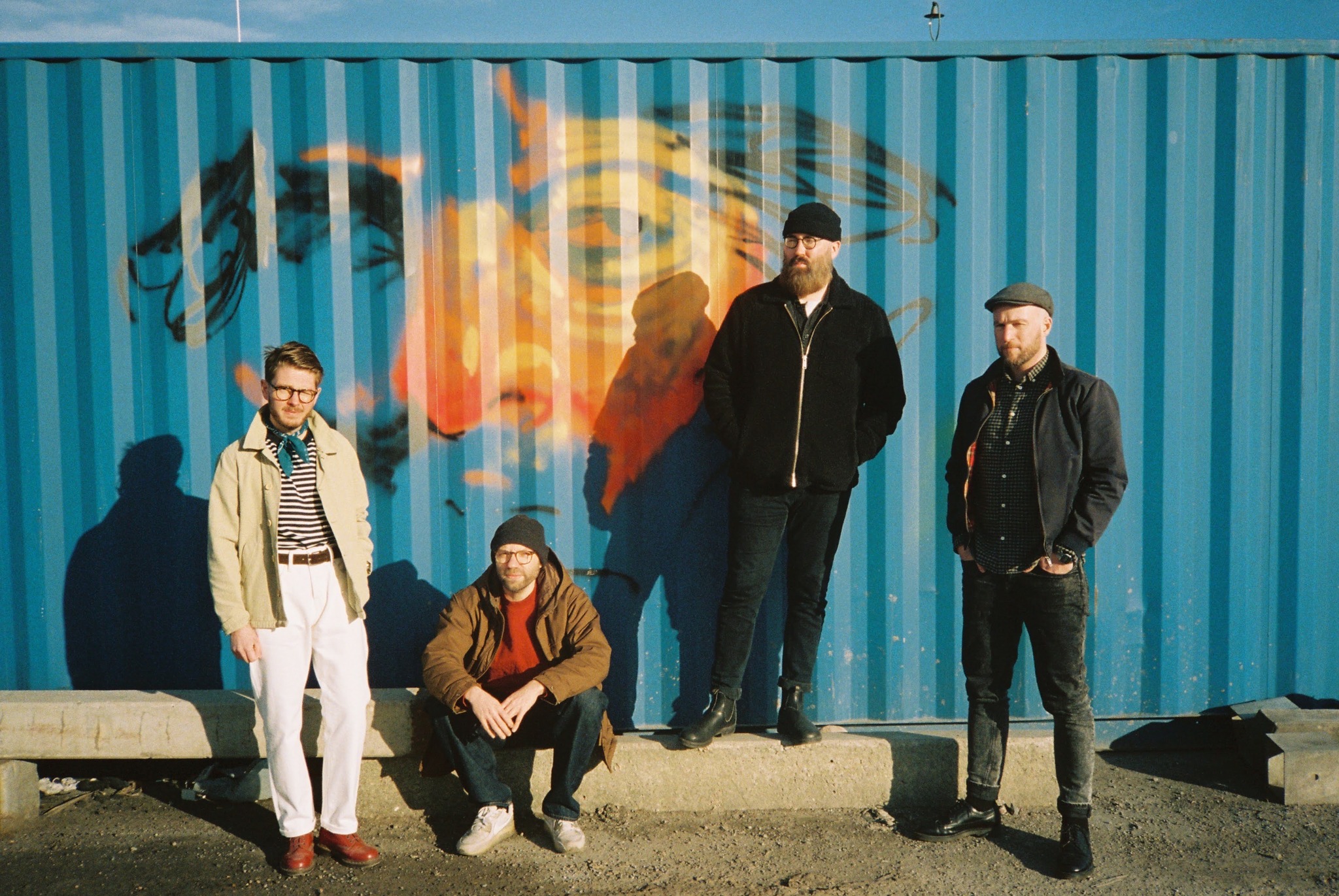
All photos courtesy of Salt Lake Alley
There is a particular kind of devotion required to keep a musical tradition alive without letting it calcify, and Salt Lake Alley seem to understand that balance instinctively. Emerging from Stockholm’s quietly fertile indie underground, the band operates with a sense of purpose that feels both scholarly and deeply emotional, as though each song is an act of preservation and reinvention at once. They describe their sound as orthodox indie pop, but there is nothing rigid about what they create. Instead, their music carries a living pulse, jangling guitars that shimmer with clarity, melodies that unfold with disarming sincerity, and an undercurrent of longing that lingers long after the final note fades.
The project began as a meeting of like-minded sensibilities between Gustav Tranback and Mikael Carlsson, musicians whose histories in Sweden’s independent scene had already honed a shared language of restraint, melody, and emotional precision. What started as a focused, almost intimate collaboration soon revealed a wider horizon, as their early recordings found an audience attuned to the subtle craft of guitar pop done right. There is a quiet confidence in those beginnings, a sense that they were not chasing trends but instead refining something enduring.
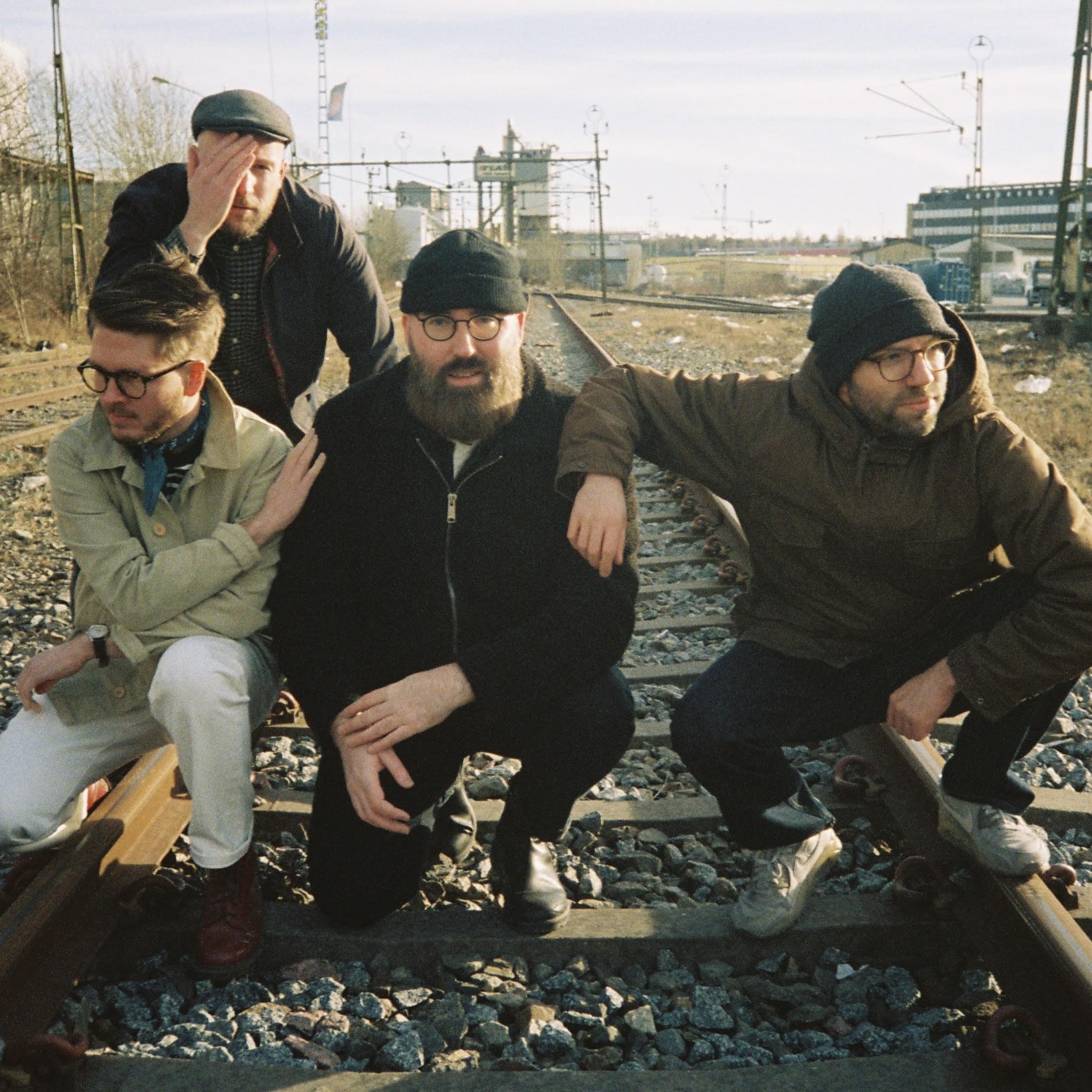
The expansion into a four-piece with Fredrik Jalker and Thomas Aherne marked a turning point, not in direction but in dimension. The band’s sound grew more expansive without losing its core identity, layering interlocking guitar lines, gentle rhythmic propulsion, and carefully arranged harmonies into something that feels both intricate and effortless. Their music evokes the lineage of classic independent guitar pop without leaning on nostalgia, drawing from its emotional vocabulary while speaking in a voice that is unmistakably their own.
Across their first two albums, Salt Lake Alley established themselves as meticulous craftsmen of melody, a band committed to clarity and feeling in equal measure. Each release has reinforced their reputation for creating songs that are immediately inviting yet reveal deeper textures with time, built on an understanding that simplicity, when handled with care, can be endlessly profound.
Now, with their third album ‘Always Out Of Time,’ they move forward not by abandoning their foundations but by deepening them. There is a sense of momentum in their evolution, a quiet insistence that this form of music still has new stories to tell and new emotions to uncover. Salt Lake Alley’s work exists in that rare space where reverence becomes renewal, where the past is not imitated but reimagined, and where the timeless qualities of indie pop are given room to breathe again.
Special thanks to both Gustav and Mikael for the generosity of their time.
James Broscheid: With ‘Always Out of Time’ serving as both the title track and a beacon of the LP’s mood, can you unpack how the concept of time (whether as nostalgia, urgency, memory, or constraint), shaped not only the lyrics but also your approach to arranging and recording the songs?
Gustav Tranback: With ‘Always Out of Time,’ time became less of a theme we illustrated and more of a condition we worked within. Lyrically, it’s present as a quiet pressure – the sense of arriving slightly too late, or holding onto something just as it’s slipping out of reach. That fed directly into the arrangements. We avoided overly dense production and instead let songs breathe, sometimes leaving ideas unresolved on purpose. In recording, we leaned into first or early takes, small imperfections and all. The album lives in that in-between space – not nostalgic in a retro sense, but aware of memory as something fragile and unreliable.
Mikael Carlsson: It’s also sort of a self-deprecating, tongue-in-cheek stab at ourselves. As modern day champions of what we like to call orthodox indie pop, we are very aware of how anachronistic we might seem. We are not of our time, we are beside our time.
JB: Speaking of early takes and small imperfections, were there any moments where you almost “polished away” something essential and had to consciously choose to keep the flaw?
MC: To some extent, yes. As you work on the recordings, it’s easy to fall into the trap of refining things until they’re technically correct but emotionally less rich. It might be a slightly wavering vocal, or a somewhat rushed guitar part. We had to remind ourselves that those small imperfections were often carrying the emotional core. They reflected uncertainty, hesitation, or urgency in a way a cleaner take couldn’t.
JB: Your music has always balanced jangly, classic indie pop elements with a sort of bittersweet sensibility; what internal or external experiences during the writing process pushed you toward this particular emotional palette on Always Out of Time, and how did those experiences influence the final sound?
GT: That emotional balance came from a mix of internal reflection and a growing awareness of distances. Between people in this increasingly divided society, between expectations and outcomes, between past versions of ourselves and where we are now. The album reflects that tension: melodies that feel open and inviting, paired with emotional content that’s more ambivalent and unresolved.
JB: Did writing this album bring you closer together as collaborators, or did it mirror that same sense of distance internally?
GT: Back when we were a duo, either me or Mikael would write semi-finished songs and then finish them in the studio. With us being a four-piece now, we had to rehearse the songs first. And that meant arranging them together, adapting them to each other’s strengths and imperfections. So yes, I would say we inevitably grew closer together as collaborators during the making of this album.
JB: Given your affinity for classic indie influences, were there moments while crafting this record where you consciously pushed against those inspirations to create something that feels distinctly your own, and can you describe a moment where that tension between homage and innovation gave birth to something unexpected?
MC: Oh sure! Our love for classic indie pop is foundational, but we’ve always seen it a just that – a foundation. As opposed to a straitjacket. On ‘Always Out Of Time,’ you can hear us leaving our comfort zone in the glam rocker ”Lady Godiva,” when the double kick drums start blasting in ”Still We Carry On Like Sheep,” or when we get our Pink Floyd on in ”Close Encounter”. At the end of the day, we feel these excursions make the album richer, rather than incoherent.
JB: When you experiment like that, do those departures begin as playful accidents or intentional provocations?
MC: They usually begin as playful accidents rather than deliberate provocations. With “Lady Godiva,” the glam elements emerged almost unintentionally, but instead of pulling it back, we leaned into it to see what would happen.
GT: Something similar happened with “Close Encounter.” The more expansive textures grew out of curiosity rather than a plan to “go bigger.” We followed the atmosphere the song seemed to ask for, even when it pushed beyond our usual restraint. So experimentation for us isn’t about provocation, it’s about giving a song permission to reveal what it wants to be.
JB: Is there a particular narrative you see weaving through ‘Always Out of Time’ that connects the tracks on a thematic level?
GT: There isn’t a linear story, but there is a shared emotional trajectory. The album moves through different perspectives on hesitation, longing, and ultimately acceptance. Many of the songs offer questions rather than answers. ”Always Out Of Time”, ”I Miss You”, ”Lady Godiva” and ”Who Could Have Known” might differ from one another quite a bit in terms of sound, but lyrically they connect.
MC: On the other hand, some of the songs have a more outward-looking perspective. ”But The Rain, It Kept On Falling” offers a bleak look on climate change, and ”What They ’Forgot’ To Tell You” deals with the subject of being a commodity in late-stage capitalism.
JB: Acceptance of what, exactly? Time, change, limitation, or something more personal?
GT: It’s an acceptance of limitation, which ironically is where the real creativity starts. When you’re younger, you feel like you have to be everything to everyone. You want to be the loudest, the smartest, and the most ”new.” Acceptance, to us, means embracing the specific, flawed, and unique space we actually occupy. It’s the realization that our limitations are actually our signature. Once you stop fighting who you aren’t, you finally have the energy to be who you are.
JB: Your singles from this record demonstrate a melodic brightness even when the subject matter is layered or reflective; how do you balance crafting melodies that feel immediate and catchy with storytelling that has emotional complexity beneath the surface?
GT: We’ve always believed that melody is the doorway. A song should invite you in before it asks anything of you emotionally. Once that’s established, we allow the lyrics and arrangements to unfold more gradually. Catchiness and depth aren’t opposites for us. The melody carries the listener, while in-depth listening reveals what’s underneath.
JB: With melody being a doorwa, have you ever written lyrics so emotionally heavy that you struggled to find a melody light enough to carry them?
MC: Not really, no. Like I said, lyrics intertwine with melodies when I write a song. I can’t remember ever feeling burdened by the heaviness of a certain lyric, or a melody for that matter. They just kind of complement each other.
GT: Same for me. I guess we just have a knack for combining light melodies with heavier lyrics.
JB: How has your relationship to your influences changed over the course of your evolution as a band, and in what ways does ‘Always Out of Time’ reflect a dialogue with those musical touchstones versus a breaking-away from them?
MC: Early on, we defined our sound as ”the sound of Teenage Fanclub and Popsicle swapping Sarah Singles”. Back then we were a duo, taking the bedroom pop of The Field Mice, Another Sunny Day et al. to heart, and infusing it with a healthy dose of distorted power. Now we’re a four-piece. Naturally, that changes the sound quite a bit. ‘Always Out Of Time’ is a much more dynamic album than its predecessors.
GT: I don’t think our relationship to our influences has changed that much, though. We’re still obsessed with the aforementioned bands, as well as The Byrds, Felt, Orange Juice … the list goes on. Our modus operandi has always been to shape those influences into something that we can call our own. It’s just that we’ve gotten better at doing it over time.
JB: As a band rooted in what you’ve called orthodox indie pop, how has living and creating in Stockholm shaped your understanding of that tradition, and in what ways does ‘Always Out Of Time’ reflect a specifically Swedish sensibility within a genre so often associated with the UK?
MC: If we’re being honest, the city of Gothenburg has probably shaped us more than Stockholm. Gothenburg has a long tradition of guitar pop that values modesty, melody, and emotional clarity over attitude or spectacle, and that sensibility has always influenced us, even though I’m the only one that ever lived there. It’s a scene where sincerity isn’t something you have to defend, and where understatement is often the point rather than a limitation.
In terms of general Swedish-ness, there are certain qualities in terms of melody and harmony that just seems to thrive here. Something in the water perhaps. There’s something special about music that carries the imprint of its surroundings. You know, the way places like Scotland or California seem to leave an accent on the songs born there.
JB: Gustav, your histories with Paper Hearts and Dismal Plight, each carry distinct emotional and sonic identities; when you began writing together, what habits or instincts did you have to unlearn in order to build a shared language that feels uniquely Salt Lake Alley?
GT: When you’ve been doing this for a while, you definitely develop a musical muscle memory. Coming together meant we had to leave our egos at the door. The biggest habit we had to unlearn was probably the instinct to over-control the song. We had to trust that handing a melody back and forth wouldn’t dilute it, but actually sharpen it. Our shared language became this mutual devotion to the perfect pop song. We realized we were both chasing the same melodic ghosts, just from slightly different angles.
JB: Was there a specific creative disagreement on this record that ultimately made a song stronger? Maybe even scrapped a song altogether?
GT: I’ll admit, I was a bit on the fence about the double pedal blasts in ”Still We Carry On Like Sheep.” They felt out of place at first, but I’m glad we decided to keep them. Unexpected moments like that bring the spice to the stew, so to speak.
JB: When the lineup expanded with Fredrik from Boa Constrictor and Thomas from The Garlands, how did the addition of new harmonic voices and guitar textures challenge the original duo’s sense of authorship, and did it force you to rethink what “orthodox” really means in practice? How has integrating new members altered the creative dynamics in the studio and on stage, especially in ways that might surprise listeners when they hear this LP?
GT: Bringing Fredrik and Thomas into the fold didn’t actually change our definition of ”orthodox indie pop,” if anything, it reinforced it. We’ve always had a very specific, almost devotional idea of what makes a great pop song, and adding them didn’t dilute that vision. It just gave us more ways to attack it. In the beginning, as a duo, we were perhaps more rigid because we had fewer hands on deck to create that wall of jangle. Now we can tackle the genre from much more sophisticated angles. It’s less about us rethinking the rules and more about finally having the right personnel to execute them fully.
MC: What might surprise listeners on this LP is that despite having more voices in the room, the sound actually feels more focused. In the studio, the creative dynamic shifted from ”how do we make this sound like a band?” to ”how do we make this the ultimate version of this song?” We’re still playing by the same rules, but the game has definitely leveled up.

JB: You mentioned Felt and Orange Juice, yet there is also a warmth and directness that feels contemporary rather than archival; how do you navigate the fine line between devotion and reinvention so that homage never slips into pastiche?
MC: It’s easy to fall into the trap of just playing dress-up with your influences. Yes, we love Felt and Orange Juice, but those bands sounded the way they did because they were reacting to their own time. We avoid pastiche by making sure the emotional core of the song is entirely our own. The anxieties, joys, and stories we’re singing about are happening right now in our lives. If you mean what you’re playing, it never sounds like a museum piece.
JB: There is a long tradition of Swedish guitar pop that includes groups like you mentioned in Popsicle, who balanced brightness with a certain introspective cool; do you see yourselves as extending that lineage, or consciously stepping outside of it to assert a more international identity?
GT: Both, probably. That is to say, we love the idea of carrying the torch of our forefathers, but we’ve never seen brightness balanced with that introspection as a specific Swedish thing. Then again, it just might be, but we’ve just been too close to realize it.
JB: As practitioners of melody-driven songwriting in an era increasingly dominated by algorithmic listening habits, how do you think about crafting songs that reward patience and full-album immersion, and does this LP function as a cohesive narrative rather than a collection of singles?
GT: We still believe in the romance of the LP. The A-side, the B-side, the deep cuts that only reveal themselves on the third listen. We don’t want to just hit you with a hook in the first five seconds so you don’t skip the track. Always Out Of Time was sequenced with a specific emotional arc in mind. We want to reward the listeners who still have the patience to sit on the floor with and let the whole record wash over them.
MC: Again, it all comes back to what we talked about in the first question. Like I said, we are very aware of how anachronistic we might seem. To sum it all up: we are always out of time.
JB: Do you think being “anachronistic” is a burden, a freedom, or perhaps even a quiet act of resistance?
GT: All of the above! It’s a burden because you aren’t always invited to the party of the moment. It’s a freedom because you stop checking the clock to see if your sound is still ”relevant”. But ultimately, it’s a quiet act of resistance because it challenges the idea that progress is a straight line.
MC: Not that we’re trying to recreate the past, we’re just refusing to let the present dictate our vocabulary.
JB: Songs like “But The Rain, It Kept On Falling” and “What They ’Forgot’ To Tell You” expand outward into societal critique. How do you decide when a song should stay intimate versus when it should confront the wider world?
MC: At the risk of sounding pretentious: We don’t decide – the songs do. I’m speaking for myself here, but I never consciously sit down with the intention of writing lyrics about a certain subject. Instead, the lyrics kind of intertwine with the melodies, if that makes sense. I’m not saying it’s a stream of consciousness kind of writing, but certain lines will just pop up in my head, together with the melodies. And then you take it from there.
JB: As you’ve become better at shaping your influences into something your own, what does authorship mean to you now compared to when you started?
GT: I guess we tend to see authorship as the way we bridge our influences. It’s like being a chef, you didn’t invent the ingredients, but the way you season them and the heat you apply is entirely yours. Authorship to us now is about the perspective we bring to the traditions we love.
JB: In an era of fragmented listening, what does sequencing mean to you spiritually, not just structurally?
MC: We see the album as a complete ecosystem. But we don’t believe you have to walk the entire trail to appreciate the forest. We’ve put a lot of intention into the sequence because it tells a specific story, but we also believe that any song should be able to carry the spirit of the whole record within it. Each track is built to stand on its own feet. The album like a collection of short stories, rather than a novel.
For more information, please visit Salt Lake Alley | Shelflife Records (U.S.) | Too Good To Be True (Europe).