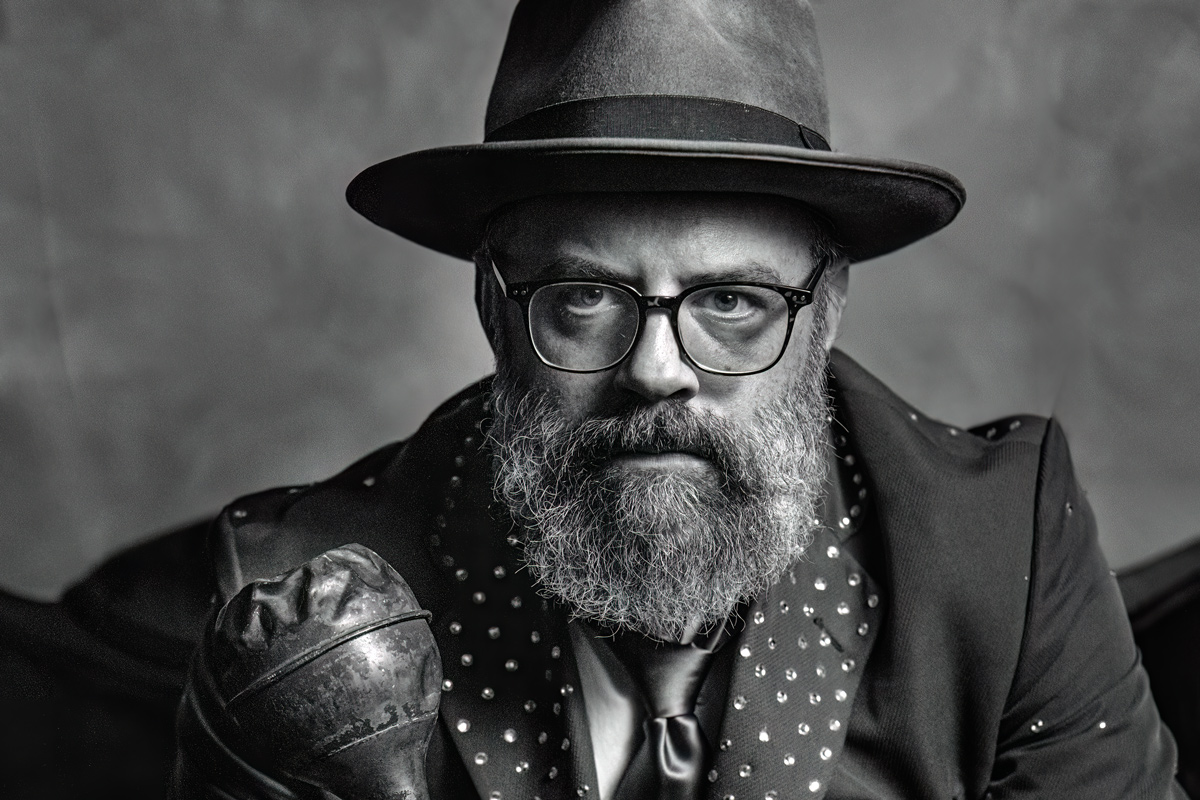
With his latest album out and plenty of deeper meaning and symbolism to unpack, not to mention a wealth of incredible songs, I sat down with Afton Wolfe for a touch of sonic stargazing.
Hi Afton, always great to catch up with you. Let’s start by looking at the concept behind the new album, Ophiuchus, which is more involved than most. Can you explain its backstory and inspirations?
The concept is existential and a quiet cry to reevaluate things we “know.” We all know our Zodiac sign, but the term “Zodiac” means the path of the sun through the constellations. And most people’s “signs” don’t correlate with that anymore, because the dates were determined by the Babylonians almost 3,000 years ago. And the stars are moving through space in an ever-expanding galaxy, and constellations are just our perception from an infinitesimally small vantage that also happens to be wobbling constantly.
So, when I discovered that on my birthday, December 3, the sun was traveling through a constellation I’d never heard of, my interest was piqued. That discovery also coincided with the planning of my next project, and the concept was born there. Using the actual positions of the constellations, I planned to release each song as the sun traveled through the celestial sphere.
You clearly have an interest in astrology and astronomy. How much bearing do you feel such forces have on our everyday lives, or are these elements more symbolic?
Much like my fixation on the number 23 a couple of years ago (and as a scheduling device for my newsletter), astrology is, in a lot of ways, apophenia – a human psychological tendency to find meaningful patterns in random or meaningless data. It’s essentially how folks fall for wild conspiracies, cults, or pyramid schemes. I think it’s certainly more likely that immediate social forces have a stronger effect on us than the patterns in the sky made by lights billions of miles away and interpreted by strangers who have long since died.
In other words, whatever constellation the sun is in, if people have told you that you had the tendencies of a Scorpio or Libra or Sagittarius for your whole life, you’re more likely to associate with that than with anything determined by the stars. And the sun itself isn’t a part of any of these constellations, but it seems to be the most important star to everyone on this planet. But I am agnostic as to the real meaning of anything, and I think that meaning is something each individual gets to determine for themselves. Without confessing to any “belief” though, I think it is more likely than not that some underlying meaning and purpose do exist beyond us or within us or somewhere we don’t perceive easily. I think music is a priori evidence of that.
Ophiuchus is a collection of thirteen singles. How hard was it to maintain the standard that your music adheres to, and how many songs did you write and discard to ensure an album that met those high benchmarks?
I think of the art of songwriting as discovery – in that aforementioned “somewhere” we don’t easily perceive. I don’t really try to write songs, but when I find the beginnings of them, I finish them so I can record them and hear them again.
Since the last few recording projects I’ve worked on – “Titanic” on the David Olney tribute “Can’t Steal My Fire,” “Dead Flowers” with Jaimee Harris, and The Harvest – a collection of my father-in-law, LH Halliburton’s songs – did not include any songs that I’d found first, I actually had a healthy bank of songs to select from, and I tried to select them based on both their lyrical importance to me and their distinctness.
I wanted this to be a very personal collection, and personally, I like albums that have very distinct styles throughout, without any songs sounding too much alike.
And each piece comes with its own astrologically significant artwork. Can you tell me more about that?
After deciding on the concept of the release – starting with Sagittarius in December and ending with Ophiuchus, releasing a new song from the record as the sun traveled into each constellation, it was only logical that I would need imagery to accompany these releases. Luckily, I live in a city with an overflow of incredible artists. However, CoraLee (who also happens to be one of my favorite songwriters and singers I’ve ever heard) was my first choice and, in retrospect, the only option that would have been sufficient. She delivered all year, making these stunning illustrations.
I gave her very few notes or directions, other than collaborating on the typeface for the first graphic for “Invocation” and some stylistic adjustments to the overall album cover. Otherwise, I was inspired every time she would complete one. Like I say in the liner notes to the lyric booklet that accompanied preorders of this album, her art for this project “repeatedly waved a rush of wind onto a shrinking fire.”
You are pushing your core sounds of blues and rock, folk and country through some interesting styles, certainly with time signatures that take in waltzes, tangos, bossa nova, and the like. How did you end up in such places?
Leonard Cohen said “If I knew where good songs came from, I’d go there more often.” I feel that way. I don’t know how I arrive at songs. I just know that it’s important to pay attention when you do come across them. That’s what I try to work on, if anything – strengthening my attention. That’s harder and harder with the “attention economy” everybody keeps talking about, and you can see it and feel its pull when you can’t put the phone down but aren’t looking at anything on it. That’s zapping attention, and there are definitely no good songs there.
But there are good songs in the conversations of birds, the interactions of wind and leaves, the persistent wearing away of rocks by rivers, the orchestra tuning up, and crowded streets heard from a balcony a few floors up.
Heavenly influences aside, what are the fundamental, real-world themes that run through the album? What are you trying to say with Ophiuchus?
The overarching theme is that attention is important, and The Medicine Man can use that attention like a snake’s venom – to destroy like a toxin or to heal with medicinal qualities. The songs themselves deal with a range of things I think are important – war, love, loss, search for meaning, and forgiveness, which explicitly shows up in two song titles. But it’s hard to deny that the album is about me – who I think I am, who I think I could be, where I find meaning, why I doubt the importance of any of it. Why I ultimately carry on.
Will you be touring the album? If so, where are you taking it, and where are you looking forward to visiting?
I toured more in 2025 than I have in 20 years, while recording and releasing the album. To be quite honest, there are no immediate plans to take it on the road, but some things are shaping up for Spring, and there’s a possibility of something really exciting in the Summer that I am not at liberty to discuss now. But after all of this, and a busy December and January, I’m looking forward to resting and regrouping. This process has been exhausting, and I’m finding that rest is important too, coming to the end of this marathon release/magic spell process.
And, as always, what does the future look like for you, and indeed, what do you hope that it might look like?
Well, expectations are the only ingredient to disappointment, so I try not to get too many of those. I’m hoping to talk to more people about this music, and I thank you for this opportunity to do so. I have some live recordings that I’m looking at releasing next year, and I’ve had some discussions about another concept recording project and collaboration that I have to keep under wraps until more is done. But, a busy December of Nashville shows and a fun return to Todos Santos for the Tropic of Cancer Music and Arts Festival in January are about as far out as I’m looking right now. Trying to connect with what’s real, and if that’s anything, it’s the present moment.
Facebook
Website
Other links
Second Harvest Foodbank