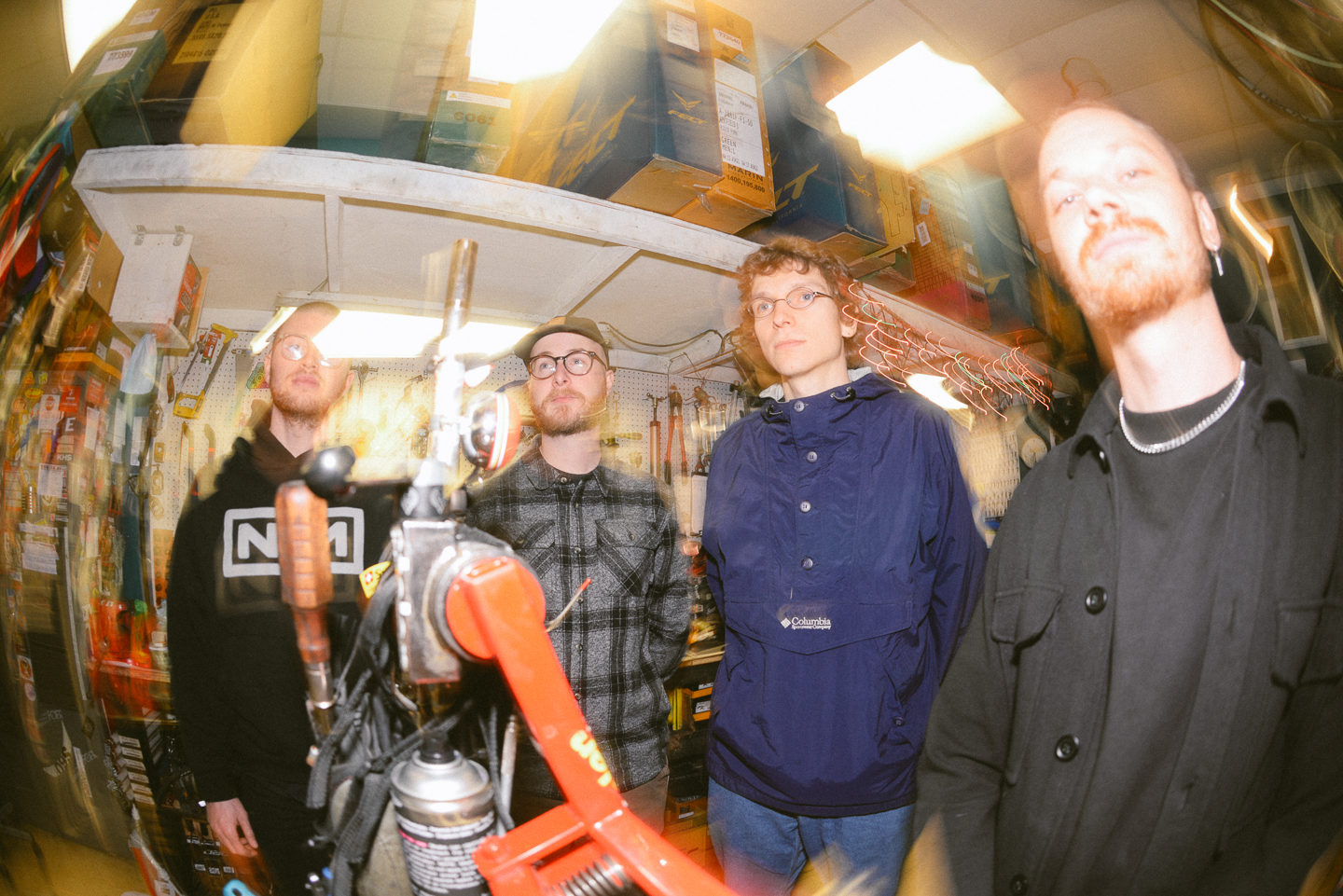
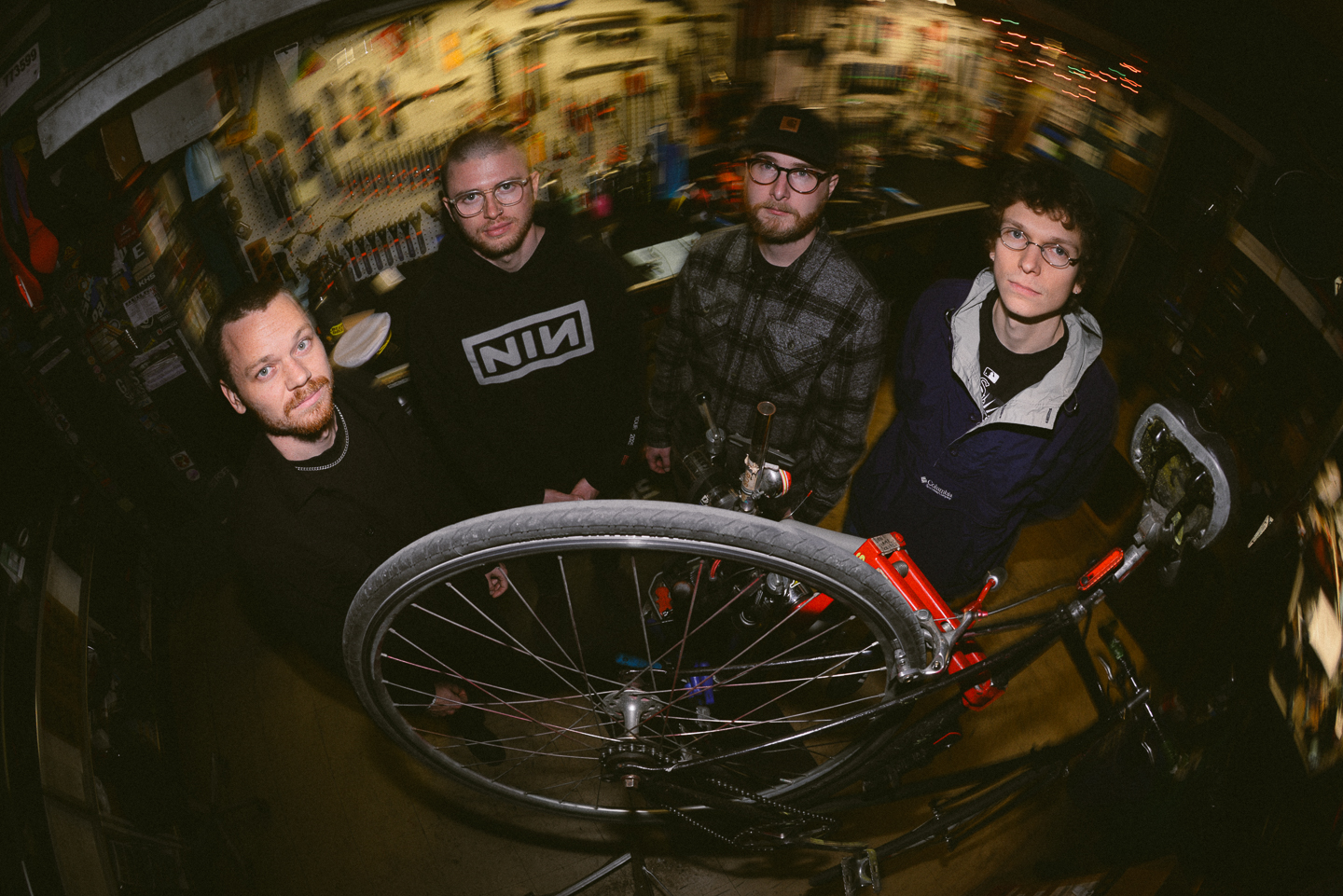
All Photos by Eric Tan
Born from the grey chill of a Chicago autumn in 2021, Griefeater began not as a band, but as an experiment in shared sonic language. What started as a digital exchange of influences between Erik Gleim, Ethan Rader, Maxxim Ludeke, and Lukas Skucas — the crushing weight of Hum, the spectral minimalism of Midwife, and the abrasive beauty of Nothing — quickly mutated into something far more visceral than the “shoegaze” label typically implies.
Over the last four years, the project has undergone a steady shedding of skin. While their early self-produced EPs (‘Will You Please Be Quiet, Please,’ 2022, ‘For Once, Then, Something,’ 2023 and ‘Bottom of the Well,’ 2024), paid homage to the 2010s emo and shoegaze revivals, they were ultimately surveying exercises: a search for the friction point where melodic vulnerability meets the jagged edges of screamo and black metal.
In 2024, the single ‘Bottom of the Well’ marked a definitive shift in scale. Collaborating with producer Seth Beck (Greet Death), the band transitioned into high-definition, trading bedroom aesthetics for a widescreen sonic architecture. It was a study in contradictions—dense, suffocating distortion balanced against an unsettling, airy spaciousness. Now, Griefeater delivers their self-released debut full-length, ‘Worn.’ Recorded again with Beck, the album is a document of a band operating in a state of deep, collective introspection. Eschewing the modern crutch of reference tracks during rehearsals, the group relied solely on instinct to craft a record that feels untethered from contemporary trends.
‘Worn’ is structured as a descent. The first half pulses with a restless, almost violent kinetic-ism with “Valentine” and “Half Past” stripping away the indulgence of “pedal-gazing” in favor of raw, propulsive energy while “Casket,” a death-obsessed dirge, features Erik Gleim’s tremolo-picked leads sear through the mix like a fever dream. The record’s second half explores the quietude that follows the storm. Here, Griefeater navigates the fragile territory of slowcore meditations (“The Trouble With Being Born”) and aching ballads (“Weekdays”), only to shatter the silence with sudden, blackened blast beats of “Walk The Streets.” The lead single, “Evelyn,” serves as the album’s most lucid mission statement. It features tension amongst the clean, crystalline guitars that spiral into a post-rock crescendo. Lukas Skucas’ vocals emerge from a distant void, eventually collapsing into a breakdown that mirrors the lyrical sense of impending doom. As the track reaches its zenith, the distortion looms like a tidal wave, finally crashing down in a spray of jagged debris and haunting, pain-stricken wails.
At its core, ‘Worn’ is a record about the quiet gravity of existing—about the weight of time, the deepening of communal bonds, and the exhausting, beautiful discipline of moving forward every day. The album functions as a singular, cohesive architecture of sound. It manages the rare feat of maintaining a consistent atmospheric language without ever lapsing into redundancy. While the band leans into the dense, textural legacies of pioneers like My Bloody Valentine, they do so with a surgical intentionality; that wall of sound never obscuring the emotional clarity of the songwriting. The record thrives in the delicate equilibrium between complex, layered distortion and the haunting simplicity of its melodies—a testament to a band no longer just exploring a genre, but defining their own territory within it.
Thanks to Harlee Young for the recommendation and to the band for their time.
James Broscheid: You set a strict rule to play no reference tracks during practice to rely on collective instinct. How did this affect the pedal-ogling culture of shoegaze? Did it make the songwriting process faster because you weren’t chasing a specific sound, or slower because you had to invent your own roadmap?
Erik Gleim: The rule was set because what initially was used as a tool–looking up music that inspired us–became a distraction and would lead to half hour sessions of just listening to music and hanging out. And while that’s our favorite thing to do as a band, we eventually realized how much rehearsal time we were spending not writing music. I don’t think we’re a super tone-driven band, although that may change with the next album, and I think the majority of the time spent writing the record this time was focused on song structure and the cohesion of all of the different parts we had written. That task was ultimately hindered by trying to mimic other people’s music and so we just decided to use our intuition and keep working.
Ethan Rader: I agree with pretty much everything that Erik said. We wasted a lot of time on our previous releases–especially ‘For Once, Then, Something’ –chasing specific tones and trying to sound like X band or Y guitarist. I still haven’t fully given up my search for the perfect guitar tone, but as a whole, we’ve absolutely put the tone quest on the back burner and focused more on song structure and part-writing. I think we all more or less dialed in our pedals and gear for this record about 3-6 months before hitting the studio, so it gave us plenty of time to slowly make adjustments before locking it in. This definitely helped us write faster and more organically, without constantly trying to compare how we stacked up against other bands we know and love.
JB: On “Half Past,” you utilize complex rhythmic subdivisions like 3+3+3+3+4. When writing these more progressive sections, are they calculated out on paper to ensure they hit with that whiplash effect, or are they born out of physical jamming and feeling where the extra beat needs to land?
EG: The clean buildup and subsequent breakdown at the end of “Half Past” follow the rhythmic structure of what you could call the “chorus” in the beginning of the song. I came up with it at home while initially writing the song and while I remember it being quite difficult for us to square up as a unit, during band practice everything was sort of worked out by feel. When we’re confused about rhythm we’ll write it out on the white board to help us cognize it, but for the most part we work through things that don’t feel good when we play them.
ER: Although we have sometimes written out our meters or more complex rhythmic groupings, we tend to go based on feel more so than math. This record has several instances of switching meter, polyrhythm and polymeter, and a whole slew of phrases with dropped beats or anacruses. Usually, these come about when we jam on our initial riffs and ideas. We love to play with the push and pull of the phrasing and are always trying to stretch ourselves by writing hooks that are catchy yet still challenging to play. I forget who said it, but your song is only a bop if it gets people to bop their heads!
JB: (Laughs) You moved from self-producing your early EPs to working with Seth Beck for ‘Worn.’ What was the most significant blind spot Seth helped you see in your own sound, particularly regarding the balance between screamo urgency and slowcore meditation?
ER: I can’t speak highly enough about working with Seth. We’ve always done our best to do everything ourselves, but having a fifth pair of ears (and experienced ears, at that!) was a total blessing. Being a shoegaze/shoegaze-adjacent band, it’s easy for us to get lost in the sauce. Seth helped us thin out some unnecessary guitar parts that were more mud and noise than they were “wall of sound,” but at the same time, he helped us find our sonic gaps and worked with us to fill them with acoustic guitars, keys, and tambourine. Without asking, Seth almost always knew the exact sound we wanted to go for and would have effects loaded up and ready for us to hit record.
JB: Especially on “Weekdays,” there is a mention of a unique, dissonant guitar line that feels unexpected for the genre. How do you decide when dissonance serves the emotional clarity of a song versus when it risks cluttering that dense wall of sound Griefeater is known for?
Lukas Skucas: As a band we are very intrigued by the use of dissonance. Some of our favorite bands like Horse Jumper of Love are really good at incorporating dissonance into melodic sections of their songs. We try to think about building tension and releasing it at the high points of the song. “Weekdays” is an example where dissonance interplays with the lyrics. It’s a song about giving up a part of yourself you no longer want to be associated with. Whenever you try to change something in your life, like quitting drinking, it creates a tension inside. How will I have fun? Can I still hang out with my friends at my favorite bar and watch the Bulls game? All this change causes tension, tension we try to portray musically by playing with dissonance between the guitars and the vocal melody. My favorite example is in the second verse of “Quietest Friend” by Pedro the Lion on their album ‘Phoenix,’ (Polyvinyl Records, 2019). You can feel the tension build as David Bazan works through his childhood. The payoff at the end of the song is much more gratifying because of this. For us, the dissonance helps lead us into the wall of sound. Hopefully people feel the release when they listen to it.
JB: Indeed. I can relate to this record having been born and raised in the Cleveland area and spending mile after mile traveling to Chicago, Detroit, Toronto and beyond for shows. Your lyrics reference long drives from Detroit to Illinois and biking through Chicago. How much does the specific Midwestern fatigue of 2025 influence the ‘Worn’ theme? Is the album’s heaviness a reflection of the landscape, or an escape from it?
LS: The intent of this record was to make it sound regional and specific. I am glad to hear that this came through on the lyrics and the tones on the album. In a time when every song ever written is available to stream, I feel as though we risk losing regionality. I wanted someone listening to this record who has never been to Chicago to be able to picture walking to the liquor store, walking in the park, hearing the train going past. I find moments like this to be so beautiful and immersive when I listen to records. The aim was not only to reflect the city and the midwest in the music and lyrics, but to build a world within the city as we experience it as a group.
Maxxim Ludeke: We also wanted to make the artwork feel very location specific to Chicago. The ‘Worn’ album art is a photograph that Lukas took from under the California Blue Line in the middle of Winter. This oddly familiar yet liminal space is something that I think a lot of Chicagoans experience consciously or unconsciously everyday and the artwork attempts to create a similar space.
JB: The title suggests a state of being at your limit. Musicians usually strive for clean or perfect takes, but this album embraces rough surfaces and cracks in the sound. How do you decide, from a production standpoint, when a take is “perfectly imperfect” versus just needing another go?
LS: When we record we really try to capture everything as quickly as possible. As soon as we get a take we are all happy with, we move on to the next part/song. A change in the recording process for ‘Worn’ was that since we were in a studio rather than a house (we recorded all our EPs at Ethan’s Grandparents’ summer home in Michigan), we played the entire record live and then went back and dubbed over guitars and bass. This gave the album a more organic and live sound because where we were used to recording each part individually and building songs from the bottom, we were able to play together and then go back and polish things we thought sounded off. The one exception was “Deebo” where we just kept the live take we did at the beginning of the session.
ER: I’d say that we also don’t really consider ourselves to be the type of band that wants to sound perfect and polished. A lot of our favorite records are pretty lo-fi and quickly recorded. When we get towards the end of the writing process and into the recording of any record, we practice all of the tracks pretty hard. There are moments when we start to question our choices and consider if we should go through another round of rewrites. We have to remind ourselves that the rewriting cycle is vicious and that it’s totally possible to write and rewrite in perpetuity without ever finishing and releasing music. When we start to doubt ourselves like this, we’ve started to throw around the phrase “moment in time.” We use this phrase to remind ourselves to be proud of what we’ve accomplished and the music we’ve written; that we should keep going with what we have and should look back at it fondly like a time capsule.
JB: Shoegaze is often known for burying vocals and using abstract lyrics, yet the single “Evelyn” features incredibly blunt, literal lines about quitting the band or being hit by a truck. Why was it important to pair such uncomfortably honest lyrics with a lo-fi, hazy wall of sound?
LS: I grew up with the emo revival of the 2010s so literal confessional lyrics are what shaped and inspired me when I first started writing songs. I find it easier to connect with artists who use hyperlocal imagery and do not hide the meaning of their songs. I think this works in our favor because as you said, shoegaze is known for being more abstract lyrically, we write lyrics that are quite literal and bury them in a wall of sound. This gives the listener an option to zone out and take the record in as a textural piece or lock in and listen to the lyrics and take in the stories. I am really not partial to how people choose to listen to our band and I love that we were able to straddle both elements in our songs.
JB: Lukas, you mentioned the record is about “feeling older and loving your friends more.” In an album that features blackened blast beats and “death-obsessed” tracks like ‘Casket,’ how does the aggressive music help express the tenderness of friendship and the mundane effort of trying to do something every day?
LS: As I get older I realize that the hardest thing to do in life is to take action. It’s so easy to daydream of how life could be, how the band could sound, of the things we could accomplish, but taking action is so hard. I try to stay stray steady and lowkey in the way I deal with things in my life. While it may feel like the world around us is in a catastrophic state, our day to day stays pretty much the same. We go to work, go to band practice, and try to spend time with loved ones. For me, it’s important that the lyrics portray everyday life as the mundane tasks that it is composed of while letting myself feel things deeply and pushing myself to do more.
JB: As you mentioned earlier, the band’s early work leaned into 2010s emo and shoegaze revival hallmarks. With ‘Worn,’ you’ve integrated elements of black metal, djent, and country with slide guitar. Do you feel the “shoegaze” label is becoming too small for Griefeater, or is the definition of shoegaze simply expanding to include these heavier offshoots?
LS: When we started this band we really wanted it to be a shoegaze project. We are super inspired by bands like Nothing, Whirr, and Cloakroom, and while we all like these bands, the songs that came out as we wrote did not really sound like any of those bands. Now, in 2025/2026, shoegaze feels like how emo felt in 2018. The revival started hearkening back to late 90’s stuff but as more and more sounds got integrated it became its own thing. I am not even sure if we qualify as a shoegaze band to be honest. So to answer your question, I think it’s a little of both. While we are actively inspired by shoegaze bands, I am not sure that the result qualifies as classic shoegaze like MBV or more modern shoegaze trends like those set by TAGABOW (They Are Gutting a Body of Water) or Nothing.
ER: I second everything Lukas said. While we all found a common genre in our love for shoegaze, I’m not sure we ever really found that sound for ourselves. We’ve always been rather genre-agnostic and I’m grateful that we can’t be entirely lumped in with any one genre. That being said, it seems like anything with a little fuzz and reverb is called shoegaze these days, so who am I to say we aren’t?
JB: So true! ‘Torn’ is something that must be absorbed as a whole. In a singles-driven “TikTok age,” why was it important for you to create a record with recurring sonic motifs and field recordings that reward the long-form listener?
LS: We have tried releasing singles and catering to the algorithm in the past and it has not worked for us as a band. At the end of the day I am just not good at getting engagement on TikTok, Twitter, and Instagram. I wish I was better at it. I tried a little bit but not only did the algorithm not really pick us up, it also left me feeling like I had lost control of the art in order to chase streams. I tried to be intentional about the way I wanted to roll this album out, with less of a focus on Spotify and streaming and more of a focus on physical media and more intentional listening. It has left me feeling much more fulfilled and happy with the way people have listened to it. We did a little run of tapes that we sold out of and I made a cut and paste lyric zine that people seem to be enjoying. I just think that physical media and intentional listening are the way to go, even if everything is telling you to post “tik toks” and farm streams on Spotify. I just feel way less burnt out and more fulfilled knowing we may not reach as many people but do it in a way that feels good and doesn’t rot my brain.
ER: God, I hate the social media aspect of making music. It completely strips the fun out of the creative process and forces everyone to shill their music in the hopes that some algorithm deems it worth sharing with a few more people. While working on ‘Worn,’ we decided not to waste our time with huge social media campaigns or an onslaught of singles. Instead, we carefully crafted our record to work as a whole, as one, singular idea. As Lukas said, we made a much larger effort to create physical copies and to get the entire record in front of people. At the end of the day, we know that some of our favorite bands we found through word of mouth, so we mailed physical copies to college radio stations and reviewers. We figured it would be more worth it to get our complete concept in front of people who were more likely to consume (and hopefully enjoy it) as a whole, rather than to chase some fleeting numbers in a digital landscape.
JB: I wanted to ask about your home town again as I love when bands are immersed in their locales. Does the physical environment of Chicago—the industrial grit, the L-train noise, the winters—directly dictate the frequency and texture of your guitar tones, or is that atmosphere something you only recognize after the songs are finished?
LS: I live in the Logan Square neighborhood of Chicago; my apartment is 3 doors down from the Blue Line. I live with the noise of the L-train every 10 minutes or so. When I was writing for this album all my demos included sporadic train noise. I think this naturally bled into the finished product. At times, we got used to hearing the songs with the train coming in and out of the recording so they felt empty and naked without it. This inspired us to add density or a layer to fill that gap. There is something so dreamy and surreal about walking in the alley behind my house (where the cover art was taken) during a snowfall. The snow muffles everything and it all seems so quiet until a train comes roaring by. I think this was definitely an influence in the way we use dynamics in our music.
JB: My wife thinks I’m crazy but I miss those slow, steady snowfalls and absolute stillness of the air. With Chicago having a history of darker, more dense alternative music, do you see Griefeater as part of a specific local lineage (like the early 90s noise-rock or the later emo-revival scenes), or do you feel you are actively trying to dismantle those traditions to build something new?
LS: We have all lived in Chicago for the better part of 10 years now, moving here for college or immediately after. I have been fortunate enough to have been a part of the music community here for the majority of that time. In a way I see our band as part of a post pandemic lineage here. Bands like Mensa, Hell of a Life, and Close Kept are some bands that we feel inspired by here. I think most of what we do in this band is try to pay homage to the bands we love and play with. I am personally not too focused on pushing any boundaries (laughs), my bandmates may disagree.
ER: I agree with Lukas that there is a pretty clear delineation between pre and post-pandemic bands. The landscape for music is far more challenging in this post-pandemic world, but I think the bonds formed between us are even stronger. I’m not sure we’ve found any bands that sound quite like us, or at least not in a way that I could say we’re defining some specific sound or subgenre, but we have found several bands that we love seeing and playing with. At the end of the day, I think what defines our scene is just a bunch of hardworking people that show up and support each other through their creative journey.
JB: The bass on this record is described as rumbling “from deep underground” and the drums as “collapsing beams.” With guitars usually taking center stage, how much intentionality went into making the rhythm section feel like the physical source of the album’s “exhaustion”?
ML: I believe that the rhythm section should act as the backbone of the music’s intention and emotion. I wanted the drum parts on this record to feel like an extension of the vocals and melodies being played. Because drums are so physical in nature, you can create a lot of raw emotion just from rhythm. Lukas and I would workshop lining up the bass parts after the drums were somewhat polished and this really put that final glue we needed to bring everything together. In terms of physical “exhaustion”, a great example of this is on the track “Walk The Streets.” The opening drum section is a pure blast beat and I am playing at my absolute max the entire time with a pretty intricate drum fill to get us out into the 4/4 section. The blast beat comes back at the very end after playing some physically demanding punk style drums and at that point I am totally physically exhausted. Everytime. Playing the song gives me anxiety because I know how tolling the song is. The hope is that this feeling is evoked even while listening to the track.
JB: Echoing that, you manage to make the sound feel “pushed to its limit” and “blown-out” without falling into total chaos. What is the secret to maintaining a melodic core when you are dealing with such immense walls of fuzz? Is there a “less is more” philosophy buried under all that noise?
ER: This is something that Seth Beck helped us with! A lot of louder, fuzzy bands tend to struggle with the wall of sound. It’s super easy to double and triple track all of the guitar parts and end up with this super dense mid-range that swallows up the whole mix. We worked hard to only double up on parts that we wanted to be thick like this. Otherwise, we were intentional to revoice guitar parts, arpeggiate others, or even strip down to a single guitar or bass to allow the tracks some room to breathe, even if that instrument was still heartily distorted.
JB: The vocals are often described as “ghostlike” and “strained,” as if they are dissolving into the music. Is this a stylistic choice to mirror the numbness described in the lyrics, or is it a way to force the listener to lean in closer to hear the “voice trying to rise above the noise”?
LS: Those are very nice descriptions! I have a pretty quiet voice that doesn’t break a whole lot. I have always wanted to sound like Ned Russin from Title Fight or our friend Chuck (Wynne) from Close Kept, but my voice just doesn’t sound like that. I have been in bands where I have tried to strain and sing with more force but I have never really enjoyed the results. The main reason for singing like I sing in this band is to get an end product that I enjoy listening to. Andy Shauf was a big inspiration for me. His vocals are so soft and intimate but they convey so much emotion. Luckily, this kind of vocal style is the norm in this genre so I like having that dynamic between the gritty instrumentation and soft vocals.
JB: The idea that fatigue isn’t “defeat” but a “liminal state where truth floats to the surface” is a powerful takeaway from the record. Was the writing of ‘Worn’ a tiring process or did the act of making the music provide a catharsis for the band?
ER: I love this question, and I’m hoping I can do it justice. I think there’s truth in both statements here. Making ‘Worn’ was exhausting. We had countless late nights, tough practices, and writing sessions where I wasn’t sure if we were going to break up the band or find our resolve and write the best song ever. With some minor breaks here and there, this is kind of how it went on for about a year and a half. But without fail, we always seemed to pull ourselves together and get to the point where the music became enjoyable again. For all of the nights where it seemed like we’d never finish writing, I remember twice as many nights where there was no greater feeling than sinking into a particularly difficult or heavy riff and feeling like the four of us were of one mind. It’s been a long and tough couple of years since we released FOTS, but I think we found our resolve through the struggle and fatigue. If it weren’t a challenge to make music that pushed all of us, I’m not sure we would find it nearly as enjoyable or rewarding to complete it.
JB: As mentioned earlier, ‘Worn’ is described as an album best absorbed and let press against your chest. When you perform these songs live, do you aim for a communal “release” of energy, or do you prefer the audience to stay in that introspective, heavy space with you?
ER: ‘Worn’ ebbs and flows, both in dynamics as well as urgency. I think some of the tracks command attention more than others. Tracks like “Evelyn” and “Walk the Streets” are both extremely in your face and resolve with cathartic final moments that I’m hoping the audience can feel as deeply as we can. Other tracks, like “Casket” and “Blurry Eyes”, have more trance-like moments that I would expect to be more introspective. I know I often get lost in my own thoughts while plucking away at some of our mixed meter parts, I’d imagine I’m not the only one. I think even leaving these brooding, contemplative moments tend to offer a form of release for the audience, as well as for ourselves.
LS: Yeah, the sequence of the record is meant to build and release as it goes. Ideally, playing these songs live would have a combination of both moments of introspection and energetic release. Most of the time we play the audience stays quiet and introspective. Though we are a heavy band our shows are not very rowdy.
Learn more here: Bandcamp | Instagram | Soundcloud | X