
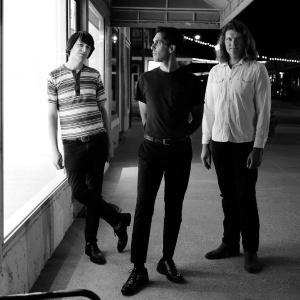
Photo by Annie Gunn
I recently sat down with Ramesh Srivastava (vocals, guitar, keys) before the first show of the Voxtrot 2026 tour which kicked off in Phoenix. We discussed the superb new record, “Dreamers in Exile”, reviewed here, as well as the tour, while also reflecting on Voxtrot’s career that has run from 2003-10 and again from 2022 to the present. As you’ll read, Ramesh is rejuvenated and eager to record and tour Voxtrot 2.0. Fans should expect much more from the band in the future. I highly recommend seeing them live.
On this tour, Ramesh is joined by founding bandmates Jason Chronis (bass) and Matt Simon (drums). Other original band members, Mitch Calvert (guitar) and Jared Van Fleet (keys), couldn’t make it on the tour this time round, but two very capable guests; guitarist Paul Price (Good Field, Brazos, The Early Tapes) and keyboardist Jack Van Norman have subbed in seamlessly.
David: I thought you guys were going to be a three piece for this tour.
Ramesh: It’s a reasonable assumption, because of the photos [ahead of the tour that only show Ramesh, Matt, and Jason]. As you probably know originally we were five and all five of us play on most of [“Dreamers in Exile”) actually. But over the course of the three years since the reunion [Mitch’s and Jared’s] involvement is now…it’s not to say that they won’t ever play with us again, but they’re not on this tour. Logistically, Mitch is in Wisconsin and Jared is in New York. So Matt, Jason, and I are kind of the core and then [Paul and Jack on this tour] have been playing with us actually for the last year plus. Paul, the guitar player, has played with Voxtrot many times over our whole career. Like he’s played with us at Primavera Sound, and a lot of international stuff actually going back 18 years. He’s a long-time friend of ours.
David: And you’re based in Lockhart, TX (near Austin) with Matt and Jason?
Ramesh: Yeah, everything is centered in Texas. Matt, Jason, and I. And actually [Jack, the keyboard player tonight] is here also.
David: Did that play a role in making the new album at all? I mean just having the three of you there. With the new album, when it was finally released there were several singles that were released over a period of years, and people might wonder why that is.
Ramesh: [Laughs] We definitely thought about that.
David: Right, but logistically it may have been difficult to just sit down with all five of you and make a 12-song album, for example.
Ramesh: Well, we released the singles kind of just to do it, but also with the intention of there being an album, but it being kind of the old school model of releasing singles to see if it, you know, leads to a record contract. You have to put something out there and see what catalyzes in the market and in the world. So, we had not intended to release so many singles, and after four we were like “Okay, let’s not release anything else.” But actually, I will say that all those singles are remixed by the same person that mixed “Dreamers” and to me they feel different, but I understand to some listeners maybe they’re not so different.
David: No, my reaction and I wrote this in the review is that I felt like the album as a whole is very cohesive. It sounds like it was all done at once. Which I imagine is a tough thing to pull off.
Ramesh: Yeah, I feel that. I appreciate that. It feels right to me. I had a lot of anxiety about the about these songs that had already been released being on the record because it’s the first record in 19 years, so you want it to be as much stuff as possible for people to sink their teeth into. But then actually once it was all mixed and I heard those four songs integrated with the other seven I was like, “It’s right”.
David: I was curious with the new record about the arrangements. They’re pretty sophisticated, and I always wonder from the songwriting perspective what’s in the artist’s head when first beginning to write/demo versus what ends up on the record when you’ve got strings or horns on “My Peace” or even a country sort of arrangement. Is that already in your head as you’re crafting these songs?
Ramesh: Some of it’s there. Well actually the demos, all of those I’m hoping to release on cassette because I saved all of them and a lot of them are pretty built out. The sophistication of the arrangements mostly comes through the work with my bandmates. Once the demo is brought to them. You’ll hear certain string or horn parts that do end up making it onto the final record. For the most part that is the magic of the chemistry of this band.
David: I imagine also there was a lot of pressure in making this record after 19 years. Maybe it was actually just the opposite? How was the recording process for you guys this round versus that first record during a very fast-paced period for the band.
Ramesh: Well yeah, [the self-titled first album] was made in a very scheduled, intentional way. This one was actually very intentional, but we didn’t have the financial backing of a record label. So, the intention was there and we’d had the money we would have said, “Okay, let’s do all of this in this three-to-six-month block and that’ll be our full time job.” But we didn’t have that luxury. [The recording for this album] extended across two plus years.
David: I’ve read that you’re very prolific in your songwriting. Like you have a bunch of songs going at once that are like 75% done. That’s seems quite unorthodox. It sounds like that’s your style. Is that the band’s style in general or are you more the leader in that role?
Ramesh: It’s certainly my style as a songwriter now, and I would say actually, yeah, for the band now it is, especially for Matt, Jason, and I. We were always working towards a record and working towards this phase two of Voxtrot so that energy was there. Once it got to the point where Mitch and Jared weren’t really coming to Austin anymore and we were determined to finish this thing it [required] a very disciplined approach. And now everything about [the band] is a workman approach. Not just the making of the music or the rehearsal but everything.
David: Even the videos I’d say are very thoughtful.
Ramesh: Oh yeah, we’ve been very lucky. We’ve just worked with people who were enthusiastic about making them so in a lot of cases we haven’t really had to do that much. I’m always part of the ideas, processes, and planning but really of few of these video makers have really taken the lead on them. Even in setting up the record label and planning the tour, every logistical part, we are totally locked in. We are in constant professional mode.
David: And there’s some division of labor so it’s not too burdening?
Ramesh: Yeah, actually Matt takes on a lot at this point, along with our manager, James. Through most of the reunion period I got to the point where [it was too much for me] to be in charge of the creative vision and totally on top of a lot of other stuff too. [Now,] I do all the press all the social media. That’s just really in my wheelhouse. But spreadsheets with distribution numbers, that is not as much.
David: I was wondering about with the tour like if it’s really down to the penny where you have to really make some hard decisions.
Ramesh: We’ve got a great [team]. We have us, our manager James, and two guys in [the club], Ryan and George. They’re incredible. They’ve done so much legwork leading up to now. And they’re the same people we [have been with]. Ryan’s a best friend from high school and he’s been Voxtrot’s tour manager since always. George is our friend for like 20 years. So, we’re just like all-in-one same family all the time.
David: I love it. Do you sense that that’s pretty unusual these days from other bands you talked to?
Ramesh: Well, I think that with bands throughout history that stay together and have multi-decade careers, it’s actually usually that it’s people from the very beginning that are their manager. Like U2.
David: I was just thinking of U2, yeah, exactly. Speaking of U2 or old bands like that, a random question I ask a lot of people is do you remember the first record you ever bought with your own money?
Ramesh: With my own money? I don’t know. I remember the first CD that I asked for and got from my parents was probably Vanilla Ice. 1991 or something. It would have been that year, so it would have been that or maybe Pearl Jam.
David: I get the sense these days, judging from your Spotify playlists that you listen to all kinds of music for inspiration.
Ramesh: Yeah, I’m obsessed with satellite radio when I’m in the car. When I’m at home I can pursue all kinds of underground music and the car I’m just like scanning everywhere. The most mainstream. All the new hits. Yeah, I listen to everything.
David: I wanted to ask you obviously about the tour, and maybe a dumb question, but are you nervous? Are you excited?
Ramesh: I’m excited. With a reunion tour it’s different because there’s so much built-in excitement. So, it’s easier. Because we knew going into it how much excitement there was behind it. We knew to an extent what to expect. I mean I will say my expectations were exceeded by the broadness of the age demographics and by just the enthusiasm of the crowd, so that was great.
But with releasing an album of new material and touring on it is different. I’ve always known that this would be a challenge or a gauntlet that we would have to pass through to truly get into the real second phase of [our] career. I’m grateful to say that actually there has been much excitement behind this album, too. Of course this tour is not the same fervor as the reunion tour and the venues are smaller. All of that makes sense, you know, but that to me is the long game. I think if you’re really going to have a lifetime career in music you have to be strong enough to have the space for allowing. To keep doing it even when it’s not always giving you that extreme dopamine hit. And I’m not saying the concerts won’t be fun. I’m just saying it’s different. You’ve got to allow time and space for the audience and your listeners to catch up with or accept the new you, the new phase.
David: I have to say speaking honestly that with the new album I like the music better than the original EP’s.
Ramesh: Oh wow, that’s awesome. Thanks.
David: Because I think first of all your voice is a lot more soulful and I think even on your solo records you could hear it when I listen back, whereas those first EPs you just sound like a young sort of indie kid. [Ramesh agrees]. And then just the diversity of arrangements, And the music is very uplifting. A lot of those choruses – you can’t get them out of your head.
Ramesh: That’s awesome. Thank you.
David: I’ll be curious to hear what your fans say. I’m more excited about you guys now and when I hear that you’re as prolific as you are, song-wise, I’m thinking there’s gonna be more music to come. And maybe some summer festivals. You’re going to be touring the UK and Europe and I saw you guys already sold out one of the London shows, too.
Ramesh: That was cool. That was kind of unexpected just because back [in the first phase of the band, London] was actually not one of our strongest markets. I wanted it to be so it’s a nice thing to see it all these years later that it’s sold out in less than two days, I think.
David: Amazing. Where are you popular in Europe and the UK?
Ramesh: Well, we can see from streaming numbers London is one of our biggest listening markets.
David: That’s awesome. Do you think is there some DJ or someone that is driving it?
Ramesh: I think it’s just over time. It’s my observation is just that time has its own plans. That’s why it’s important to not get attached to a certain phase of your career. You gotta go back to the theme of playing the long game.
David: I just think that the new music is much more interesting to me now that some of the earlier records and I really hope fans agree, though I get the sense that many are just waiting for you to play “The Start of Something.” I mean c’mon!
Ramesh: [Laughs]. Yeah some people might be. But even though that song is mathematically proportionally more popular than all of our other songs when you look at streaming numbers, I will say that I have never felt like Voxtrot, even back in early years, was a band that people were only there to see one song. I’ve always felt that we were fortunate in that people had emotional relationships with many of our songs.
David: I don’t want to take up too much more of your time. Is there anything else that you want to tell people about the tour or the album right now.
Ramesh: Gosh I guess that there’s much more to come, basically. I’ve demoed almost the whole next Voxtrot album, and I have another solo album that’s almost done. We’re just really in it again and I think there will be a lot more to come in these next 5-10 years. It’s almost hard for me to relax into this moment, because I’m so excited about what can come down the road. This is the first show, so I’m sure once we start actually playing the shows I’ll be “here.” We’re grateful that people stuck with us all these years.
LinksBuy the “Dreamers in Exile” LP