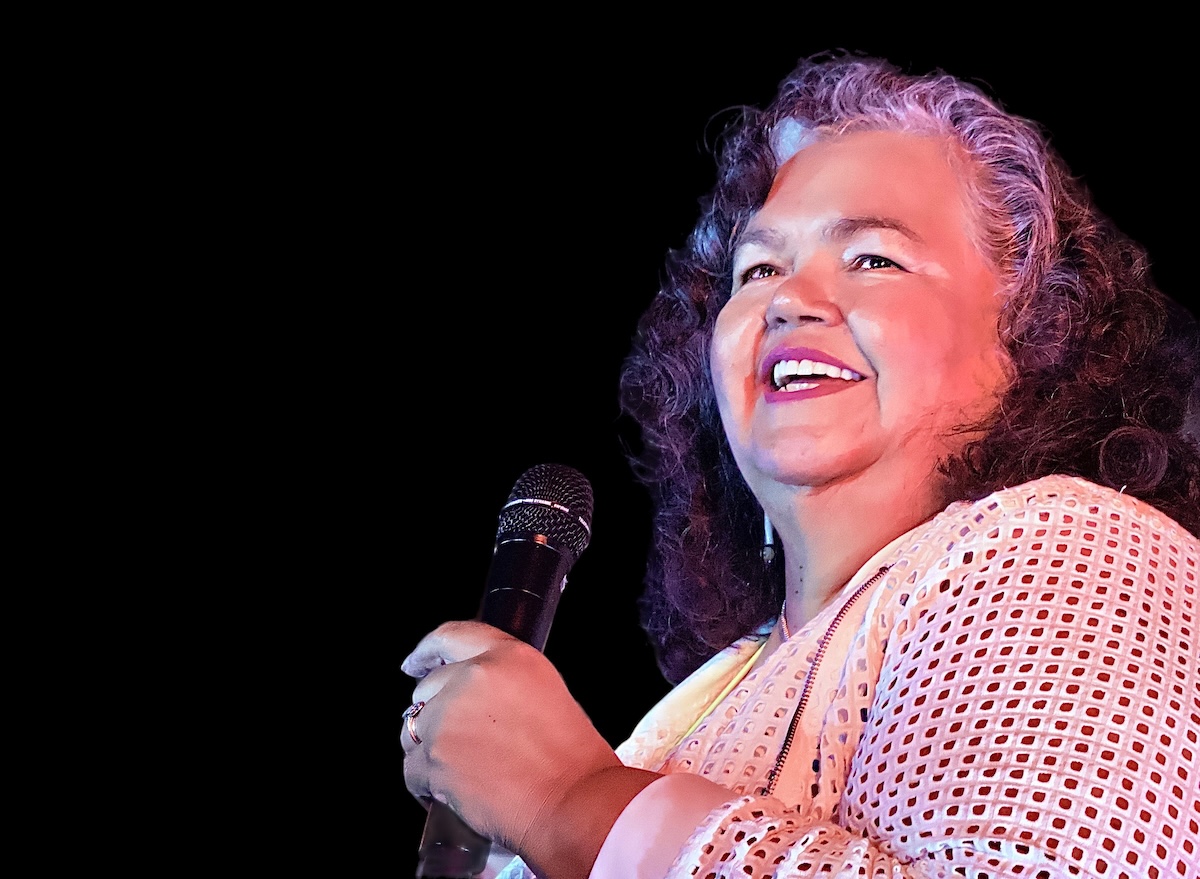
Photo by Tony Smith
When Romeo Void formed in San Francisco in 1979, the band members immediately created something utterly unique. Building on the jagged guitar-based edginess of post-punk and the melodicism of New Wave, they added in skittishly danceable rhythms, along with soulful saxophone parts. Frontwoman Debora Iyall easily shifted between passionate and angelic vocal stylings, all while delivering lyrics that were pointed yet poetic. During their five years together, they released three remarkable studio albums: It’s a Condition (1981), Benefactor (1982), and Instincts (1984), as well as one EP, Never Say Never (1981), and earned international fame with the hit singles “Never Say Never” and “A Girl in Trouble (Is a Temporary Thing).”
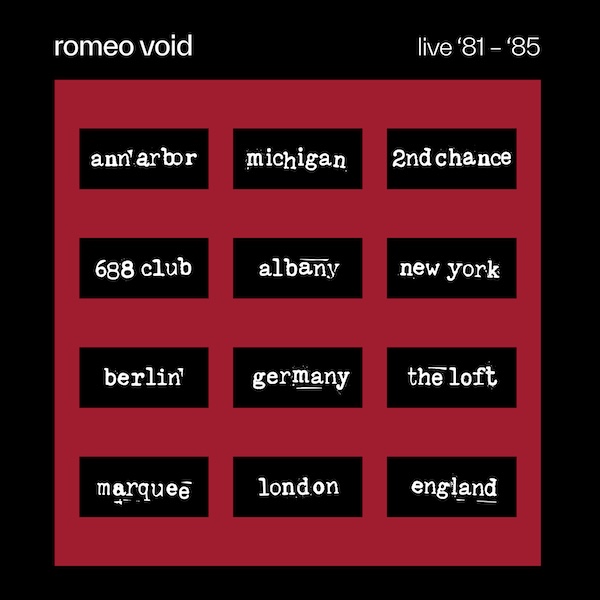
Four decades later, the band’s innovative songs still sound as fresh as ever – as they prove with Live ’81-’85, a double album of previously unreleased live recordings that’s set for release on April 18 (via the Liberation Hall label) as part of Record Store Day. Documenting mesmerizing performances from the band’s tour stops around the world, this release perfectly captures the band’s intensity. During a phone call from her home in New Mexico, Debora Iyall tells The Big Takeover why the time was right to revisit Romeo Void, as well as reminiscing about the band’s early days, and what their legacy means to her today.
What made you decide to gather these live tracks and put them out now?
DEBORA IYALL: Actually, my husband is an audio engineer, and during lockdown he got out the box of cassettes that [Romeo Void drummer] Larry Carter had sent to him, and they were great recordings by our live sound engineer. We just thought, “The world should hear this stuff; this is great.” And I also do have to say that having band members pass is very motivating because Benjamin Bossi, the sax player, passed just a few years ago, and so did Larry. They passed within six months of each other. That was kind of like, “Wow, if we’re ever going to do this, we have to do it because we’re still around, and the role of the survivor is to champion those who contributed to your success, even after they’re gone.” I really do feel the world owes Benjamin another listen, as far as how he took the state of the art of saxophone and rock and roll and pop music.
How did you ever decide on which tracks to use?.
DEBORA IYALL: We went through them and decided on, “What are the best shows? What are the best performances of the best shows?” There wasn’t a whole lot of debate over which were really the best shows, because when you’re on, you’re on. Unless there’s a technical issue – and sometimes the technical issue was, the cassette ran out in the middle of a song, because it was all recorded on cassette.
As you were going through these tapes, did it bring back memories of playing these particular shows?
DEBORA IYALL: Yes, in some ways, it sure did. But also, just that physical memory of standing together onstage and looking at each other and hitting that sweet spot of, “We’re all being really unabashed and we’re focused.” Taking a risk is really part of performance, but so is remembering what verse you’re on, and making the change when everybody else does. So it’s a combination of having some technique, and then also giving yourself the freedom and the joy when you’re onstage. Because if you’re not having fun when you’re onstage, why are you on tour? The traveling is so rigorous that you have to love that time onstage.
It seems like you have some songs that people would expect you to play at every show. How did you avoid burning out on playing those songs so many times through the years?
DEBORA IYALL: Because I wrote the lyrics, I knew what was behind them, and I kind of put myself there. But also, I was trying to be honest in the moment, so that if I’m feeling a little extra sad that day, [I thought], “Go ahead and let that creep into how I interpret this song differently tonight.” Or if I’m feeling more anger, I’ll hear that bite come out. So you’re putting your impressions of the day onto material that hopefully, because we wrote it, has a universality to us as a unit. It’s our common language.
What do you think it is about your work that has made it resonate with listeners like it has?
DEBORA IYALL: I think it’s because of our intention. We wanted to make art. We weren’t trying to be rock stars – in fact, that would be something we would eschew as any kind of goal of ours. We wanted to make art; we wanted to be honest. And also, the audience told us, “Be more honest. Take bigger risks. Go further out.” And it’s fun to do that.
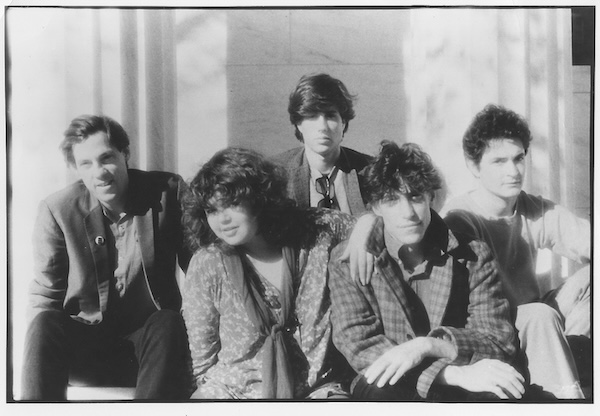
Photo by Stefano Paolillo
_How did you know that you should be a musician in the first place?
DEBORA IYALL: I fell into it. I was at the San Francisco Art Institute. I was taking video performance classes. I was painting. I met Frank [Zincavage], the bass player. He was working in the gallery, and I was working as an assistant at the studio. I was like, “Do you do anything that’s performance?” He goes, “Yeah, I play bass. I have a drum machine.” I’m like, “Well, let’s go down to the studio and make something happen!” We just started spending time together. “Let’s make some songs.” And that’s kind of how it started.
Do you remember the first song you wrote as a band where you realized yes, you really could do this?
DEBORA IYALL: I think we kind of felt that way from the start. I remember we wrote this song called “Admit It,” and it was based on a country sound, but the lyrics were, “Admit it, you like it. Admit it, it’s all right.” So we thought that was clever and fun. The poetics of it were fun for me because I always loved language, and I pretty much got the urge to really want to be onstage more after I’d seen Patti Smith and I thought, “This doesn’t have to be about being the most glamorous woman, or the biggest sexual prize. This can be just, ‘I’m going to tell you what my life is like, and how I see things, and I’ve got something to say.’” So she was very inspirational for me.
I always thought you must have had singing lessons because your voice is so powerful.
DEBORA IYALL: I took singing lessons after we had been on tour for a while. Probably it wasn’t until a year and a half into Romeo Void that I thought, “Oh man, maybe I’d better take some singing lessons to figure out the breathing, and also how not to get hoarse.” I remember one of the first times I was really sick on tour. I had this terrible sore throat, and sneezing. But we were all the way in Salem, Massachusetts, and I think it might have been a sold out show. We weren’t going to get back there – if we didn’t do the show that night, that would be it for Salem, and we didn’t want to do that. So I stayed in the hotel room until it was time for the show. I didn’t even go to soundtrack. And then I had a great night. I came off the stage sweatier than I’ve ever been in my life, because I probably already had a fever. But I remember after that thinking, “You know, I might want to go see a vocal coach and take better care of my voice.” Because I certainly couldn’t have done it two nights in a row. Luckily, I think we were travelling into Canada, so we had a night or two off before the next show.
As the lyricist, have there been any particular themes you find yourself going back to again and again?
DEBORA IYALL: Yeah, like how love doesn’t work out, and how it can be frustration and yet so compelling. I was a pretty sexual gal, and so I always wanted to have things work out in that realm, and yet they wouldn’t always go my way. And I was also a very independent woman. I guess I took that energy and turned it into finding a way that seduced through strength rather than vulnerability. Although, there’s plenty of songs were vulnerable, too. I was just discovering what I could do, and the more I explored, the more I liked what I was doing. [After Romeo Void], I was an art teacher for a number of years, and I’d always tell my students, “Don’t worry about what you can’t do. Whatever you do that you’re liking, keep doing more of that.”
The band had a really distinctive and edgy sound. Did you ever get pushback from people who wanted the band to take a more conventional path?
DEBORA IYALL: I don’t know if you could say that. I remember after “Never Say Never” hearing from the producer of the next record that he had been talking to the label in New York, the guys at Columbia Records, and they were like, “Does she have any more sex lyrics?” And I just thought, “Oh my God.” I wrote “Shake the Hands of Time,” which is basically about domestic violence: “He left a hole in the wall / You asked, ‘Did he call?’” That’s what that’s about. So was it just the sex lyrics that made Romeo Void appealing to audiences? I don’t think so. I think it was the reportage of modern life. Because I definitely always felt like I want to chronicle my time; I believe in using language in sort of a timeless way so that you don’t have so many references that no one will understand in thirty years.
What do you think as you look back on your legacy with this band?
DEBORA IYALL: I’m super proud of it. I am. I’m not going to say that there aren’t some lines that still make me cringe, but most of those songs didn’t make it on the record. I think there’s a place. I mean, when I was watching Lola Young on the Grammys, I thought how far the Grammys have come. When I see Bad Bunny at the Superbowl, I see how far the Superbowl has come. And so it’s like, I feel like I have a place in what has become. Especially now that we’re in the social media world, I’ve gotten so many emails from brown girls of all ages, including some who are only 25 [years old] right now, who just say, “Seeing you do it gave me life.”