
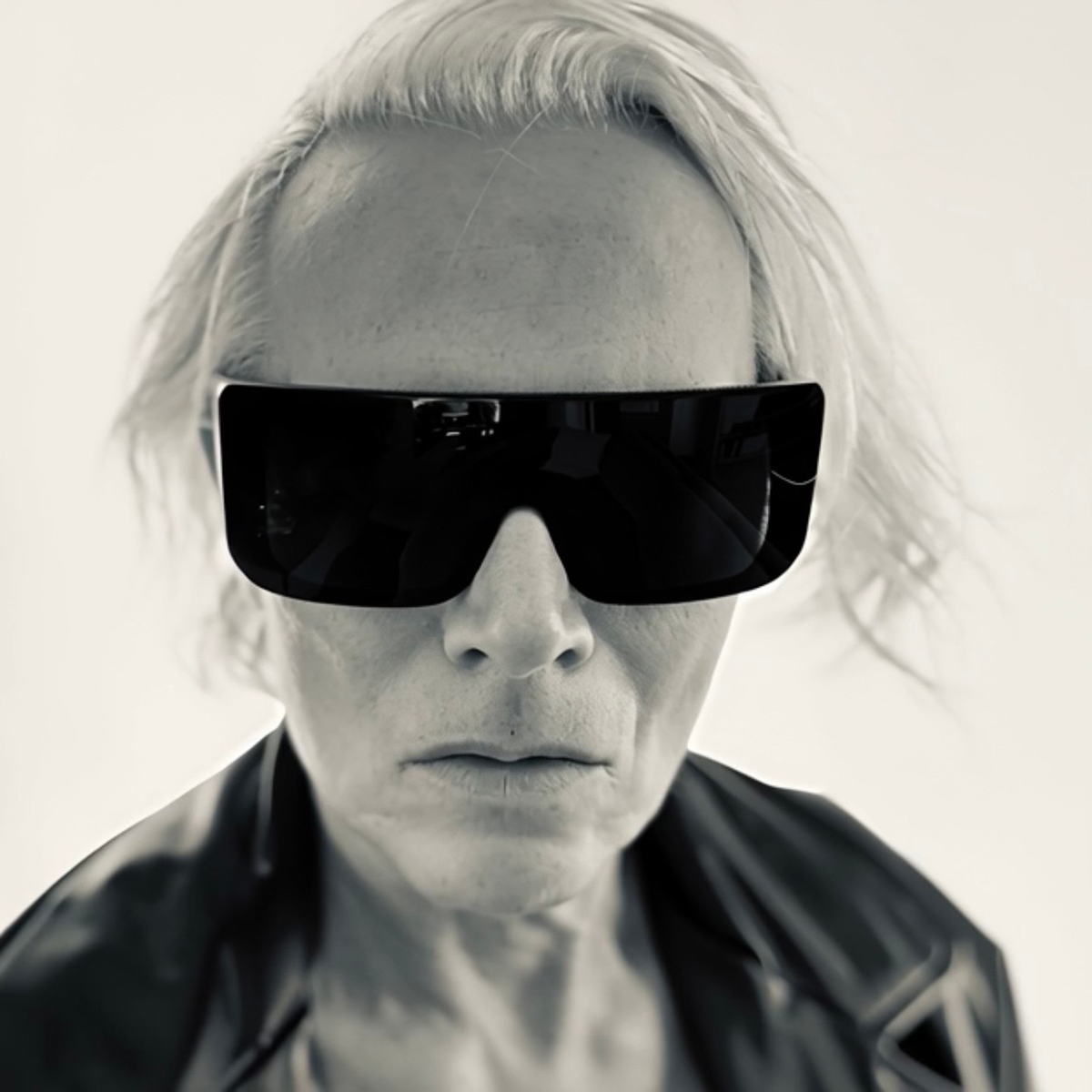
Utopia PKWY Photo credit: Utopia PKWY
For decades, John Beckmann has cultivated one of underground music’s most singular voices. As the songwriter, producer, and sonic architect behind The Mortal Prophets, Beckmann has built an expansive catalog rooted in noir atmospheres, poetic surrealism, and cinematic experimentation. His music has always occupied its own strange geography, a place where literature, film, psychedelia, and dream logic converge.
With Utopia PKWY, Beckmann isn’t abandoning that world. He’s opening its windows.
The new project, whose debut album Debut debuts November 6, reveals an unexpected shift in perspective. While Beckmann’s fascination with mystery, altered consciousness, and emotional ambiguity remains intact, the music reaches toward something brighter. The shadows are still there, but sunlight now filters through them.
That evolution comes into sharper focus on “Sleep In Moving Colors,” the album’s second single. Floating between psychedelic pop, dream-pop, and cinematic rock, the track is anchored by soaring melodies and luminous arrangements while exploring one of Beckmann’s recurring fascinations: the fluid boundary between consciousness and imagination.
“Perhaps astral projection is only a dream,” Beckmann reflects. “And perhaps waking life is the projection. Either way, ‘Sleep In Moving Colors’ reminds us that distance exists mainly for those who still believe they are trapped inside a body.”
The sentiment captures the philosophy at the heart of Utopia PKWY. Rather than treating surrealism as escape, Beckmann embraces it as another way of understanding reality—a place where memory, emotion, and imagination exist on equal footing.
Even the project’s name carries its own mythology. Utopia PKWY references Utopia Parkway in Queens, forever associated with Surrealist artist Joseph Cornell, whose intricate shadow boxes transformed everyday objects into portals of memory and possibility. Like Cornell’s work, Beckmann assembles fragments of suburban Americana, damaged pop melodies, cinematic textures, and dream imagery into something that feels both deeply nostalgic and impossible to place in time.
Musically, Debut marks one of the most significant creative turns of Beckmann’s career. For the first time, he steps away from center stage vocally, entrusting lead duties to Tanner McGraw, whose youthful performances bring warmth and immediacy to the material. Lawson Mars adds shimmering backing vocals that broaden the songs’ emotional palette, while Beckmann remains firmly behind the scenes, writing, producing, and constructing every corner of the record’s richly detailed sonic landscape.
The result is music that feels simultaneously familiar and entirely new. Sci-fi theremins drift through chrome-tinted keyboards. Sitars weave around radiant hooks. Psychedelic flourishes coexist with classic pop instincts, while lush harmonies balance Beckmann’s trademark sense of psychological unease. The album never abandons its experimental instincts, but it wears them with an inviting melodic confidence.
If The Mortal Prophets often explored abandoned hallways and midnight city streets, Utopia PKWY feels like stepping outside after the storm has passed. It’s optimistic without becoming naïve, psychedelic without sacrificing structure, and emotionally expansive without losing the intellectual curiosity that has defined Beckmann’s work for years.
Rather than representing a departure, Utopia PKWY feels like another dimension within Beckmann’s creative universe—a parallel reality where melody leads the way and possibility outweighs dread. It’s the work of an artist who continues to reinvent his language while remaining unmistakably himself.
With “Sleep In Moving Colors,” Beckmann offers another invitation into that universe: one where waking life and dreams blur together, where distance dissolves, and where the brightest colors often appear only after closing your eyes.
“Sleep In Moving Colors” arrives August 14. Debut follows on November 6.
“Sleep In Moving Colors” explores astral projection as both a spiritual and psychological experience. What drew you to that concept, and how did you want listeners to interpret the line between dreams and waking life?
BECKMANN: What interested me about astral projection wasn’t really the idea of literally leaving the body. It was more the question of where experience actually begins. We treat waking life as the official version of reality, but dreams, memories and altered states can feel just as real when we’re inside them.
I wasn’t trying to prove whether astral projection is real or symbolic. I was more interested in that moment when your sense of certainty starts to slip—when you’re no longer completely sure where you are, or even what “here” means.
I wanted the song to stay inside that uncertainty. It doesn’t draw a clear line between dreaming and waking life because I’m not sure that line is as solid as we like to think. Maybe it’s simply a useful distinction we’ve agreed on so we can function.
Hopefully, the listener comes away without a definite answer, but with a little less certainty about where one state ends and another begins.
Utopia PKWY embraces brighter melodies while still carrying the surreal, cinematic qualities that define your work. How did “Sleep In Moving Colors” become a bridge between the darker world of The Mortal Prophets and this more optimistic sonic universe?
BECKMANN: The bridge between the two projects is really more about perspective than subject matter. The Mortal Prophets often explored darker, more enclosed spaces that felt haunted by memory. With Utopia PKWY, it’s like opening the doors and letting some daylight into the same room.
I don’t think darkness and optimism are necessarily opposites. They can exist at the same time. Sometimes it’s simply a matter of where you’re standing and what you’re paying attention to.
“Sleep In Moving Colors” sits right between those two worlds. It still has the philosophical questions and surreal atmosphere of the earlier work, but there’s more air, movement, and color in the production. The questions are still unresolved, but they don’t feel trapped in the shadows anymore.
It felt like a natural passage from one project into the other—acknowledging the darker place I was coming from while moving toward something more open and expansive.
The song pairs shimmering psychedelia with the idea that “distance exists mainly for those who still believe they are trapped inside a body.” How did you translate such an abstract philosophical idea into something that feels emotionally immediate through the music?
BECKMANN: The main thing was not to over-explain it. Once an idea becomes too intellectual, it can lose some of its emotional impact. I wanted the music to make you feel the collapse of distance rather than explain what it means.
That’s why sounds move in and out of focus, textures overlap, and different elements seem to shift around the listener. The production creates the feeling that the usual boundaries aren’t completely stable.
I think emotion often reaches you before meaning does. Your body responds to a sound before your mind has had time to analyze it. That was the goal with the arrangement—to let the idea register physically first.
So when the lyric suggests that distance might be an illusion, the music is already creating that sensation. You don’t have to fully understand the concept. For a few minutes, you can simply feel what it might be like.


New music on the way? Pitch Big Takeover Exclusives.