Caulbearers release their long awaited debut album Come Back Home on October 30 via Single Cell Recordings, nearly two decades after first forming in Manchester. Led by Damien Mahoney, the collective brings twenty four musicians into ten songs, and you can hear that scale almost immediately. Players enter, disappear and alter the character of the music without disturbing the groove underneath. The album can feel intimate one minute and enormous the next, sometimes within the same song.
“Harpses” opens in one of its prettiest states. It is spooky and romantic, with airy vocals floating over violin, guitar, bass and drums while small sound effects flicker around the edges. There is something of Portishead in the nocturnal pull, though the rhythm is lighter and the whole song feels more delicate on its feet. Ruth Blake sings with an ease that lets everything around her remain visible. Nothing has to compete with the vocal, and nothing disappears behind it.
That warmth makes the arrival of “Small Space” later in the record especially striking. The temperature suddenly drops. The opening feels wet and icy where much of the earlier music had been warmer and softer, and Blake moves into a higher register that catches beautifully against it. Will Lenton’s saxophone gradually becomes more agitated as the song develops, until something initially cool and controlled begins pushing outward through increasingly frantic horns.
Between those two songs, “Truth” settles into one of the simplest grooves on the album. Guitar and drums carry it almost effortlessly, with Mahoney on lead vocal and Blake moving behind him. The repeated chorus could easily become too familiar, but her backing voice keeps changing its colour. Brass and woodwinds bring a slight ska and jazz looseness into the song, and there is a mischievous quality underneath it all, like an evening continuing peacefully while something questionable is beginning just out of view.
The chorus grew from the rhythm and pattern of Tibetan monks Mahoney recorded while they were praying in the Bylakuppe refugee settlement in South India. That history sits behind a recording already full of different hands, including Lenton on saxophone and keys, Anton Hunter on guitar, Stefan Skrimshire on cello, Dan Mitchell on bass and Gavin Mullan on percussion. The source is fascinating enough without needing the song to explain it.
“Next World” brings the pulse down and lets the record become more melancholic and storylike. Anne Eltard’s violin and John Ellis’ piano move gently around Blake, whose voice again keeps the song light even when the mood turns inward.
The change into “Over Comes A Cloud” is almost funny because the body suddenly wants something completely different. Its beat is absurdly danceable, while everything around it remains mysterious and slightly unsettled. It sounds like two people dancing dramatically through the middle of an argument, still trying to work out the knot in their relationship while neither is willing to stop moving. That tension between pleasure and unease gives the track much of its personality.
“Twisted Cord” produces pressure differently. It has a perfect wind up, gathering intensity without suddenly announcing that something important is happening. Olivia Moore adds violin, Ellis returns on piano, Phil Bennett plays drums and Alex Berry bass. The strange thing is how fast and slow the song can feel at the same time. The rhythm keeps pressing forward while the arrangement seems to stretch each stage of the build.
That quiet intensity is all over Come Back Home, but the album rarely repeats the same emotional texture twice. “Paths” is slower and more reflective, led by Sarah Sayeed rather than Blake, with Peter Digby Lee on flute, Ian Fletcher on guitar and Rob Turner on drums. The saxophone and wind instruments give it the reflective pull of waiting at a train station while old memories start running through your head. It could just as easily be playing in a bar at the exact moment the night turns inward. The song creates that feeling quickly and then trusts it.
Mahoney has said its vocal and cello melody was influenced by a devotional mantra he heard while recovering from illness on India’s east coast, while the bass draws from techno repetition and Gnawa trance. Those references make sense once you know them, though the recording never feels like a catalogue of influences. By the time you start identifying individual ingredients, the song has already carried you somewhere else emotionally.
The political anger becomes clearest on “Brothers At The Wheel,” which begins in a deep, easy groove. Bass, percussion, keys and guitar leave plenty of air around Mahoney’s vocal, making the weight of the lyrics almost easy to miss at first. Moore’s violin eventually winds through Hunter’s guitar as Skrimshire’s cello adds weight underneath, and the song keeps expanding without losing that original pulse.
Mahoney’s “wheel” is the system built around profit and power at the expense of people, communities and the planet. His frustration gradually turns outward toward the people caught underneath it. Blake enters with a wordless vocal that rises over the arrangement with sadness and strength at once, while the strings and guitars continue climbing below her. The subject remains heavy, but the music keeps its physical pleasure.
That balance matters because Come Back Home carries a lot of ideas. Mahoney writes about belonging, displacement, class, colonialism, spirituality and the systems people live inside, while the title itself keeps asking what anybody can really return to when they say “home.” The record is more persuasive when those questions remain inside the songs rather than sitting above them. “Brothers At The Wheel” works because you can still move to it. “Paths” can carry spiritual history and still feel like a private late night memory. “Truth” can draw from prayer while retaining something playful and slightly dangerous.
“Burst Through The Borders” strips much of that tension away. Its opening feels almost starry, and the vocal sits inside the arrangement with a vulnerability that borders on drowsiness. Howard Jacobs plays drums, Nicholas Malin bass and Edward Chilvers piano, with Moore returning on violin. The song stretches out for more than eight minutes and lets itself become almost suspended, the kind of track that can make time feel softer around the edges if you give yourself over to it.
“Once Inseparable” unmistakably sounds like the final song. Its rhythm has a familiar shape, almost immediately recognizable, and Caulbearers use that familiarity to finish in motion. Mark Pilkington joins on keys and Lenton returns on saxophone, bringing the record back toward groove after so many changes in mood and pace.
By then, the scale of the album makes more sense. Blake can make one song feel weightless and another suddenly ache. Sayeed changes the vocal character completely on “Paths.” Moore can sharpen a passage with violin while Skrimshire gives another section darker gravity through cello. Lenton can sit quietly inside an arrangement and later push it toward frenzy. Even the changing drummers alter how the songs sit in the body. Grenville Harrop, Jacobs, Turner and Bennett each leave a different physical impression. Twenty four contributors could easily have disappeared into a single polished mass. Here, you keep hearing people.
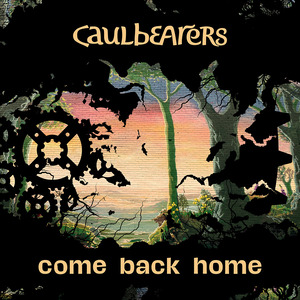
Mahoney produced and edited Come Back Home. The album was mixed by Seadna McPhail at Airtight Studio and mastered by Jim Spencer at Eve Mastering. Recording took place across Toast Recordings, Mahoney’s Padded Cell studio and Airtight, with further sessions involving John Ellis. The album artwork and design are by Latent Variables, incorporating Cookie Love’s “Open” mural.
Nineteen years is a long time to arrive at a debut album, but Come Back Home does not feel burdened by the need to explain those years. It sounds curious instead. The songs keep changing because the people inside them keep changing what is possible, sometimes through something as small as a backing vocal or a violin line, sometimes by shifting the entire temperature of the record. Caulbearers have made an album large enough to hold all of those differences without sanding them down.
Come Back Home is released October 30 via Single Cell Recordings.