
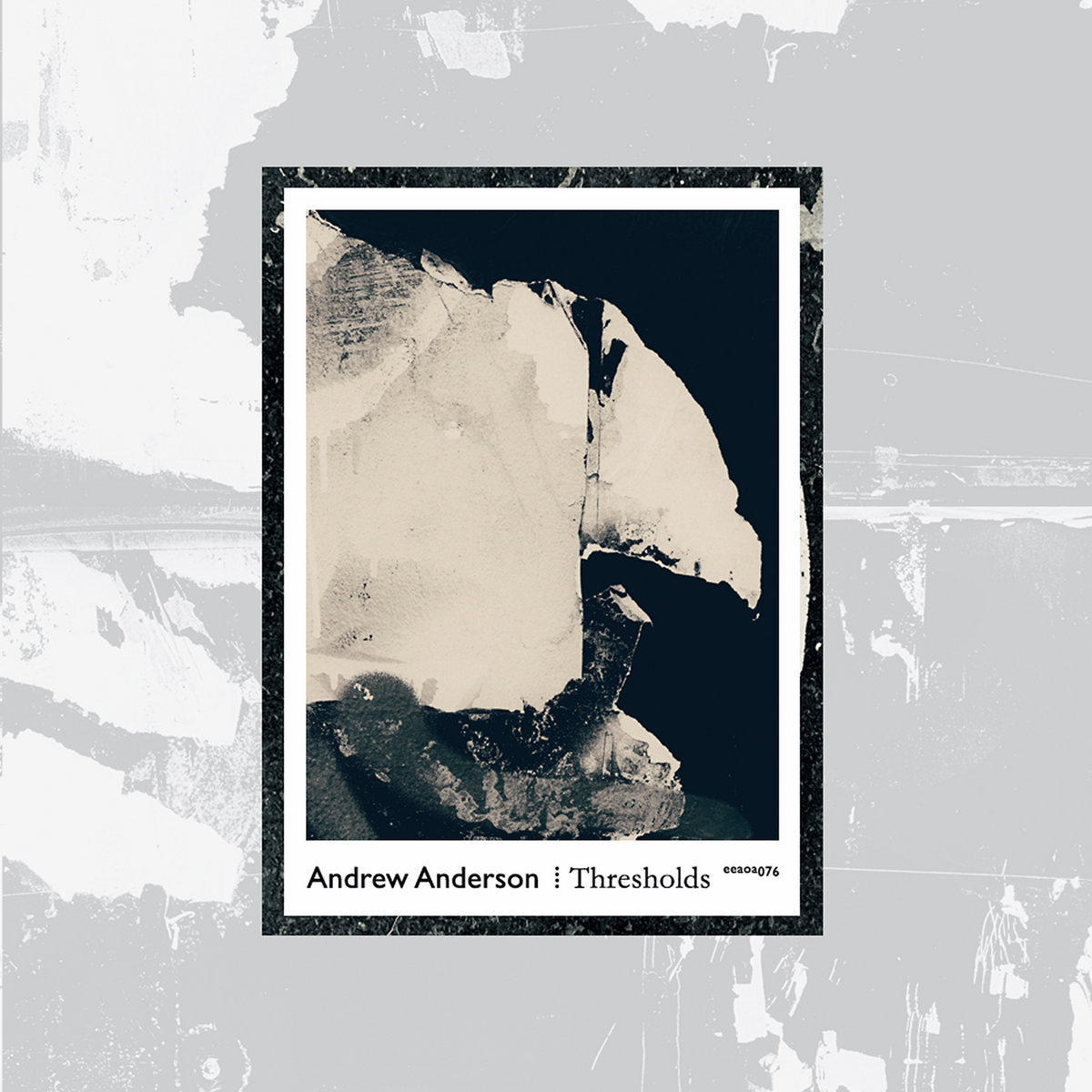
Andrew Anderson’s ‘Thresholds’ occupies a rare psychological space within contemporary sound art: it is neither purely environmental composition nor strictly musique concrète, but an unstable architecture of memory, decay, ritual, and acoustic hallucination. What distinguishes the album is not simply its command of atmosphere, but the extraordinary patience with which Anderson arranges sonic matter into states of emotional dislocation. These pieces do not present themselves as compositions in the conventional sense. They behave more like shifting conditions; weather systems of consciousness assembled from fragments of lived experience, physical objects, damaged media, and spectral residue.
The album’s conceptual foundation is inseparable from its method of construction. Anderson’s use of field recordings, found sounds, dead tape, contact-mic granular synthesis, bowed twelve-string textures, organ, bells, storms, playground ambience, and environmental debris creates a body of work obsessed with unstable perception. Yet ‘Thresholds’ never collapses into abstraction for abstraction’s sake. Even at its most alien, the music remains uncannily intimate, as though every sound carries the imprint of touch, erosion, or prior existence. The record suggests rooms that remember previous occupants, landscapes altered by weather and neglect, voices arriving from impossible distances.
“Until My Blood Contains All” establishes the album’s central dialectic between physical presence and psychic dissolution. Anderson layers distant metallic resonances, drifting drones, and fractured environmental recordings with a remarkable sensitivity to spatial depth. Sounds emerge not as foreground gestures but as intrusions from adjacent dimensions. A low rumbling pulse resembles thunder approaching across an open plain, while high-register squeals and trembling frequencies cut through the mix like damaged circuitry attempting communication. What is most striking here is Anderson’s refusal to force dramatic climax. Instead, the piece accumulates unease through implication. Every sonic event appears partially concealed, denied full revelation. The result is profoundly disorienting: the listener becomes trapped between recognition and uncertainty, hearing traces of organic life within structures that seem almost post-human.
The album’s title becomes increasingly meaningful as the record progresses. These compositions exist on thresholds between interior and exterior sound, between deliberate composition and accidental occurrence, between meditative stillness and psychological collapse. Anderson demonstrates extraordinary control over negative space, allowing silence and low-level environmental murmur to function as compositional agents rather than absence. This restraint gives the album a peculiar emotional gravity. Rather than overwhelming the listener with density, Anderson cultivates anticipation and dread through suggestion.
“All Devoured, All Begotten” deepens the album’s fascination with transformation and erosion. Here, chopped vocal fragments flicker through the composition like damaged recollections trying unsuccessfully to reconstruct themselves. The piece possesses a ritualistic quality, though not in any romanticized spiritual sense. Its ritual is one of decomposition and reassembly. The sustained tones that drift beneath the surface create an almost liturgical solemnity, while the scraping and shuffling textures imply unseen physical actions occurring just beyond perception. Anderson’s handling of dynamics throughout this work is exceptional. Tiny sonic details like the scrape of movement across a surface, the flutter of corrupted tape, the distant resonance of bells acquire immense psychological significance because of how carefully the surrounding space has been prepared.
What elevates ‘Thresholds’ above many contemporary experimental releases is its resistance to academic sterility. Anderson understands that mystery cannot be manufactured through obscurity alone. These compositions retain emotional consequence because they are rooted in lived sonic environments: old bridges, wind through leaves, dying light, oceanic resonance, remnants of forgotten activity. The album continuously negotiates the relationship between the natural and the artificial without privileging either. Storm recordings become indistinguishable from electronic drones; human gestures dissolve into mechanical abrasion. This ambiguity gives the record its deeply unsettling power.
The twenty-minute “Voice of Fire Come Through Me” serves as the album’s towering achievement. The inclusion of Thor Harris on dulcimer introduces an extraordinary textural dimension to Anderson’s already expansive sonic palette. Harris’ contribution does not function as traditional accompaniment; rather, the dulcimer appears within the composition like an artifact recovered from a half-erased cultural memory. Its resonant tonalities drift through the piece with mournful instability, at times sounding ancient and ceremonial, at others corroded and ghostlike.
The composition itself operates with astonishing narrative instinct despite avoiding linear progression. Anderson structures the piece through waves of emergence and disappearance, allowing environmental recordings, bowed instrumentation, distant voices, and cavernous drones to circulate around one another in constantly shifting relationships. Certain passages evoke the sensation of standing inside an abandoned structure during a storm, hearing architecture resonate under atmospheric pressure. Elsewhere, the music becomes strangely luminous, suspended in a state between transcendence and annihilation. Much credit must also be given to Lawrence English’s mastering work at Negative Space. The album’s immense spatial character depends upon an extraordinary degree of sonic precision. English preserves the raw instability of Anderson’s source material while giving every frequency a startling physical presence. Andreas Lubich’s lacquer cut further emphasizes the album’s corporeal qualities, allowing these sounds to occupy space with almost sculptural density.
What lingers most after ‘Thresholds’ concludes is its refusal to offer interpretive certainty. Anderson does not guide the listener toward resolution or conceptual clarity. Instead, he constructs environments in which memory, decay, natural force, and subconscious imagery circulate freely, colliding in unpredictable forms. The album captures the sensation of encountering meaning at the edge of comprehension; hearing significance reverberate through damaged matter without ever fully translating itself into language. Few experimental records manage to feel this deeply inhabited. ‘Thresholds’ is not merely heard; it imposes itself upon perception, altering the listener’s relationship to silence, environment, and acoustic memory long after the final resonance disappears.
For more information, please visit Elevator Bath Records | Bandcamp