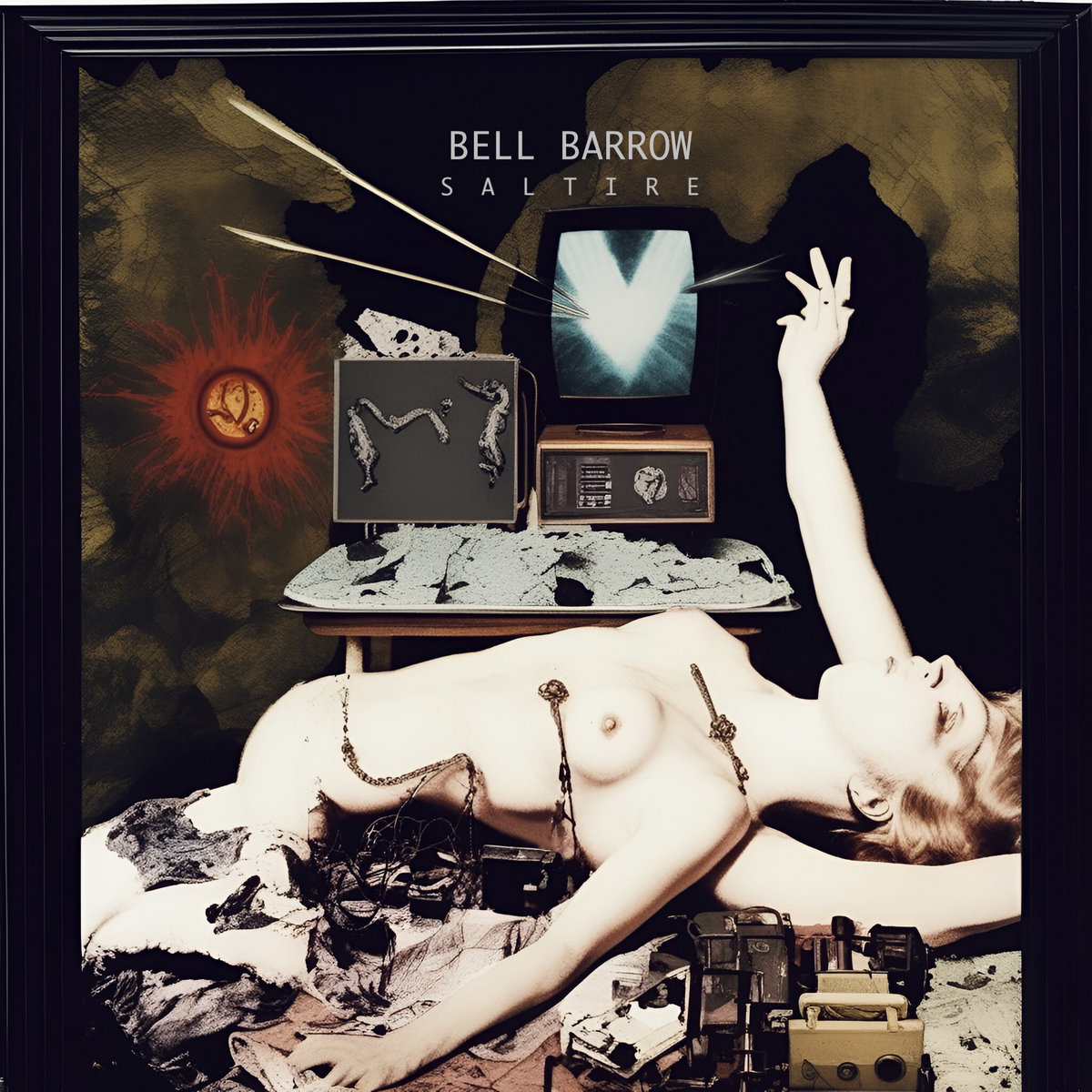
There is a sense of both continuity to Saltire, the new long-player from Bell Barrow, as well as that of striking out in a direction. Like the previous album, Core Core Pulp Jeremy Moore, the sonic adventurer behind these eclectic, ahead-of-the-curve albums, is once again using sound to explore “the concept of generational curses and their impact on the human psyche, mortality, and providence”. Though given the nature of music, such themes are often deeply buried and abstracted, and as such, the music becomes as much a soundtrack to the listener’s own more profound meditations and hidden meanings.
As always, the music can be best described as challenging but also, if you have the right mindset, rewarding, a blend of chaos and cacophony guided through the musical landscape by the deft hand that yields its own brutal beauty and beguiling hypno-sonics. And, in the absence of voice or lyrics to lead you to the artist’s intended conclusion, you are free to garner your own meanings where you find them.
“Death Lullaby” opens the album with a droning, cavernous array of sonics, the limbo sensations described in The Tibetan Book of the Dead as a soundtrack, perhaps, yawning and disorientating. This is followed by “Breath of an Acrobat,” a track that pushes the limits of what a song might be and where noise begins, walking a fine line between art and adventure, and avant-garde creativity. But then you didn’t come here for the three-minute pop song experience or a dance tune, did you?
“Cor Orans” is an industrial onslaught with bass pulses and skittering percussion pushing each other to the limits as growing guitars and searing soundclashes descent like Armaggeddon arriving on the dark horizon and “Fourth Stream” pushes such adventourousness and outside the box thinking into a droning space, one of sheet metal ambience peppered with the bleeps and hiss of half-heard radio signals and the sound of the sonic after-glow of the Big Bang.
This is music on the cutting edge, and to some, barely music at all. But that is to miss the point. The point being that this is music to make you think. Music to make you muse on the themes being discussed, though with only the track titles to work with, you will often not be on the same page as the artist’s intention. Which is fine, for this is music designed to trigger your own more profound thoughts, whatever they might be. And then there is the whole debate about what music actually is, the transition between noise and harmony, art and academia, that runs through the length of the album.
But whatever you get out of it, it will affect you in a way that music rarely has before. Why do we need another three-chord pop tune when we have music that makes us think about the very nature of existence, creativity, and the human condition?