
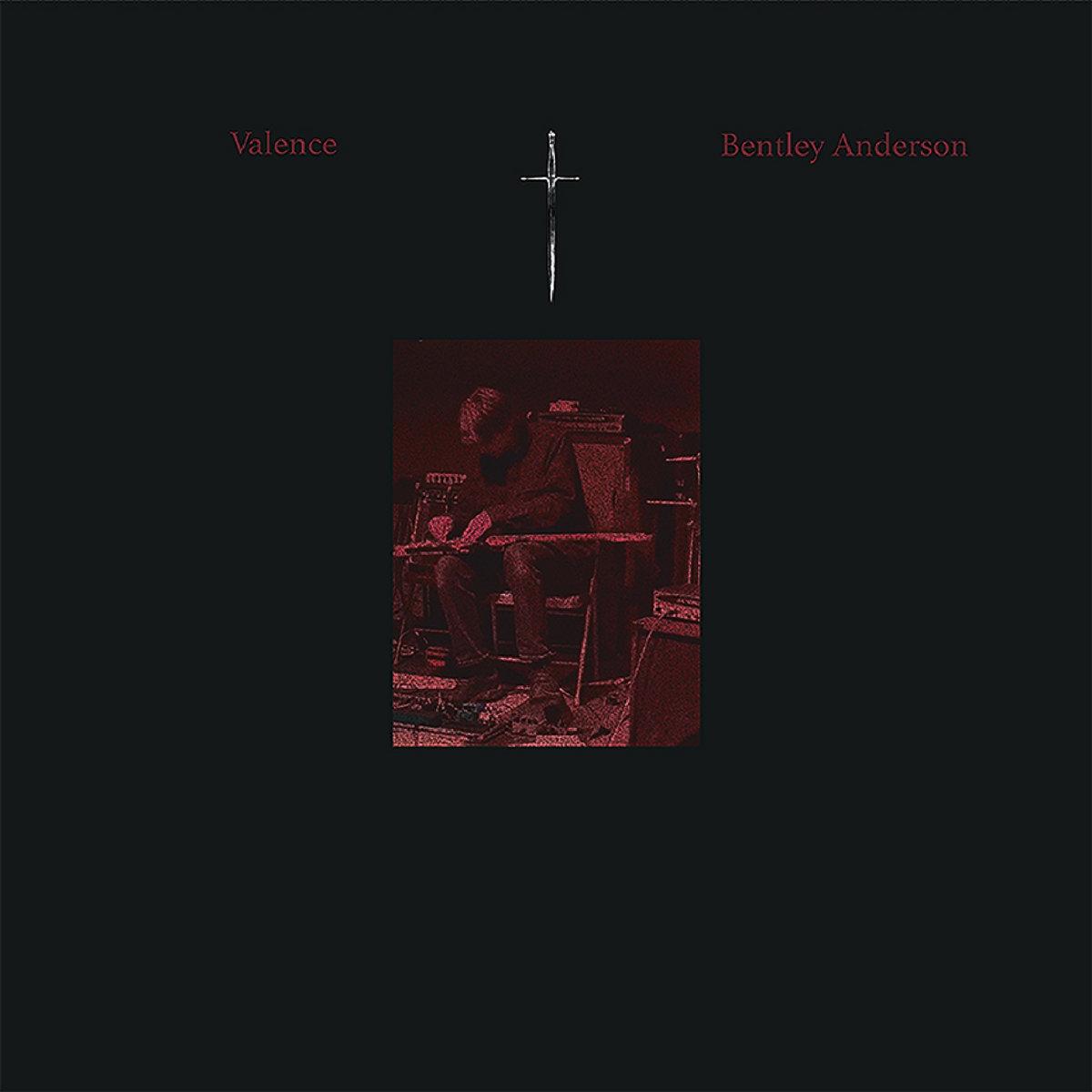
‘Valence’ positions itself as an inquiry into force and response, an exploration of how sound can carry both attraction and resistance within the same gesture. Bentley Anderson approaches the electric guitar not as a vehicle for melody in any conventional sense, but as a field of energies with vibrations that collide, disperse, and recombine in ways that feel at once physical and abstract. Across its extended compositions, the record sustains a delicate equilibrium between immersion and disruption, asking the listener to remain attentive to shifts that are often gradual yet deeply consequential.
“Susurration” opens the album with a low, murmuring intensity, its title suggesting quiet speech but its execution leaning toward something more elemental. The guitar seems to circulate rather than progress, each layer feeding back into the next, creating a sonic environment that feels less composed than accumulated. Anderson’s playing resists clear articulation, favoring density and resonance, as though the instrument were being used to map unseen currents rather than to state ideas directly. The effect is disorienting in a productive way, encouraging a mode of listening attuned to texture and duration.
With “Escape,” that sense of enclosure gives way to something more kinetic, though not necessarily freer. The piece pulses with a restless energy, its shifting tonal centers implying movement without granting release. Anderson constructs a dynamic where motion itself becomes a kind of constraint, a loop that continually redirects the listener back into its orbit. The guitar’s timbre sharpens and recedes in cycles, suggesting an ongoing negotiation between propulsion and stasis. “Hedonic Drone” introduces a different register, one that leans into sustained pleasure without relinquishing complexity. The word hedonic might imply indulgence, yet the track avoids easy gratification, instead building a layered continuum where overtones interact in subtle, unpredictable ways. Anderson’s control over harmonic density becomes especially apparent here, as small fluctuations in tone generate a sense of internal variation that keeps the piece from settling into complacency.
On “Dulcetly Now,” the album reaches a kind of suspended clarity. The guitar tones soften, their edges diffused, creating an atmosphere that feels momentarily receptive rather than resistant. Yet even within this gentler framework, there is an undercurrent of instability, as if the calm were provisional. The track suggests that sweetness, when sustained, can carry its own form of unease, a recognition that any moment of equilibrium exists in relation to forces that might disrupt it. “Thrum” reintroduces a more physical presence, its rhythmic undercurrent evoking the sensation of vibration as something bodily. The guitar here seems to press outward, its frequencies occupying space with a palpable insistence. Anderson’s performance emphasizes repetition not as redundancy but as intensification, each cycle reinforcing the previous one while introducing minute deviations that accumulate over time.
“Metallically” sharpens the album’s focus on timbre, foregrounding the harder, more abrasive qualities of the instrument. The tones ring with a kind of industrial clarity, their resonance extended and refracted through subtle manipulations. Anderson treats the guitar almost as a percussive object, drawing attention to the materiality of sound production itself. The track’s insistence on surface and resonance creates a striking contrast with the more diffuse passages elsewhere on the record. The digital-only “Approach And Avoidance” serves as a coda that encapsulates the album’s central preoccupation. Its title gestures toward a psychological framework, but Anderson renders it in purely sonic terms, constructing a piece that alternates between invitation and withdrawal. The guitar lines seem to reach outward before retracting, establishing a pattern that resists resolution. It is a fitting conclusion for a record that consistently privileges process over arrival.
Though ‘Valence’ is performed solely by Anderson, its realization is shaped by the contributions of Mo Miller in mixing and Nick Klein in mastering, whose work ensures that the album’s intricate layers retain both clarity and depth. The visual dimension, informed by Naomi Hawksley, complements the music’s balance of structure and abstraction, reinforcing the sense that the project operates across multiple sensory registers.
What distinguishes ‘Valence’ is its commitment to sustaining ambiguity without lapsing into opacity. Anderson does not seek to guide the listener toward a singular interpretation; instead, he constructs a space where perception itself becomes the subject. The album’s long-form compositions demand patience, but they also reward a mode of engagement that is increasingly rare, one that values attention as an active, evolving practice. In this sense, ‘Valence’ is less an object to be consumed than an environment to inhabit, its shifting energies offering no fixed conclusions, only the ongoing interplay of forces that define its core.
Find out more by visiting Bandcamp | Decontrol Tapes | Soundcloud | Instagram