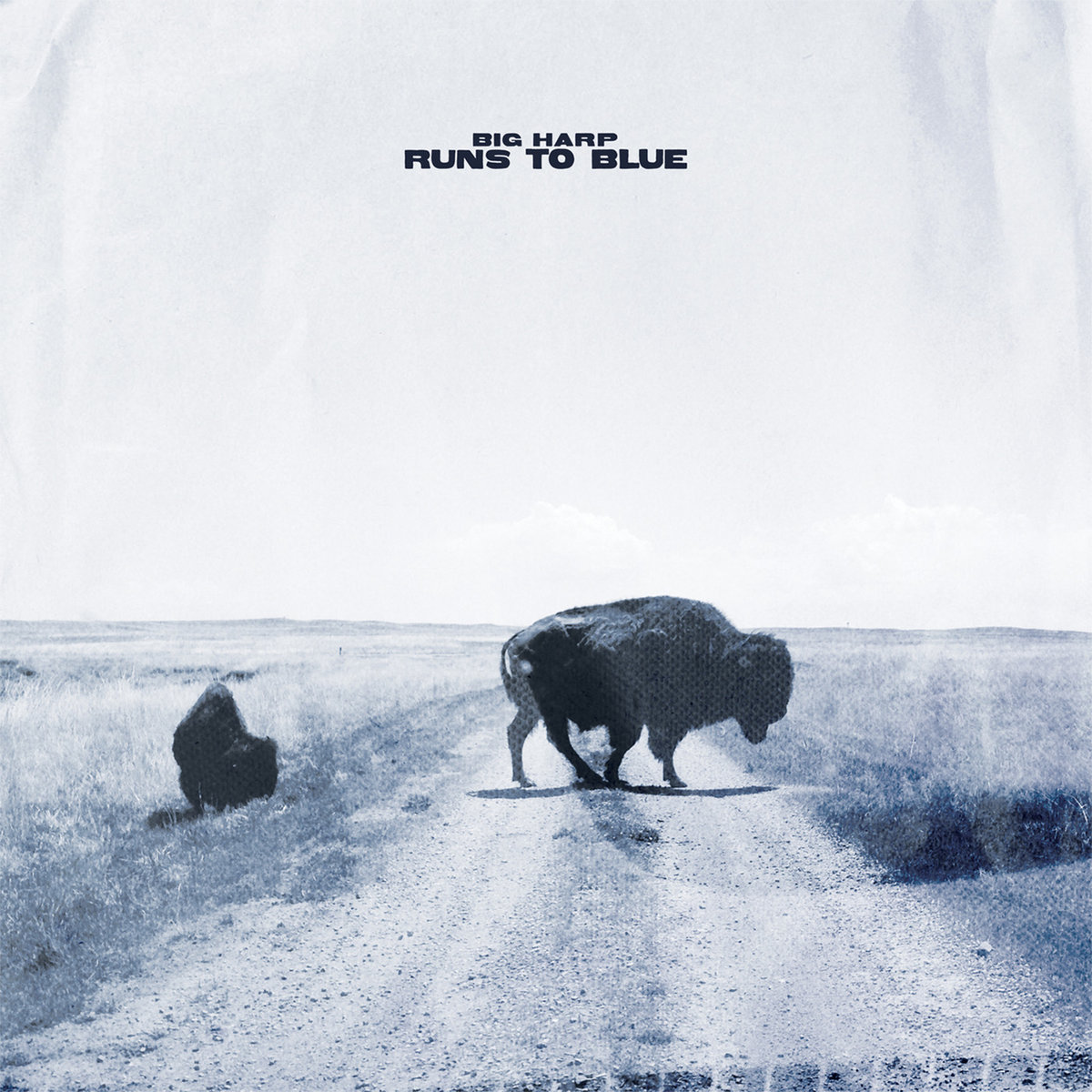
There is a particular kind of artistic clarity that only arrives after time has done its quiet work on people who never stopped paying attention. Big Harp’s fourth album, ‘Runs To Blue’, emerges from that clarity; not as a comeback, but as a continuation shaped by distance, grief, devotion, and a recalibrated sense of purpose. Stefanie Drootin and Chris Senseney have always made music that feels lived-in, but here the feeling is less about texture and more about truth, as if each note has been weighed against the simple question of whether it deserves to exist.
Recorded live with only acoustic guitar, bass, and their interwoven voices under the guidance of Pierre de Reeder, the album resists adornment at every turn. That restraint is not an aesthetic limitation but a philosophical stance. These songs do not seek to impress; they seek to endure. The result is a collection that feels almost conversational, yet carries the cumulative weight of two intertwined lives.
The opening track, “Kill It, Kill It, Kill It,” sets the emotional terms with startling directness. Written in the shadow of Senseney’s mother’s passing, it grapples with the fragility of naming feelings that might otherwise remain intact if left unspoken. His baritone moves with a deliberate gravity, while Drootin’s harmonies hover just beneath, not as embellishment but as emotional counterbalance. It is followed by “Hello Honey,” which pivots toward intimacy with a disarming lightness. The song captures the peculiar vulnerability of long-term love, where reassurance is both unnecessary and constantly sought. There is a gentle self-awareness in the way Senseney questions his place within the relationship, and Drootin’s voice answers without ever needing to assert.
The title track, a meditation on movement and inevitability where the color itself suggests both melancholy and continuity. It is here that the duo’s instrumental interplay becomes most apparent: Drootin’s bass lines do not simply support but converse, tracing melodic paths that subtly redirect the emotional current of the song. That same restless undercurrent fuels “I Got an Itch,” a wry acknowledgment of the persistent desire to upend stability in favor of motion. The song’s humor is understated, but its implications are not; there is always another version of life waiting just out of reach.
“Colored Lights” stands among the album’s most vividly rendered pieces, assembling fragments of shared memory into something resembling a private mythology. Rather than offering a linear narrative, it accumulates detail, moments of recognition, domestic scenes, fleeting images, and allows them to coexist without hierarchy. This approach mirrors the way memory itself operates, refusing neat conclusions. In contrast, “I’ll Write You Love Songs Until I Die” leans into a kind of artistic vow, both earnest and slightly self-conscious, as if aware of the weight such a promise carries. The song acknowledges the absurdity of its own premise while still committing to it fully.
Parenthood enters the frame most poignantly in “Take it Easy on Me,” a song that captures the dissonance between unconditional love and the inevitability of distance. Senseney’s vocal delivery carries a quiet resignation, not as defeat but as acceptance of a dynamic that cannot be controlled. That acceptance finds a different expression in “Runnin’ For It,” where motion becomes less about escape and more about survival, a necessary act rather than a romantic one.
“I Ain’t Gonna Cry” is perhaps the album’s most deceptively simple composition, transforming grief into a form of endurance. The refusal to collapse into sorrow is not framed as strength in the conventional sense, but as a deliberate choice to honor what was rather than dwell on what is gone. It recalls the narrative plainspokeness of John Prine, where profundity is delivered without ornament. The closing track, “I Get Lonesome Singin’ These Songs,” brings the record full circle, reflecting on the act of performance itself. There is a quiet paradox at its core: songs that connect can also isolate, especially when they are drawn so directly from personal experience. The loneliness described here is not a failure of communication, but its inevitable companion.
What distinguishes ‘Runs To Blue’ is not merely its thematic coherence but its refusal to resolve those themes into something easily digestible. Drootin and Senseney do not offer conclusions about love, loss, or time; they present them as ongoing conditions. Their musicianship, her bass, his guitar, both voices intertwined, is inseparable from that perspective, functioning less as accompaniment and more as a shared language developed over decades.
There is no sense here of artists attempting to reclaim past momentum or redefine themselves for a new context. Instead, Big Harp operates with a quiet assurance that comes from understanding exactly what they have to say and how they want to say it. The album’s modest scale becomes its greatest strength, allowing every detail to resonate without competition. In that space, ‘Runs To Blue’ becomes something rare: a record that feels neither nostalgic nor forward-looking, but entirely present, grounded in the unremarkable miracle of continuing on.
Releases March 27, 2026
To find out more or to pre-order, please visit: Big Harp | Saddle Creek | Bandcamp.