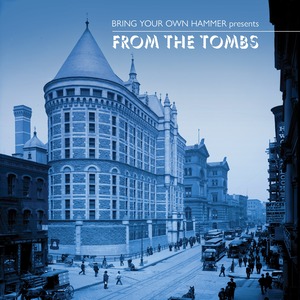
Bring Your Own Hammer opens From The Tombs with a guitar melody so full of feeling that it almost hurts to listen. On “Asking Alms,” Cian Nugent plays with a solemn, bittersweet grace, each phrase carrying a sadness that grows more affecting in its simplicity. It has the lingering emotional force of a film’s closing scene, when the story has ended and you remain in your seat, unwilling to let the music go. There is sorrow in the playing, but also a wonderful affection for the melody itself. It is a beautiful introduction to an album that moves through some of humanity’s darkest and strangest circumstances while remaining remarkably alive to everything that makes existence worth celebrating.
Ahead of its November 13 release through Dimple Discs, The Big Takeover is delighted to premiere From The Tombs, the second full-length album from the Irish music and history project Bring Your Own Hammer. The ambitious 21-song double album gathers an exceptional company of Irish and British musicians to explore crime, punishment, migration and everyday life in nineteenth-century Ireland and among the Irish diaspora, extending into the early twentieth century. Curated by historian Dr. Richard Mc Mahon, with support from Dr. Niall Whelehan, the project begins with court proceedings, newspapers, surviving ballads and other historical sources, inviting musicians to develop their own interpretations of the people and events they encounter.
The result is a collection of extraordinary musical variety, moving between intimate folk compositions, elaborate pop arrangements, theatrical performances, electronics and expansive orchestration. Its four sides, From The Sessions, From The Americas, From The Assizes and From The Island, carry the listener across countries, generations and musical traditions. There is tremendous pleasure in hearing so many distinct artistic personalities gathered around such unusual material, with each composition revealing another possibility within the collaboration.
The opening side, From The Sessions, establishes much of that variety through its instrumental character. Following Nugent’s aching guitar, Mike Smalle and Kelsey Michael bring a floating sweetness to “Ragged Red Shirt,” its warm, organ-like textures lending the arrangement a soft, almost dreamlike quality. Audrey Riley and James Woodrow offer a different kind of movement on “A.M.,” where cascading guitar phrases flow into strings with the delicate continuity of falling water. The compositions are beautifully measured, their melodic details given enough room to settle naturally.
Then Adrian Crowley arrives with “The Butter Witch,” accompanied by maxo, and a more peculiar personality emerges. Crowley’s wonderfully deep voice possesses the melancholy richness of an old jazz or theatrical recording, bringing considerable elegance to an eccentric historical subject. There is an appealing mischief beneath the seriousness of his delivery, the singer’s gravity making the oddness of the story even more entertaining. The music already suggests how much imaginative freedom these historical sources offer, and how readily the musicians embrace their stranger possibilities.
Listen to Side One: From The Sessions on Spotify
The title track, opening From The Americas, is among the album’s most affecting achievements. Smalle is joined by June Miles-Kingston, Bernard Butler, Marcus Holdaway, Fergal Lawler, Ian Catt and Terry Edwards for a composition whose melodic warmth is almost startling beside its historical source. Bright guitar, graceful strings and wonderfully clear vocals lift one another through an uplifting arrangement, with Miles-Kingston’s singing bringing a particular affection to the chorus. Her voice has an openness that makes the melody feel immediately welcoming, carrying a sense of warmth that remains long after the song finishes.
The historical account concerns a young Irish servant committed to the Tombs prison in New York in October 1881, accused of infanticide and subsequently convicted of manslaughter. She was imprisoned on Blackwell Island before being released in July 1883, after which she disappears from the surviving record. The documents preserve the accusation, conviction and dates of her confinement, while revealing remarkably little about the rest of her existence.
Smalle’s composition responds to that absence with an almost overwhelming generosity of feeling. The arrangement gives its contributors room to bring their individual musical character into the song, with Butler’s guitar and Holdaway’s cello enriching the warmth of the ensemble. Miles-Kingston sings with such sincerity that the performance seems to reach beyond the circumstances of the historical account, allowing the listener to imagine an entire human existence that the surviving documents could never describe.
The second side subsequently moves through a fascinating collection of musical personalities. Smalle and Luke Haines transform the 1887 Irish American song “The Black Maria, O” into a cold, increasingly volatile electronic composition, its programmed rhythms, synthesizers and metallic commotion giving the old language an unsettling contemporary force. “Sing a Song to Sing Sing,” by John Carter Wood with Holdaway, is equally captivating in an entirely different register, its shadowy electronic atmosphere gradually expanding into a gorgeous meeting of synthesizers and strings.
Elsewhere, Holdaway’s “Powerplays” introduces an almost satirical character through its heavily processed vocals and unusual instrumental colours, while Miriam Ingram and Seán Mac Erlaine give “Pale Blue Dress” an irresistible, faintly threatening innocence. Its sweetness recalls the charm of 1950s popular music, although something uncanny seems to linger beneath the surface. The effect is deliciously unsettling, as though the song is smiling while keeping a secret. These unexpected shifts give the album much of its excitement, allowing humour and eccentricity to coexist with its more serious historical subjects.
Crowley’s “Quinn the Adventurer” is particularly enchanting. Inspired by James Quinn, an Irishman who left Belfast in 1920 and spent the following years pursuing extraordinary opportunities throughout the Americas, the song follows a character whose ambitions seemed to grow larger with every new possibility. Quinn travelled extensively, worked as a silent-film extra in Hollywood and eventually attracted police attention over a collection of Amazonian shrunken heads. After being convicted of burglary in California, he fled before serving his sentence and resurfaced in Panama. His life contains enough invention, ambition and improbable incident to seem almost fictional.
Crowley finds a musical personality perfectly suited to that restless imagination. His low, expressive voice carries a mischievous, romantic quality, while the atmosphere suggests nighttime streets, peculiar encounters and the irresistible promise of another adventure. There is something deeply recognisable in Quinn’s desire to become someone extraordinary, even when his ambitions lead him into trouble. The vocal captures both his confidence and the uncertainty beneath it, the sense of a man forever pursuing a future that might turn out wonderfully or disastrously.
Crowley’s storytelling instincts are particularly impressive here. His delivery gives Quinn a convincing presence, allowing the listener to feel the excitement of his adventures alongside the absurdity of his circumstances. It is a wonderfully atmospheric performance, full of character and imagination, and one of the album’s clearest examples of how an unlikely historical subject can inspire an entirely distinctive musical world.
Listen to Side Two: From The Americas on Spotify
The third side, From The Assizes, moves into more dramatic territory, beginning with the formidable “Carrickshock (A Brief but Desperate Deed of Blood).” Tony Higgins, Hugh Bunker, Damian O’Neill and Michael Walsh build an increasingly unruly arrangement from its Celtic foundations, the music gathering into something dark and almost overwhelming. There is a sense of public commotion in its movement, recalling the clamour of a crowded fairground as different sounds compete for space. The performance carries an intensity that feels both theatrical and threatening.
The transition into “In the Dark,” by SJ McArdle and Lisa Lambe, is exquisite. McArdle’s resonant guitar establishes a wonderfully romantic atmosphere, while the two voices meet with such natural warmth that the melody seems to unfold through the relationship between them. Lambe’s clear, expressive singing rises alongside McArdle’s lower register, their different vocal tones creating a closeness that makes the performance almost impossible to resist. There is something sweeping and timeless about the music, reminiscent of the emotional grandeur of an old romance or adventure, yet the arrangement remains intimate enough for every slight change in delivery to matter.
Its historical origins are considerably less romantic. The song draws on a case heard at the Fermanagh summer assizes of 1833, when Margaret McDermott was accused of stealing eighteen shillings from John Monaghan. The surviving newspaper account describes both individuals with open contempt, while McDermott’s defence introduced allegations of improper conduct against her accuser. She was eventually acquitted after undermining his credibility before the court.
The contrast between that hostile public record and the musical intimacy of McArdle and Lambe’s performance is fascinating. Their voices create an emotional experience that seems far removed from the accusations and ridicule preserved in the newspaper, allowing the listener to hear the material through a different imaginative perspective. The duet’s romantic character belongs to the music rather than any certainty about the historical individuals, and that distance makes its expressive choices all the more intriguing. It is among the album’s most beautiful recordings, with the natural interplay between the performers carrying an extraordinary amount of feeling.
The side’s emotional variety continues through the delicate, pastoral singing of Brigid Mae Power on “I Swear to You,” alongside composer Linda Buckley, and the deeply restrained performance of Michael J. Sheehy on “Luck.” His rich, low vocal seems to hold its feelings close, allowing tension to develop through the smallest changes in delivery.
“The Cruel Father” takes a more theatrical approach altogether. Lavinia Blackwall and Neil Farrell, joined by McArdle, revive an early 1860s street ballad concerning Richard Guinness Hill, who was accused of attempting to abandon his infant son. Hill was never convicted, although the allegations became the subject of considerable public outrage. Blackwall’s dramatic vocal and Farrell’s expressive arrangement embrace the story’s origins in popular performance, bringing out the theatrical possibilities of an account that had already become a public spectacle. The performance has the character of a stage production, its changing musical emphasis allowing the narrative’s cruelty and sensationalism to emerge with tremendous force.
Listen to Side Three: From The Assizes on Spotify
The final side, From The Island, opens with one of the record’s most mesmerising achievements. Lawler’s “The Elphinstone Voyage,” inspired by a convict ship sailing to Australia, creates an extraordinary sensation of movement through its expansive orchestral arrangement. The music seems to drift through open air, carrying the listener somewhere between waking and dreaming. Its gradually developing textures suggest an enormous surrounding space, while the orchestration maintains a delicate sense of motion beneath the grandeur.
There is something particularly impressive about the freedom of this composition. The historical voyage provides its imaginative setting, yet the music allows the listener to experience the movement from different perspectives, at times suggesting the physical passage of the vessel and at others seeming to float far above it. The instrumental writing leaves room for wonder, uncertainty and anticipation, with no single emotion overwhelming the experience. Lawler’s arrangement is magnificent in its ability to suggest the scale of such a journey while remaining so graceful and absorbing.
The subsequent “We Were Bound,” by Sheehy and Anne Gilpin, returns to a more intimate folk character, its expressive female vocals and gentle rhythmic movement bringing another kind of vitality to the record. Inni-K’s “Na Connerys” is equally enchanting, her traditional Irish singing carrying a sense of age and familiarity while remaining vividly present.
Finally, “Faultlines,” by Walsh and Not Quite Light, closes the album with an extended composition that begins among flute-like tones and the cries of seabirds. The natural sounds establish an immediate sense of place, while the developing narrative carries a quiet longing, almost like a love song reaching toward something distant. Its unhurried atmosphere allows the storytelling and surrounding environment to settle together, giving the closing minutes a feeling of spaciousness that lingers after the music has finished.
Listen to Side Four: From The Island on Spotify
Across its four sides, From The Tombs follows people chasing love, recognition, escape and improbable futures, some foolish, some cruel, others impossible to understand from what survives. The musicians respond with their own restless curiosity: Crowley’s instinct for character, Miles-Kingston’s open-hearted singing, Blackwall’s theatrical command and Lawler’s orchestral imagination give these stories distinctly different musical identities. Their pleasure in experimenting, imagining and discovering unexpected connections is everywhere, making this 21-song undertaking feel abundant rather than imposing. It is an exceptional achievement in collaborative music-making, as compelling for the music itself as for the remarkable histories behind it.
The record begins with a guitar sounding almost ready to weep and ends with seabirds calling over the water. Between them, 21 songs find room for just about every reason a person might keep going.
From The Tombs is released November 13, 2026, via Bring Your Own Hammer and Dimple Discs.
Album release and streaming links
Bring Your Own Hammer Bandcamp
The Elphinstone Voyage official video
Bring Your Own Hammer Instagram