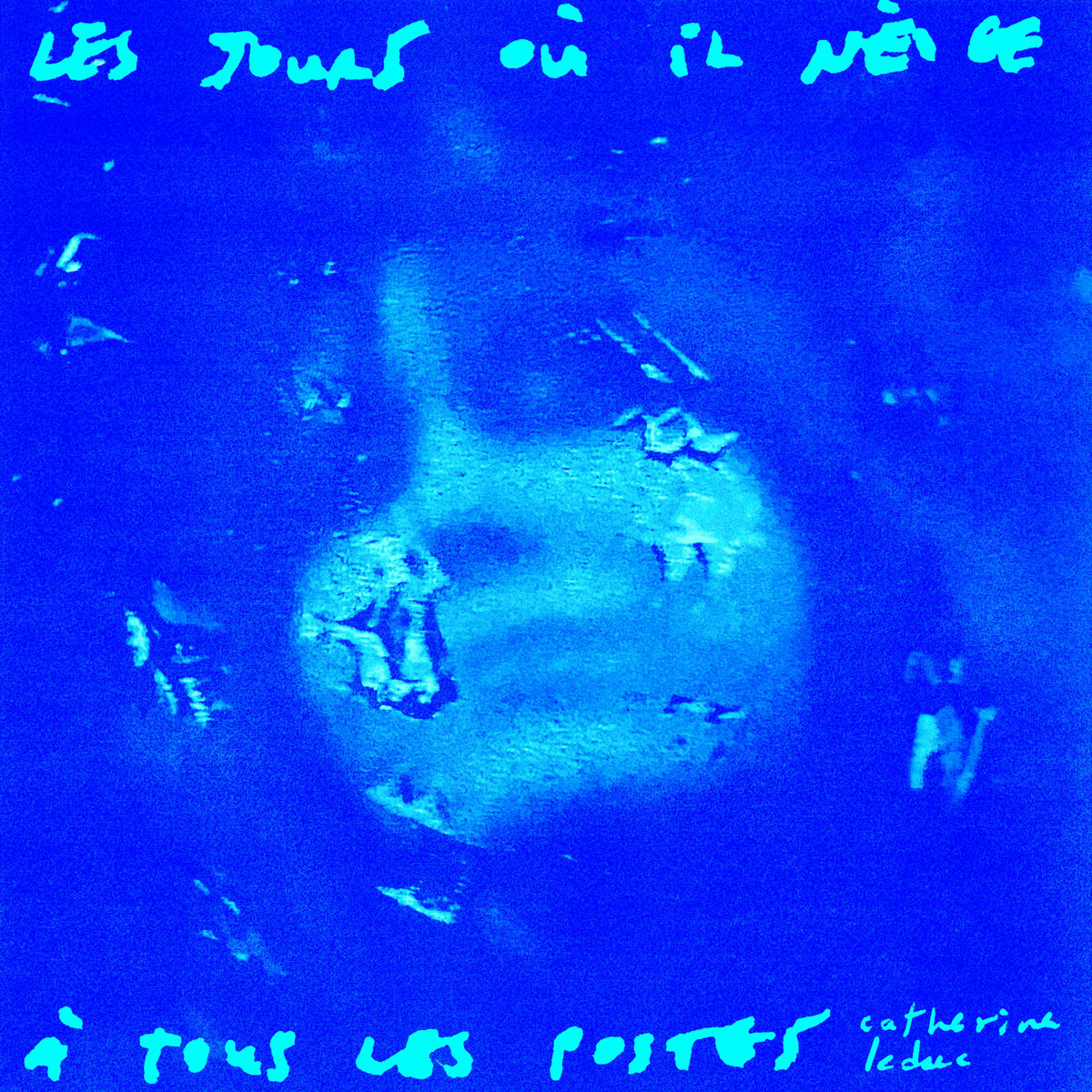
In an era of content churn, where algorithms demand a constant stream of ephemeral singles and 15-second hooks, Catherine Leduc’s return after an eight-year hiatus feels less like a comeback and more like an act of quiet rebellion. Her third solo effort, ‘Les jours où il neige à tous les postes’ (‘The days when it snows at all posts’), is a masterful defense of the slow-burn creative process. It is a record that doesn’t just ask for your time; it honors the very concept of time passing.
Collaborating once again with Matthieu Beaumont (her partner in life and in the late, celebrated Tricot Machine), Leduc has crafted a work of uninhibited psych-pop where the fascinations lie in the negative space. While Leduc often composes on guitar, the instrument has been largely exorcised from the final mix, replaced by a lush, subterranean forest of synthesizers and a bass frequency that acts as the album’s pulse. Catherine’s obsession with detail, three specific bass notes here, a scratchy synth texture there, elevates the record from simple dream-pop to a sophisticated study in arrangement. The tracks aren’t long for the sake of indulgence; they are long to allow for resonance. In “Les raisons embaument la défaite” (“The reasons embalm the defeat,” the use of “embaument” is a brilliant double entendre in French: it can mean to preserve, but it also refers to a sweet or powerful fragrance filling the air), a seven-minute monolith, the movements bleed into one another with a transparency that suggests a composer who is more interested in the efflorescence of a melody than its immediate impact.
Leduc’s economy of language produces a profound, punched-through weight. The titles themselves, “Quand la seule arme qu’il nous reste c’est de ne plus jamais mourir” (literal translation: ‘When the only weapon we have left is to never die again.’), function as poetic anchors. The lyrics possess the raw immediacy of automatic writing, yet they have clearly been subjected to a rigorous distillation, stripped of excess until only the poetic essence remains. Their themes oscillate between the funereal and the resilient, bridging the gap between guttural grit and ethereal suspension. On “Tu meurs sans arrêt,” (“You die constantly”), the repetition of her voice against the asperity of the synthesizers creates a hypnotic, psalmic quality. Driven by themes of renewal, the record chronicles her self-recovery from a state of dormancy, charting a clear path toward artistic autonomy after a period of professional uncertainty.
For those attuned to production value and rhythmic fluidity, this album offers a sonically panoramic and more exploratory profile than the leaner textures of her previous effort, ‘Un bras de distance avec le soleil’ (Grosse Boîte, 2017). Leduc’s rejection of the “studio-in-a-week” mentality is palpable in every bar. Les jours où il neige à tous les postes is jewelry-making in a world of fast fashion. It captures that specific, endless Quebecois transition from winter to spring—a period of suspended animation where the soil is thawing but the air still bites. The record’s foundation rests upon a high-profile bass presence, a warm and driving pulse that functions as the album’s vital circulatory system, necessitating a higher-volume immersion to fully appreciate its depth. Floating above this grounded low-end are vocals defined by a diaphanous, translucent quality; they are often layered in ghostly voice-overs or intentionally recessed in the mix, evoking a state of profound vulnerability and a resilient, quiet power. This delicate vocal work is constantly challenged by the grain of the synthesizers. Their vintage-tinted textures introduce a deliberate friction, successfully pivoting the project away from Leduc’s folk-pop origins toward a more sophisticated, avant-garde psychedelic landscape.
The very structure of the album over seven expansive tracks, frequently stretch beyond the five-minute mark and serve as a structural manifesto. By demanding an extended attention span, Leduc forces a decelerated cognitive pace, offering a defiant alternative to the frantic, fragmented consumption of the modern digital era. It is music that does not merely occupy time, but breathes within it. It is a record for the musician who doubts, for the listener who craves integrity over accessibility, and for anyone who understands that some things simply cannot be rushed. After eight years, the snow has finally cleared, revealing an album of generous and enchanting stability, a testament to an artist who has reclaimed her ground.
Please visit: Bandcamp | Spotify | Apple Music | Youtube