
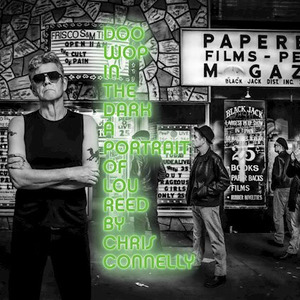
A greasy guitar line runs through “House of 70’s,” rubbing against Chris Connelly’s vocal while the rhythm underneath refuses to settle too comfortably. The song has an oily, agitated cool to it, appropriate for a track built around Lou Reed’s New York in the early and mid 1970s.
Connelly is reaching for a period after the optimism of the previous decade had already soured. Reed’s world is filled with nightlife, drugs, sex, sarcasm, exhaustion, danger, and people making an identity out of whatever survived the night. “House of 70’s” carries that atmosphere into its sound. The guitar keeps scraping around the edges of the vocal, the arrangement moves with a loose physicality, and the whole recording feels slightly frayed.
That roughness gives the song character. Its parts do not sit politely beside one another. Guitar and voice keep pressing into the same space, while the rhythm underneath adds enough instability to keep the track restless. Connelly lets the music retain some dirt, which suits a portrait of Reed at a point when grime, glamour, cruelty, and wit could all exist within the same few blocks.
The song becomes most convincing when the period stops feeling historical. Connelly has described “House of 70’s” as Reed’s New York distilled into a rock song, and the recording catches something more useful than surface nostalgia. The swagger is there, but so is the agitation underneath it. The cool feels worn rather than immaculate.
The accompanying video from Someoddpilot Studios, directed and edited by Chris Eichenseer, carries that same physical unease. Kira Ledholm and Jay Drenkel move through a theatrical, nocturnal environment that gives the song bodies and gestures without cleaning up its uglier edges.
“Bye Bye Johnny Viola” moves several years backward and becomes far more precise about the moment it enters.
It is 1968. Andy Warhol has been shot. White Light/White Heat has already driven The Velvet Underground into some of its harshest music, and John Cale is about to leave the band after Reed sends Sterling Morrison to deliver the news.
Connelly gives that rupture a very different musical shape.
Broad piano and keyboard chords establish the track almost immediately. They return throughout the song with a dark, deliberate weight, giving the arrangement a sense of movement even when the harmony itself remains patient. Those chords are the part that stays behind after the song ends. Each return seems to make the split at its centre feel a little more permanent.
Chris Bruce’s production gives those instruments room. Connelly’s vocal sits more exposed against them, while the arrangement develops with greater separation between its parts. The voice has a rough surface, the keyboards are smoother and wider, and the distance between those textures creates much of the song’s tension.
Jebin Bruni adds further keyboards, deepening the chordal movement without making it ornate. The keys have a cold, almost electronic gravity while remaining recognisably rooted in piano. They make the song feel suspended somewhere between rock drama and the darker emotional pull of synth music.
That sound fits the story unusually well. Cale’s departure was already a decision made by the time Morrison arrived at his apartment. The real drama sits in the moment when a creative relationship suddenly becomes past tense. “Bye Bye Johnny Viola” seems to understand that. Its recurring chords do not chase the event. They sit with its aftermath.
The song consequently feels less interested in recreating the noise of the Velvet Underground than in what happens after one of its defining tensions is removed. Cale leaves, the chemistry changes, and several creative lives begin moving somewhere else.
That distinction opens up the larger idea behind Doo Wop In The Dark: A Portrait of Lou Reed.
Across 21 tracks, Connelly mixes Reed compositions with his own songs about specific periods, relationships, and events in Reed’s life. “House of 70’s” enters through environment. It catches the dirt, swagger, nightlife, and damaged glamour surrounding Reed in the 1970s. “Bye Bye Johnny Viola” narrows the frame to one break inside the Velvet Underground and lets the music dwell on what that break cost.
Connelly has lived with Reed’s work for too long for the project to feel like a detached exercise in biography. As a nine year old in Edinburgh, he encountered the cover of Rock N Roll Animal while wandering through a department store with his mother. The strange yellow figure on the sleeve stayed with him long before he could have understood everything Reed represented.
More than five decades later, Connelly is still following that image.
His own career eventually moved through Fini Tribe, Ministry, The Revolting Cocks, Pigface, and a long solo catalogue that repeatedly crosses rock, industrial music, electronics, post punk, and experimental songwriting. Reed sits somewhere inside that history as an artist whose influence became absorbed rather than preserved at a respectful distance.
That is what gives these two songs their value within the larger portrait. Connelly does not flatten Reed into one approved version of himself. “House of 70’s” allows him to remain abrasive, stylish, filthy, funny, and slightly dangerous. “Bye Bye Johnny Viola” looks behind that mythology at a decision whose consequences continued long after the conversation itself ended.
The former leaves grease on everything it touches. The latter is carried by those dark keyboard chords, returning again and again as the distance between people becomes permanent.
Doo Wop In The Dark: A Portrait of Lou Reed arrives October 16 via Shipwrecked Industries.
Doo Wop In The Dark
Album on Bandcamp
House of 70’s
House of 70’s video
Bye Bye Johnny Viola
Chris Connelly online:
Website
Bandcamp
Facebook
Twitter
Instagram
SoundCloud
YouTube
Spotify
Apple Music