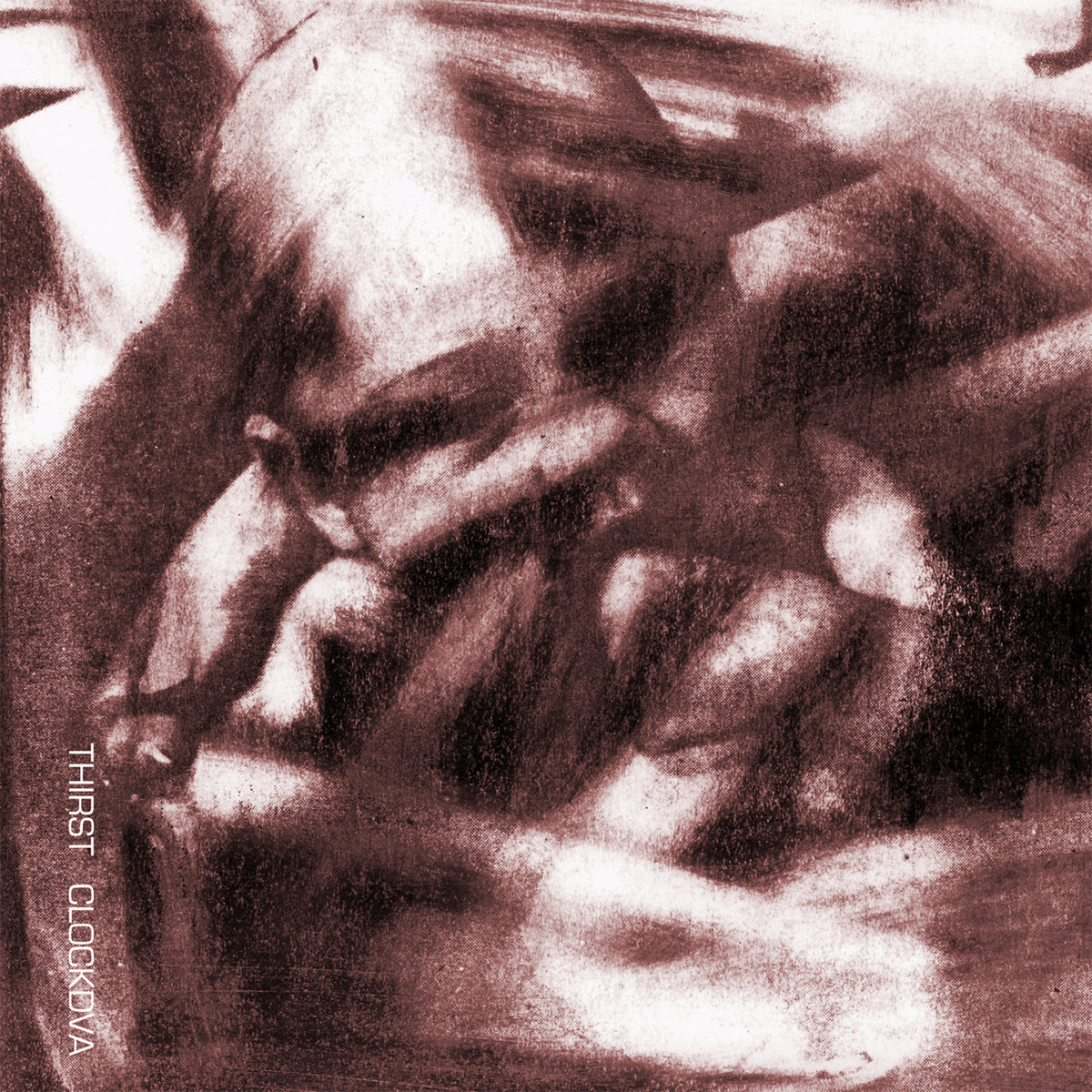
Certain albums document a musical movement. Others seem to anticipate entire futures. Clock DVA’s ‘Thirst’ belongs firmly in the latter category. Originally released in 1981 and now revisited through a meticulously assembled 2026 remaster sourced from the original tapes with the involvement of surviving members, the album remains one of the most fascinating documents to emerge from the fertile post-punk landscape of early-1980s Britain. It captures a band standing at the threshold between experimentation and accessibility, between industrial abstraction and songcraft, between the decaying certainties of the twentieth century and the technological anxieties that would come to define the decades ahead.
While many of their contemporaries explored alienation through minimalism or aggression, Clock DVA approached similar concerns through a more complex and multidimensional vocabulary. Adi Newton’s vocals, clarinet work, and tape manipulations interact with Steven “Judd” Turner’s bass, Roger Quail’s drums, Paul Widger’s guitar, and Charlie Collins’ saxophone and flute contributions to create a sound world that feels simultaneously cerebral and visceral. Produced by Newton and Ken Thomas, the album transforms familiar rock instrumentation into something unstable and uncanny, constantly shifting between structure and disintegration.
The opening epic, “Uncertain,” immediately establishes the album’s philosophical ambitions. Rather than functioning as a conventional introduction, the track immerses the listener in a landscape of ambiguity and psychological unease. Turner’s bass moves with hypnotic determination beneath layers of guitar, saxophone, and electronic manipulation, while Newton’s vocal delivery suggests an observer attempting to decipher an increasingly fragmented reality. More than four decades after its original release, the song remains remarkably contemporary in its examination of uncertainty as a defining human condition.
“Sensorium” condenses many of the album’s central ideas into a far more concise form. One can hear the blueprint for countless darkwave and industrial dance records that would follow. Collins’ saxophone introduces an unusual organic quality into an otherwise mechanized environment, creating a fascinating contrast between human expression and technological repetition. The song’s enduring popularity is no mystery; it captures a rare balance between experimental daring and immediate appeal. The stark and unsettling “White Cell” ventures deeper into the album’s preoccupation with confinement, surveillance, and psychological isolation. Widger’s guitar work becomes particularly effective here, generating textures that seem to dissolve conventional rock forms from within. The performance carries an almost cinematic quality, evoking dim corridors, institutional spaces, and fractured states of consciousness without resorting to literal storytelling.
“Piano Pain” offers one of the album’s most intriguing juxtapositions. The title itself suggests the collision of refinement and discomfort, and the music reflects precisely that contradiction. The composition draws upon elements of jazz, avant-garde experimentation, and post-punk without settling comfortably into any of those categories. Newton and his collaborators seem less interested in genre than in discovering new methods of emotional communication.
One of the record’s most absorbing achievements arrives with “Blue Tone.” Stretching close to six minutes, the piece demonstrates Clock DVA’s remarkable command of atmosphere and pacing. Collins’ flute and saxophone contributions become particularly significant, adding shades of melancholy and mystery that enrich the composition’s emotional range. Rather than building toward a conventional climax, the track develops through accumulation, layering textures and ideas until a distinctive psychological environment emerges. “North Loop” continues the album’s exploration of movement and repetition. The rhythm section excels throughout, with Quail and Turner providing a foundation that remains fluid while maintaining a sense of purpose. Their interplay allows the more experimental elements to flourish without losing coherence. Few groups of the period were capable of integrating improvisational instincts and disciplined composition so effectively.
The focal point of the album remains “4 Hours,” one of the defining tracks of early industrial and post-punk music. Its reputation has only grown with time and hearing it within the context of the remaster reveals why. The song possesses a hypnotic quality that transcends stylistic boundaries. Built upon a relentless rhythmic pulse and enriched by Collins’ saxophone textures, it transforms repetition into a form of psychological immersion. The track’s influence on subsequent generations of darkwave, gothic rock, industrial dance, and electronic music is difficult to overstate. “Moments” provides one of the album’s most emotionally resonant passages. Here, Clock DVA demonstrates that experimentation need not come at the expense of feeling. The composition navigates introspection and unease with remarkable subtlety, creating an atmosphere that is simultaneously reflective and unsettling. Newton’s vocal performance is especially compelling, balancing detachment and vulnerability in equal measure.
Closing the original album, “Impressions of African Winter” remains among the band’s most ambitious creations. The title alone suggests displacement and contradiction, and the music embraces those qualities fully. Elements of jazz, industrial sound design, post-punk rhythm, and abstract composition coexist within a piece that resists straightforward interpretation. Rather than providing resolution, it leaves listeners suspended within the album’s enigmatic world. The expanded material included in this edition adds valuable context. “The Opening (Live At The Lyceum)” and “Remain Remain (Live At The Lyceum)” capture the group’s formidable stage presence, revealing how effectively these complex compositions translated into a live environment. The performances possess a raw immediacy that complements the studio recordings while highlighting the musicians’ strengthening improvisational skills.
The inclusion of “4 Hours (Single Mix)” and “Sensorium (Single Mix)” offers an illuminating glimpse into how the band adapted their ideas for a broader audience without compromising their artistic identity. These versions emphasize clarity and momentum while preserving the qualities that made the original recordings so distinctive. Most fascinating, however, are the newly recorded reinterpretations. “4 Hours (DVATION 2026 version)” demonstrates how resilient the composition remains, its core ideas proving just as potent in a contemporary setting. Even more striking is “Sensorium (DVATION 2026 version),” which expands the original into an extended meditation that bridges the distance between Clock DVA’s origins and their continued evolution. Rather than treating the past as a museum piece, these recordings engage in a dialogue with it.
What makes ‘Thirst’ such a remarkable achievement is its refusal to provide easy answers. The album is concerned with perception, identity, technology, memory, and alienation, yet it approaches these subjects through suggestion rather than declaration. Clock DVA understood that mystery can often communicate more effectively than certainty. Their music invites interpretation without demanding consensus. The 2026 remaster highlights the sophistication of the original recording while preserving its sense of danger and discovery. Every instrument occupies a clearer space, allowing listeners to appreciate the intricate relationships between Newton’s vocals and tape experiments, Widger’s guitar, Turner’s bass, Quail’s drums, and Collins’ woodwind contributions. The result is not a revision of history but a sharper lens through which to experience it.
Viewed from the perspective of the present day, ‘Thirst’ stands as one of the defining achievements of early industrial and post-punk music. It remains adventurous without becoming inaccessible, intellectual without sacrificing emotional impact, and innovative without relying on novelty. Few records from its era have aged with such grace or retained such a powerful sense of possibility. This remastered edition confirms what devoted listeners have long understood: Clock DVA were not merely documenting a changing world, they were imagining one that had not yet arrived.
Find streaming, purchasing, and artist information in the following links: Mute Records | Bandcamp | Adi Newton | TAGC | ARMComm