
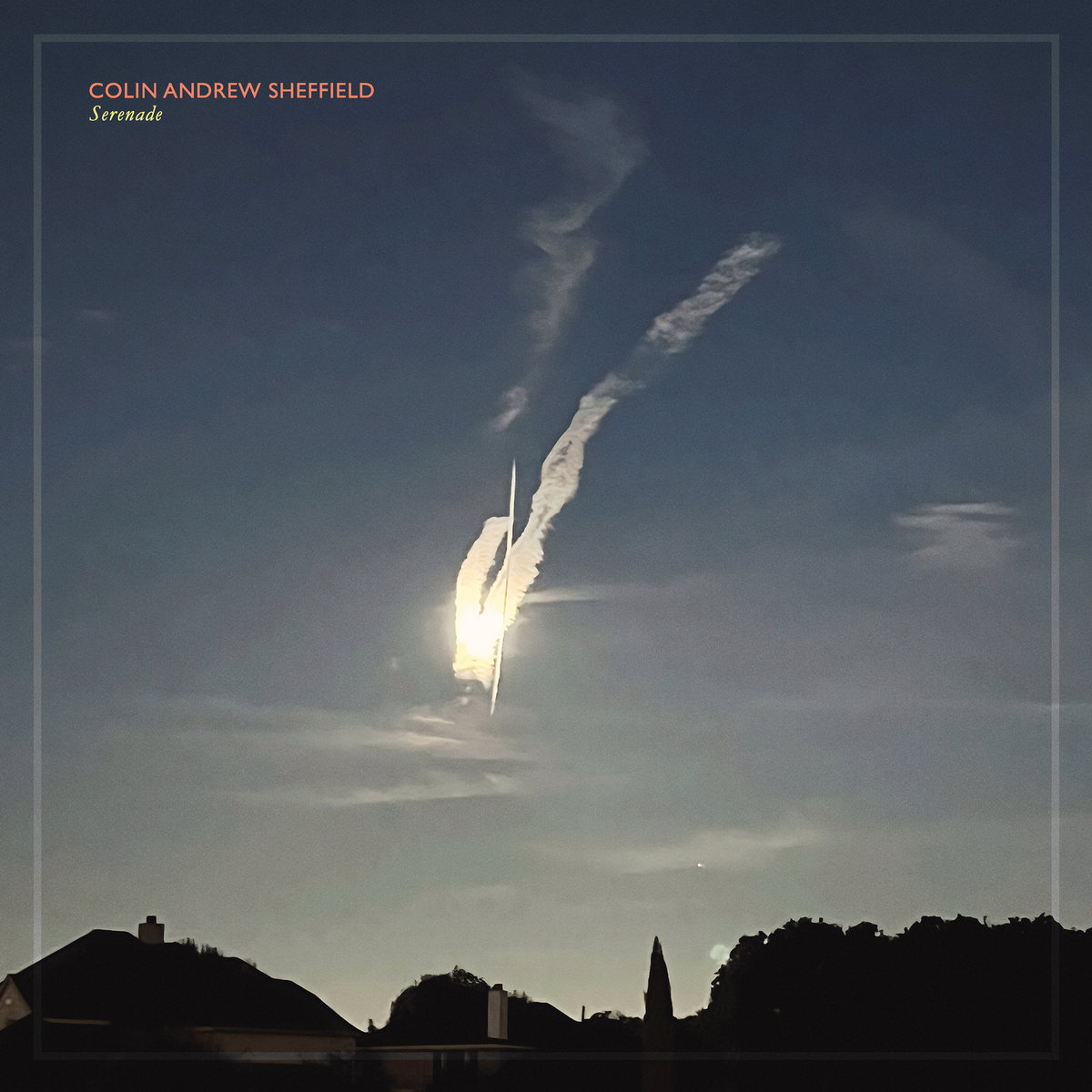
Colin Andrew Sheffield’s ‘Serenade’ achieves something increasingly rare within contemporary electroacoustic composition: it sustains abstraction while remaining unmistakably emotional. Built entirely from manipulated commercially available sound sources and assembled over an extended period of solitary studio work in Austin, the album transforms microscopic fragments into a deeply expressive language of suspension, erosion, memory, and interior movement. Sheffield approaches sound less as material to be organized than as emotional residue to be carefully excavated and recontextualized. Every composition on the record seems to hover between disappearance and revelation, as though the music were struggling to preserve itself against time and decay.
Although Sheffield has long demonstrated an extraordinary command of collage-based composition, ‘Serenade’ distinguishes itself through its unusual warmth and lyrical sensitivity. The album retains the abstract density associated with his earlier work, yet these pieces are guided by a melodic instinct that quietly reshapes the emotional architecture of the record. Even when recognizable instrumentation has been dissolved through processing, traces of orchestral motion, harmonic progression, and romantic gesture remain suspended within the mix like partially remembered dreams.
The opening “Falling” establishes this atmosphere immediately. A slow drift of blurred harmonic matter descends through layers of softened resonance, creating the sensation of movement without clear destination. Sheffield manipulates spatial depth with exceptional precision; sounds seem to recede even as they emerge, producing an unstable listening environment in which foreground and background continuously exchange roles. What is remarkable is the emotional specificity carried by these otherwise abstract textures. The piece evokes resignation, melancholy, and quiet wonder without relying on recognizable melodic phrasing.
“Whirlpool” contracts the album’s scale into something more claustrophobic and psychologically circular. Processed fragments rotate through the stereo field with hypnotic persistence while submerged drones create a sense of submerged pressure. Sheffield’s editing technique is especially impressive here. Tiny sonic particles flicker briefly before dissolving back into the composition’s larger current, suggesting memory fragments caught within repetitive internal motion. The brevity of the track only intensifies its effect, functioning almost like a transitional psychological state rather than a discrete composition “Another Time” introduces one of the album’s most poignant emotional gestures. Beneath its delicate surface lies a profound meditation on distance and irretrievability. Sheffield allows softened harmonic textures to drift through vast spatial environments, creating the impression of music remembered imperfectly across decades. The piece demonstrates his remarkable understanding of restraint. Nothing is overstated. Every processed tone appears carefully weathered, carrying traces of former identities while refusing full clarity.
“Invocation” expands the album’s emotional and structural dimensions considerably. Here, Sheffield assembles elongated drones, blurred orchestral remnants, and distant resonances into something approaching ceremonial music, though stripped of any fixed cultural reference point. The composition possesses an almost liturgical solemnity, yet it avoids grandeur. Instead, it communicates vulnerability through fragmentation. Sounds emerge slowly from obscurity, gather temporary coherence, then dissolve once again into spectral diffusion. Sheffield’s manipulation of harmonic density throughout the piece is extraordinary, allowing frequencies to overlap in ways that produce subtle emotional dissonances without conventional conflict.
One of the defining characteristics of ‘Serenade’ is its relationship to physicality. Despite the extensive processing involved, the album never loses its sense of material presence. One can almost feel the friction of tape manipulation, the soft abrasion of degraded audio surfaces, the pressure of layered frequencies interacting within confined space. Yet Sheffield never fetishizes texture for its own sake. These sonic details serve emotional and psychological purposes, shaping the listener’s perception of memory, absence, and temporal instability. “Reason” introduces a fleeting sense of composure before “Maneuver” shifts the album into more uncertain territory. The latter piece is particularly striking in its subtle complexity. Processed tonal fragments seem to reposition themselves constantly within the mix, creating a sensation of delicate recalibration. The composition suggests movement through obscured emotional terrain, where orientation remains perpetually unstable.
“Sunrise” stands among the most luminous works Sheffield has produced. Without abandoning the album’s abstract vocabulary, the piece introduces a surprising openness and harmonic clarity. Soft drones rise gradually beneath suspended tonal fragments, creating the impression of light diffusing through fog or cloud cover. Yet even here, Sheffield avoids easy transcendence. The beauty of the composition remains fragile, shadowed by instability and impermanence. The brief “Burning” interrupts this calm with a denser, more compressed emotional atmosphere. Frequencies rub against one another with uneasy intensity while fragments of processed sound seem to collapse inward under invisible pressure. The track functions as a moment of psychic disturbance before the eerie minimalism of “Premonition,” where absence itself becomes compositional material. Tiny resonances drift through near-silence with startling emotional weight.
“Progression” serves as one of the album’s most structurally intricate works. Sheffield layers multiple streams of processed harmonic material into slowly shifting patterns that suggest development without traditional narrative movement. The piece captures the album’s central paradox beautifully: despite being assembled from heavily manipulated external sources, the music feels deeply personal and introspective. Sheffield transforms anonymous sonic fragments into something profoundly human. The pair of “Night Watch” and “Testament” provide a magnificent conclusion. “Night Watch” carries a sense of suspended vigilance, its low-frequency drones and distant tonal flickers evoking insomnia, solitude, and nocturnal reflection. Then “Testament” arrives as the album’s emotional culmination, gathering many of the record’s central sonic characteristics into a final meditation on transience and memory. The composition moves with quiet inevitability, allowing softened harmonic structures to rise and dissipate in slow succession. Sheffield resists closure in any traditional sense. Instead, the album concludes by dissolving gently into ambiguity, preserving its emotional resonance long after silence returns.
Because ‘Serenade’ was composed entirely by Colin Andrew Sheffield using transformed commercially available sound sources, no additional musicians appear on the release. Yet the album never feels isolated or hermetic. On the contrary, Sheffield’s source manipulation creates the uncanny sensation of countless invisible presences embedded within the music; erased performances, dissolved orchestras, fragmented histories lingering beneath layers of processing and recombination.
Stephan Mathieu’s mastering contributes enormously to the album’s remarkable spatial coherence. Every frequency occupies space with extraordinary delicacy, preserving both the softness and complexity of Sheffield’s layered constructions. What makes ‘Serenade’ so affecting is its refusal to separate formal experimentation from emotional expression. Sheffield understands that abstraction can communicate feeling with enormous precision when approached with patience, sensitivity, and compositional discipline. The album meditates on memory not as nostalgia, but as acoustic instability, fragments continually shifting shape as they pass through time and perception. Few contemporary electroacoustic records possess this degree of emotional intelligence. ‘Serenade’ confirms Colin Andrew Sheffield as one of the most sophisticated composers working within abstract sound today, crafting music that transforms erosion, fragmentation, and uncertainty into something quietly profound.
To learn more, please visit Elevator Bath Records | Bandcamp