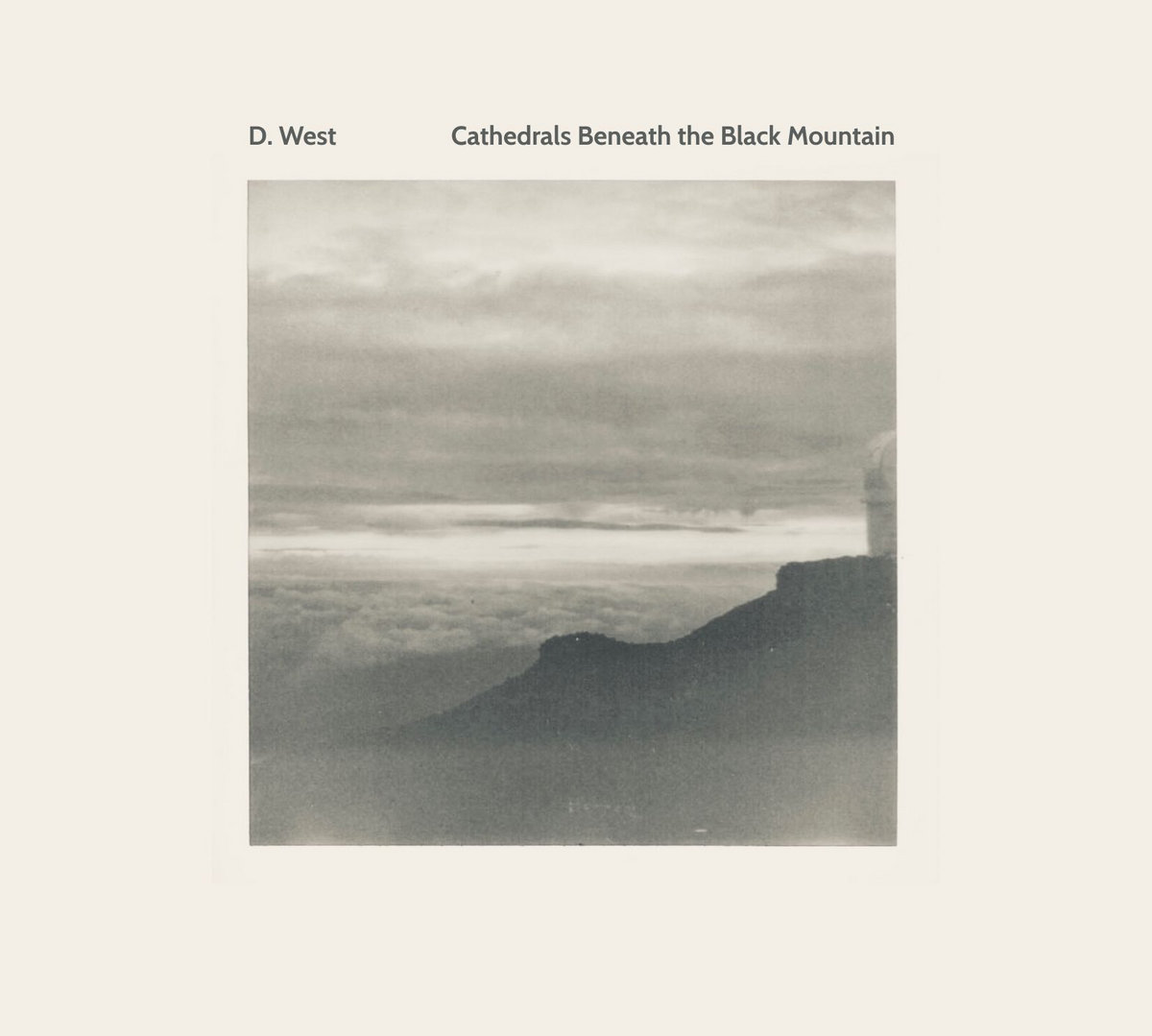
There is an austere, almost architectural sensibility at work within ‘Cathedrals Beneath the Black Mountain’, the latest offering from D. West. Like a structure uncovered rather than constructed, each passage exposes another chamber of thought, another corridor of unease or wonder. It is an album preoccupied with scale (spiritual, geographic, psychological), and yet it is rendered with a precision that keeps it from collapsing under its own ambitions.
D. West, who appears to helm the instrumentation with a near-solitary focus, treats sound less as decoration and more as material. Melodies swell and recede like weather systems, guitars emerge not as carriers of melody but as tonal anchors, and percussion arrives sparingly, often suggesting motion rather than dictating it. This careful orchestration gives the record a sense of internal logic, as though each sound has been placed according to an unseen blueprint.
“Dance of the Cathedral Flames” opens the album with a paradoxical energy, its title suggesting motion within stillness, or ritual within destruction. The composition leans into that duality, pairing luminous tonal clusters with an undercurrent of unease. It feels ceremonial, but not in any comforting sense; instead, it implies a rite whose meaning has been partially lost, leaving only the gestures behind. This ambiguity carries into “New Dystopia,” where the palette darkens and the sense of space expands. Here, West explores repetition not as stagnation but as erosion, with motifs returning slightly altered each time, as if worn down by their own recurrence.
“Cult of the Celestial” introduces a more overtly melodic thread, though it never fully resolves into something familiar. The piece hovers between reverence and skepticism, its ascending figures suggesting aspiration while its harmonic shifts subtly undermine any notion of transcendence. This push and pull becomes a defining characteristic of the album, particularly in “The Path to the Black Lodge,” which unfolds like a slow descent into a place that is both physical and symbolic. The pacing here is deliberate, almost meditative, but there is an undercurrent of inevitability that prevents it from feeling static.
“Cathedrals Beneath the Black Mountain,” stands as the album’s core, both in scale and in conceptual weight. It synthesizes the record’s central concerns (structure, depth, obscured meaning), into a single, extended meditation. Layers of sound accumulate gradually, forming something that feels less like a song and more like an environment. There is a sense of being enclosed within it, of moving through a space that resists easy comprehension. The cathedral, in this context, is not a place of worship but of confrontation, a site where the listener is forced to reckon with the vastness implied by the music.
“Blue Spider II” shifts the focus inward, offering a more intimate, though no less enigmatic, interlude. Its textures are finer, its gestures more restrained, as if examining the intricate details that were previously overshadowed by larger forms. This attention to microstructure provides a necessary contrast, reminding the listener that the album’s grandeur is built from smaller, carefully considered elements.
The closing piece, “The Transpacific International Causeway,” extends outward once more, but with a different perspective. Where earlier tracks often suggested enclosure or descent, this one evokes distance and connection, a spanning of spaces that are otherwise separate. The composition carries a quiet momentum, less concerned with arrival than with the act of traversal itself. It leaves the album unresolved in a deliberate way, emphasizing continuity over closure.
What makes ‘Cathedrals Beneath the Black Mountain’ compelling is not simply its atmosphere, but its intellectual rigor. D. West approaches composition as a form of inquiry, using sound to explore ideas that resist straightforward articulation. The absence of overt narrative or lyrical guidance places greater responsibility on the listener, but it also allows for a more personal engagement. Each track becomes a space to inhabit rather than a statement to decode.
There is a confidence in the album’s restraint, in its refusal to over-explain or overextend. By limiting its palette and focusing on the relationships between sounds, West achieves a kind of clarity that paradoxically enhances the record’s sense of mystery. The result is a work that feels both meticulously constructed and curiously open-ended, inviting repeated listening not for the sake of familiarity, but for the possibility of new understanding.
Visit Bandcamp to have a listen or to purchase.