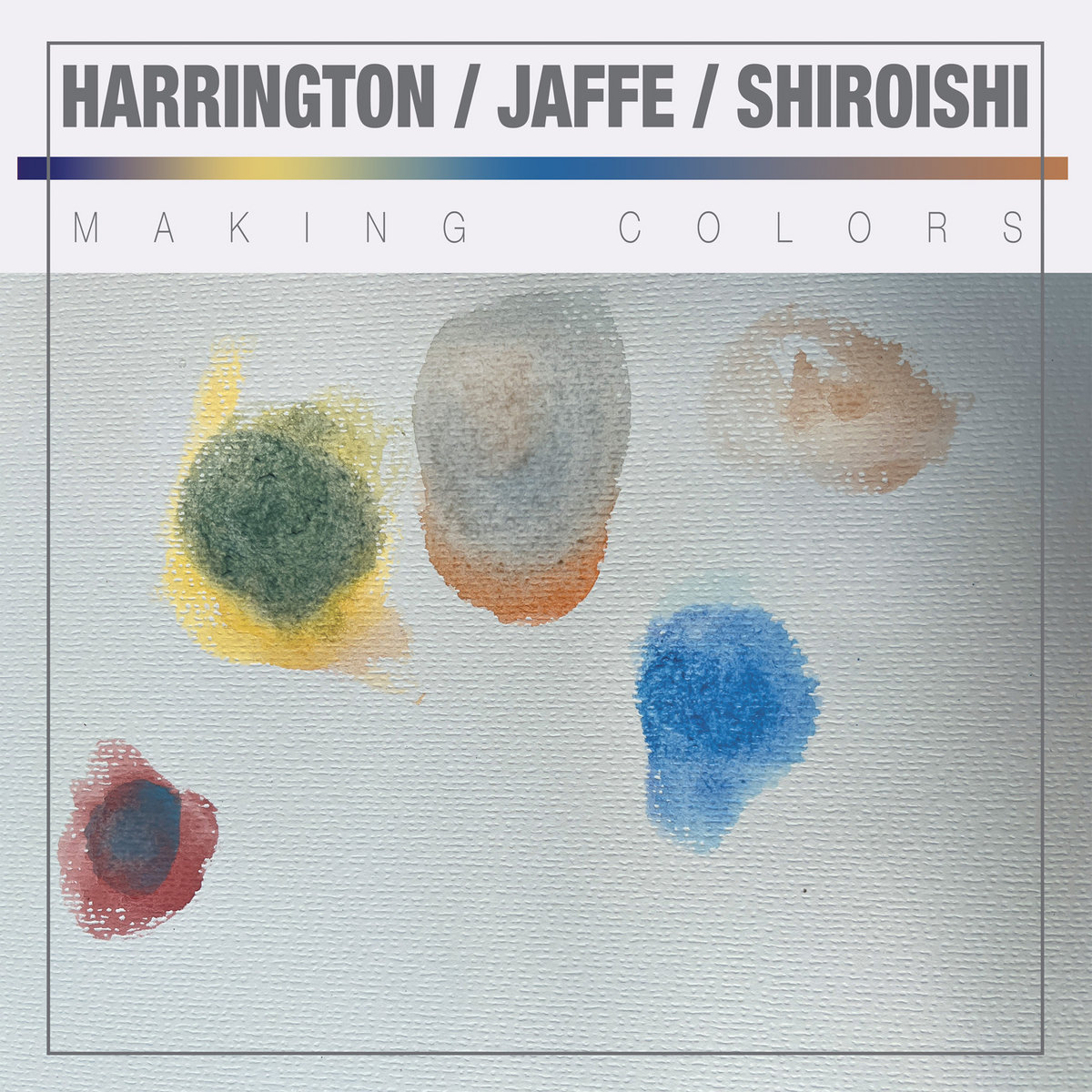
Improvisation often carries with it an implicit promise of discovery, but on ‘Making Colors,’ Dave Harrington, Max Jaffe, and Patrick Shiroishi pursue something more elusive: a language that forms and dissolves in real time, shaped equally by instinct and by the subtle afterlife of editing and mix decisions. Recorded in a single day yet refined through considered post-production, the album captures not just an encounter between three musicians, but the evolving logic of their shared vocabulary.
“open (4-a)” introduces this logic with deceptive restraint. Harrington’s guitar, occasionally shaded by organ and electronics, sketches out a melodic contour that seems tentative only on the surface. Beneath it, Jaffe’s drum set and sensory percussion articulate a rhythmic field that resists strict meter, while Shiroishi’s alto saxophone enters in fragments; phrases that feel exploratory, searching for alignment rather than asserting it. The piece establishes a key principle of the record: movement without fixed destination.
That principle intensifies in “six acting orange (aaaaa),” where the trio leans further into contrast. Jaffe’s percussive language becomes more textural, incorporating gongs and processed elements that blur the line between rhythm and atmosphere. Harrington responds with sharper tonal gestures, while Shiroishi’s saxophone oscillates between lyrical clarity and near-abstraction. The result is a passage that feels simultaneously grounded and unstable, its internal coherence emerging through interaction rather than structure.
“steal from walgreens” shifts the emphasis toward density. Electronic elements become more pronounced, filling the spaces between instrumental lines with a kind of restless energy. Harrington’s guitar here takes on a more fragmented role, its phrases interlocking with Jaffe’s rhythmic patterns in ways that suggest a shared vocabulary of interruption and continuation. Shiroishi, moving between saxophone and electronic augmentation, threads these elements together, his contributions acting as both connective tissue and point of departure.
“sweat street 7-QS:ZBN9_” completes the album’s first arc with a heightened sense of propulsion. The trio’s interplay becomes more assertive, though it never settles into predictability. Jaffe’s drumming, augmented by effects, creates a shifting ground over which Harrington and Shiroishi navigate with increasing confidence. The piece suggests a culmination, yet it avoids resolution, instead leaving the energy suspended as the record transitions into its second half.
“need buy in (17-b)” introduces a more overt engagement with repetition. Loop-oriented structures emerge, not as rigid frameworks but as flexible anchors around which the trio can orbit. Harrington’s electronics play a more central role here, while Jaffe’s percussion interacts with the loops in a way that blurs authorship; rhythm becomes both generated and performed. Shiroishi’s contributions, whether through saxophone or electronic manipulation, weave in and out of this structure, maintaining a sense of fluidity within the repetition.
“FRACTAL HASH” marks one of the album’s most forceful statements. The trio draws on a heavier palette, with Jaffe’s drumming pushing toward a more physical intensity and Harrington’s guitar responding in kind. Shiroishi’s saxophone cuts through with a clarity that feels almost declarative, yet the piece never abandons its improvisational core. Even at its most assertive, the music remains open-ended, each gesture inviting a response rather than closing a thought.
“trackerKeeper” brings the album to a close with an extended meditation on space and duration. Here, the trio allows ideas to stretch, to linger, to dissipate. Harrington’s guitar and organ create a soft harmonic field, while Jaffe’s percussion recedes into subtle coloration. Shiroishi’s saxophone, at times barely more than a breath, traces lines that feel less like statements than like echoes. The piece does not aim for a definitive ending; instead, it gradually withdraws, leaving behind a sense of suspended continuity.
Across ‘Making Colors,’ the trio demonstrates a rare sensitivity to balance. Each musician occupies multiple roles with Harrington shifting between guitar, organ, and electronics; Jaffe expanding the drum kit into a broader field of percussive and electronic possibilities; Shiroishi navigating between acoustic and digital expression. Their interplay suggests not a hierarchy but a network, each node influencing and being influenced in turn.
What ultimately distinguishes the album is its treatment of time. The music acknowledges its origins in spontaneous performance, yet it is shaped by decisions made after the fact; choices in mixing and mastering that determine how these moments are perceived. Jaffe’s work in shaping the final form, alongside Harrington’s mastering, ensures that the album retains both immediacy and clarity, allowing its complexities to emerge without obscuring its core.
‘Making Colors’ does not present improvisation as a display of virtuosity, but as a method of inquiry. It asks how sound can be organized without predetermined structure; how three distinct voices can converge without losing their individuality. The answers it offers are provisional, constantly shifting, yet they cohere into a work that feels both deliberate and alive, a document of collaboration that continues to resonate beyond the moment of its creation.
Releases April 24, 2026
Learn more by visiting AKP Recordings or Bandcamp.