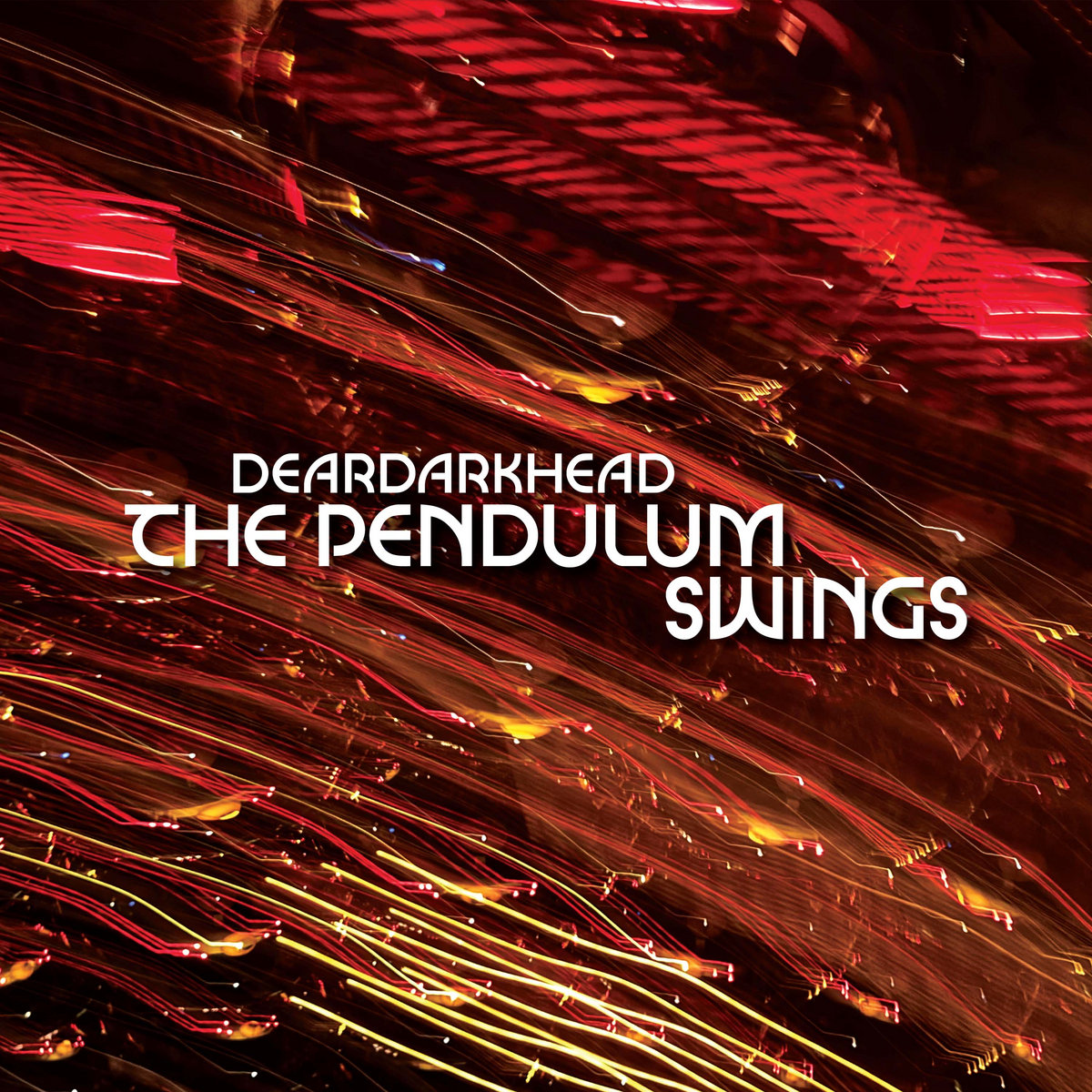
A quarter century between full-length albums can become either an insurmountable obstacle or an opportunity to rediscover artistic purpose. Deardarkhead embrace the latter with remarkable assurance on ‘The Pendulum Swings’, an instrumental record that communicates with uncommon emotional clarity while never relying on a single lyric. Rather than treating the absence of vocals as a limitation, the New Jersey trio has refined its language of melody, dynamics and atmosphere into something deeply expressive. Every composition suggests stories without prescribing them, allowing listeners to project their own memories and emotions onto a richly textured sonic landscape.
The opening “Flamethrower” immediately dispels any notion that this is an exercise in nostalgia. Kevin Harrington’s layered guitars ignite with controlled intensity, balancing shimmering melodic figures against walls of distortion that retain surprising clarity. Beneath them, Brandon Howard’s melodic bass playing anchors the arrangement with confidence, while Robert Weiss delivers drumming that propels rather than dominates. The result is forceful yet graceful, introducing the album with momentum instead of spectacle. “Coming Undone” shifts toward a more introspective register without sacrificing forward motion. Harrington’s guitar work glides between crystalline arpeggios and expansive washes of sound, creating an emotional dialogue that captures uncertainty with remarkable elegance. Weiss’ percussion subtly alters the pulse throughout the piece, allowing the composition to evolve naturally rather than depending upon abrupt changes. The song demonstrates the band’s ability to sustain interest through nuance instead of excess.
With “Tomorrowland,” Deardarkhead explores optimism tempered by reflection. The melodies reach skyward while the rhythmic foundation remains firmly grounded, producing an intriguing balance between aspiration and restraint. Howard’s bass lines become almost conversational, weaving through Harrington’s guitar textures with melodic independence that enriches every harmonic turn. “Tears” avoids sentimental excess by allowing emotion to emerge through patient development. The guitars shimmer with quiet luminosity, while Weiss introduces rhythmic accents that gently reshape the composition’s emotional contours. The absence of words encourages listeners to engage more actively with the music itself, discovering meaning through phrasing, harmony and tonal color rather than narrative.
One of the album’s most affecting moments arrives with “Sad Songs (and Better Days).” Its title suggests melancholy, yet the music continually reaches toward renewal. Harrington’s soaring lead lines carry unmistakable emotional weight without becoming indulgent, supported by Howard’s beautifully articulated bass melodies. Weiss understands precisely when to step forward and when to recede, giving the arrangement remarkable fluidity. The composition embodies the album’s central belief that hope and sorrow rarely exist in isolation but continually shape one another. The graceful “Letting Go” serves as both emotional and structural centerpiece. Joe McGinty’s keyboard contribution enriches the band’s established palette without overwhelming its identity, adding subtle harmonic depth that broadens the music’s emotional vocabulary. His understated performance blends seamlessly with Harrington’s guitars, creating luminous textures that reinforce the song’s themes of release and renewal. The arrangement possesses an almost meditative quality, demonstrating how instrumental music can communicate profound emotional transformation through carefully balanced sonic relationships.
“A Thanksgiving” follows with quiet confidence, expressing gratitude not through overt celebration but through measured elegance. The interplay between guitars, bass and percussion reflects years of collective musical understanding. Every phrase appears carefully considered, yet nothing feels overcalculated. The composition radiates warmth while maintaining the album’s contemplative character. “Black Pearls” ventures into darker harmonic territory, though never descending into despair. The guitars acquire greater weight, and Weiss’ rhythmic approach introduces subtle asymmetry that keeps the listener slightly off balance in the most engaging way. The piece highlights the trio’s ability to generate dramatic contrast while preserving cohesion across the broader arc of the album.
Among the record’s finest achievements, “In Another Life” captures the quiet melancholy of unrealized possibilities without becoming trapped in regret. Harrington’s soaring lead guitar suggests memories just beyond reach, while Howard’s melodic bass provides emotional grounding beneath the expansive arrangement. Weiss’ drumming, informed by an understated appreciation for cyclical rhythmic patterns, lends the composition a hypnotic quality that mirrors the recurring nature of reflection itself. The music acknowledges life’s unanswered questions while gently suggesting that acceptance carries its own form of peace. The closing title composition, “The Pendulum Swings,” provides a deeply satisfying conclusion. Here Harrington expands his instrumental role, adding bass VI, ebow and bass alongside his guitar work to create an especially rich sonic landscape. The additional layers broaden the harmonic spectrum, allowing the piece to encompass many of the album’s recurring themes within a single composition. Movement and stillness, light and shadow, certainty and ambiguity coexist with remarkable balance. Rather than striving for dramatic resolution, the music accepts perpetual motion as life’s defining condition, making the album’s title resonate both musically and philosophically.
The musicianship throughout ‘The Pendulum Swings’ deserves particular focus because every performance prioritizes collective expression over individual display. Kevin Harrington demonstrates exceptional versatility, building intricate guitar architectures that remain emotionally direct despite their sophistication, while his additional bass VI, ebow and bass work on the closing track expands the album’s sonic vocabulary with subtle imagination. Robert Weiss provides far more than rhythmic accompaniment; his drumming shapes each composition’s emotional trajectory through carefully judged dynamics, inventive accents and an instinctive understanding of pacing. Brandon Howard’s bass playing across the first nine tracks forms an indispensable melodic foundation, consistently enriching the harmonic dialogue rather than merely reinforcing it. Joe McGinty’s tasteful keyboard appearance on “Letting Go” adds another dimension without disrupting the trio’s established chemistry.
Equally significant is the production by Brian McTear and Amy Morrissey. Their recording captures the expansive qualities of Deardarkhead’s music while preserving intimacy within every arrangement. Each guitar layer occupies its own distinct space, allowing even the densest passages to remain transparent. Joe Lambert’s mastering enhances that clarity, giving the album warmth, depth and impressive dynamic range without sacrificing immediacy. ‘The Pendulum Swings’ refuses to rely upon genre convention despite clearly drawing inspiration from shoegaze, dream pop and post-punk traditions. Those influences remain visible, yet Deardarkhead transforms them into something unmistakably personal. Melody carries the emotional narrative, texture provides psychological depth and rhythm supplies constant forward momentum. The absence of vocals encourages closer engagement with details that might otherwise remain unnoticed, revealing a level of compositional sophistication that rewards careful listening.
Rather than marking a nostalgic return, ‘The Pendulum Swings’ represents an artistic evolution shaped by experience, patience and renewed creative purpose. Deardarkhead demonstrates that instrumental music can communicate profound emotional complexity without explanatory lyrics, trusting melody and atmosphere to speak directly to the imagination. It is an elegant, deeply considered album that finds beauty in reflection while keeping its gaze fixed firmly on the possibilities that still lie ahead.
Releases July 10, 2026
Learn more links:
Deardarkhead
Bandcamp
YouTube
Facebook
Twitter