
The debut collaboration ‘Abacomancy’ by Derek Monypeny and Kevin Corcoran arrives less as a conventional document of improvisation than as a study in perception itself, a sonic analogue to the act of reading meaning into shifting surfaces. Its title, drawn from a method of divination through dust and sediment, proves uncannily precise: each piece feels less composed than discovered, as though the duo are tracing forms that already exist in the air between them.
The opening “Abacomancy Part 1” surges forward with an almost volatile immediacy, Monypeny’s guitar spitting angular phrases that flirt with dissolution while Corcoran answers in restless, prismatic bursts. The reference point might briefly evoke the ecstatic extremity of late-period free jazz guitar, yet what distinguishes this performance is its sense of spatial awareness. Even at its most forceful, the music never collapses into density for its own sake; instead, it breathes, leaving fissures where resonance and decay become as expressive as attack.
A recalibration occurs with “Abacomancy Part 2,” where gesture replaces velocity. Corcoran’s percussion turns fragmentary and investigative, sketching out irregular patterns that seem to test the edges of silence. Monypeny responds with a vocabulary of restrained timbres, allowing harmonics and faint distortions to hover rather than assert. The result is less a reduction of intensity than a redirection, an inward focus that sharpens the listener’s attention to minute shifts in texture.
“Abacomancy Part 3” introduces the shahi baaja, and with it a profound transformation of atmosphere. Monypeny’s engagement with the instrument opens a luminous, droning field that suggests an affinity with modal traditions without ever settling into pastiche. Corcoran’s accompaniment is strikingly empathetic here, his percussion dissolving into a constellation of delicate accents that seem to orbit the sustained tones. The piece achieves a rare equilibrium, balancing stillness with subtle motion in a way that feels almost architectural.
The brevity of “Abacomancy Part 4” belies its significance. It functions as a hinge within the record, compressing ideas from the surrounding pieces into a concentrated form. Guitar and percussion interlock in a series of quick exchanges, each phrase suggesting a path that is immediately abandoned. This constant redirection generates a quiet sense of unease, as though the music is deliberately resisting coherence.
With “Abacomancy Part 5,” the album reaches its most immersive and demanding passage. Extending beyond twelve minutes, it inhabits a shadowed terrain of sustained tones and low-frequency rumble. Monypeny constructs a dense, slowly shifting drone, while Corcoran layers percussive textures that feel less like rhythm than environmental presence. The piece evokes a landscape shaped by time and erosion, its contours revealed gradually through patient listening. What emerges is not narrative progression but accumulation, a deepening awareness of sonic detail that rewards sustained attention.
The closing “Abacomancy Part 6” gathers the preceding threads into a final meditation that feels both conclusive and open-ended. Elements of movement return, yet they are tempered by the restraint cultivated earlier in the record. The interplay between guitar and percussion achieves a quiet clarity, each gesture placed with deliberate care. Rather than resolving the tensions explored across the album, the piece allows them to coexist, suggesting that the act of interpretation remains ongoing.
What makes ‘Abacomancy’ particularly compelling is the evident history between Monypeny and Corcoran, a rapport forged through years of collaboration, including their work alongside the late Chad Stockdale. That shared experience manifests not in predictability but in trust, an ability to pursue divergent ideas without losing cohesion. Corcoran’s sensitivity to dynamic and texture proves essential, especially in the quieter passages where his restraint becomes a form of articulation. Monypeny, meanwhile, reveals a breadth of expression that extends far beyond the idioms typically associated with free improvisational guitar.
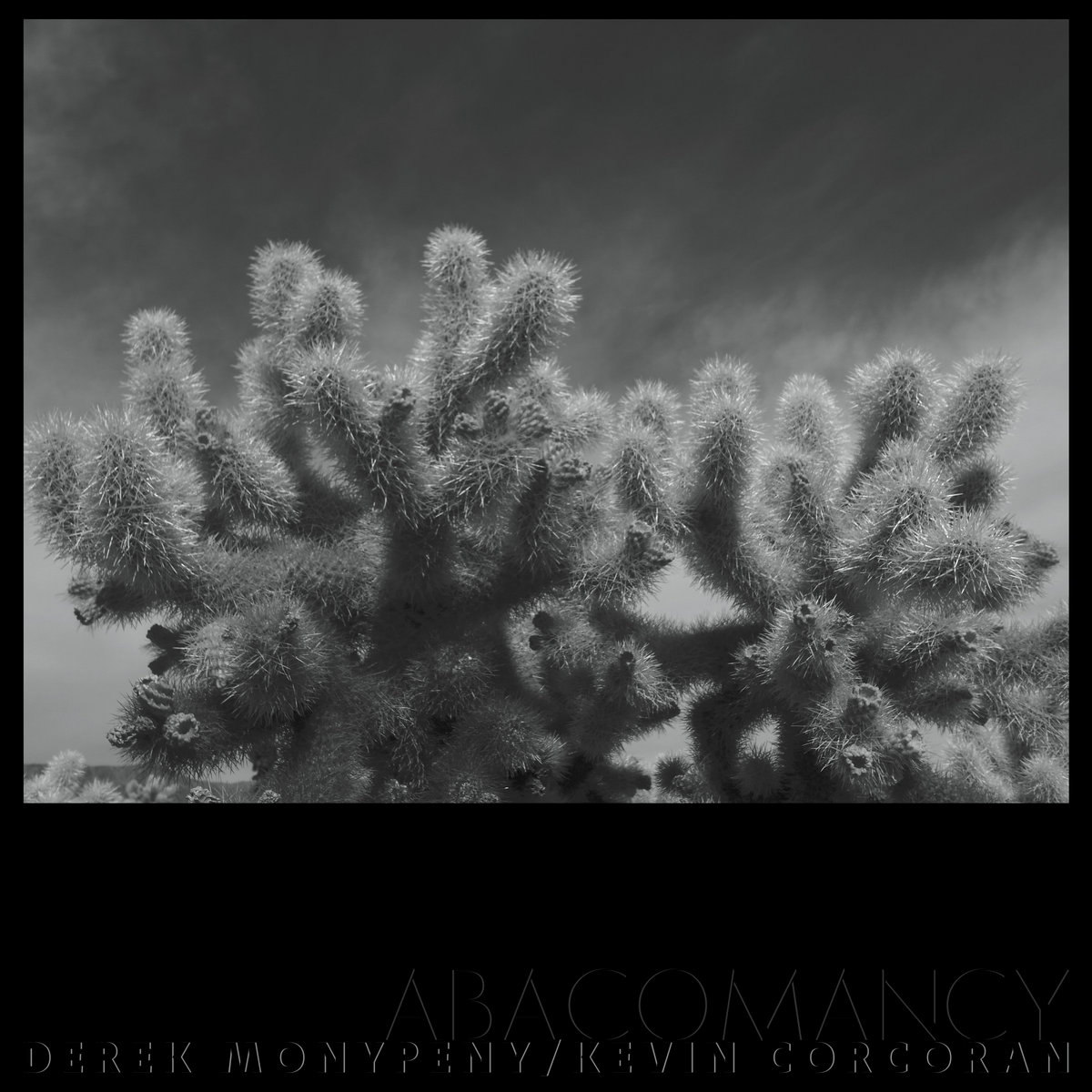
Recorded over a single day in Joshua Tree, the album carries with it an imprint of place that is never literal yet persistently felt. The accompanying visual work, drawn from Corcoran’s explorations of the Mojave landscape, finds a parallel in the music’s attention to surface and depth, to the traces left by both natural and human forces. Sound and image converge in their shared preoccupation with patterns that invite interpretation without yielding fixed meaning.
‘Abacomancy’ resists easy categorization, not through obscurity but through its refusal to prioritize any single mode of listening. It can be approached as an exercise in texture, as a dialogue between two deeply attuned musicians, or as an abstract reflection on environment and perception. Each perspective reveals different facets, none of them definitive. Like the practice from which it takes its name, the album invites repeated engagement, each encounter offering new configurations within the same shifting field.
To learn more, please visit 2182 Recording Company | Bandcamp.