
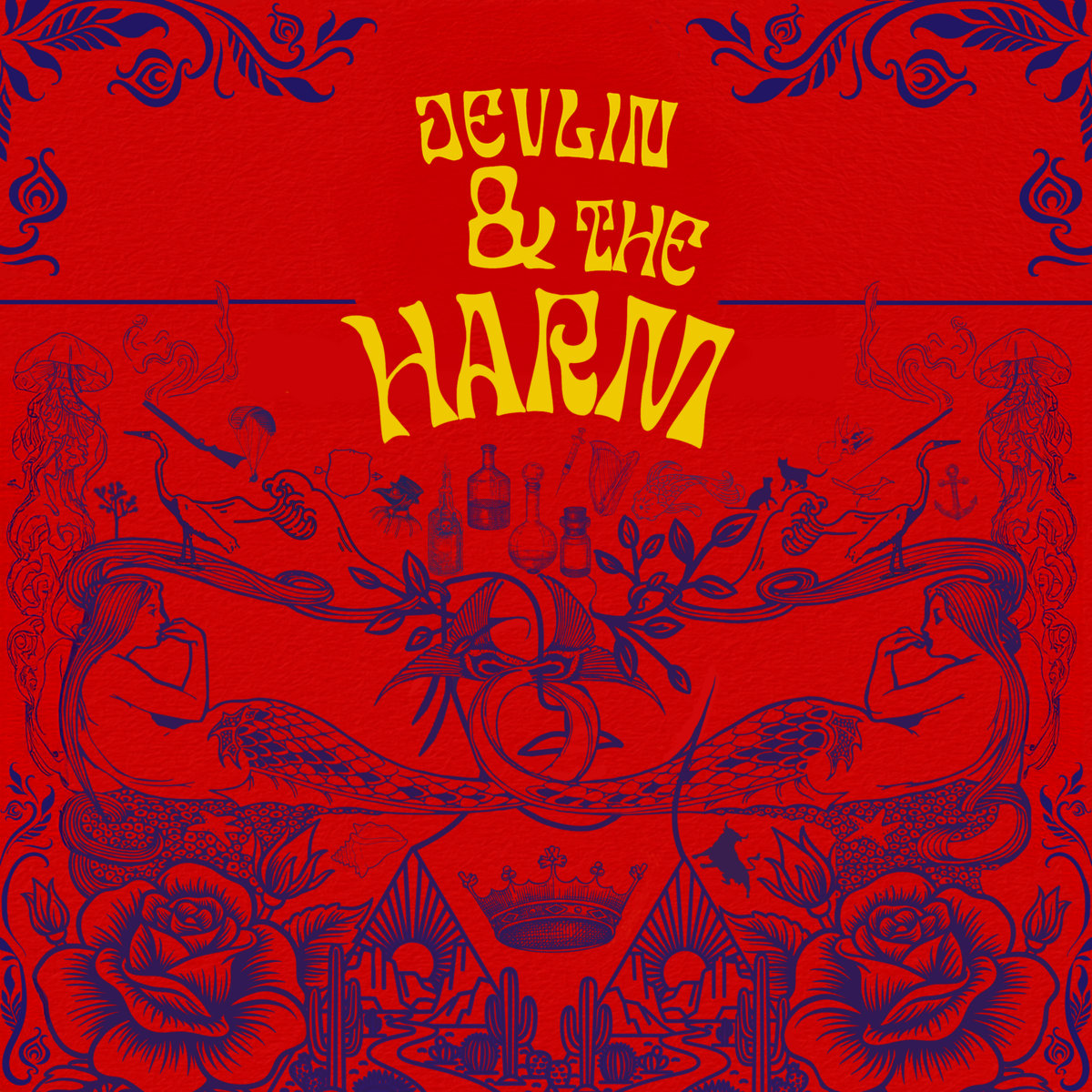
Faith, memory, and longing are often treated as separate subjects in contemporary songwriting. On ‘Devlin and the Harm,’ they become inseparable forces, each shaping the other in subtle and unexpected ways. The debut album from Devlin McCluskey and his collaborators arrives carrying the wide-screen atmosphere of desert noir, the melodic instincts of baroque pop, and the unvarnished directness of classic garage rock. Yet what distinguishes the record is not its stylistic blend. It is the way those influences are harnessed in service of larger questions concerning belief, loss, and the stories people construct to make sense of impermanence.
McCluskey’s voice serves as the album’s emotional anchor. His baritone possesses a weathered authority that recalls wandering narrators and disillusioned prophets rather than conventional indie-rock frontmen. Throughout these eleven songs, he sounds like someone simultaneously searching for answers and doubting the value of finding them. That ambiguity gives the record much of its power. “Kingdom Comes” opens the album with a cinematic sweep that immediately establishes its scope. Vibrato-soaked guitars stretch across the arrangement like heat rising from desert pavement, while McCluskey delivers the song with the conviction of a man staring into a distant horizon that may or may not contain salvation. The composition evokes images of forgotten border towns and fading myths, yet beneath its grand scale lies a deeply personal meditation on spiritual erosion. Few opening tracks in recent memory have balanced spectacle and introspection so effectively.
The excellent “No Havana” follows by narrowing the lens. Its imagery of blocked roads, unreachable destinations, and deferred hopes transforms geography into metaphor. The song wrestles with the distance between imagined futures and lived reality, finding beauty within disappointment rather than attempting to overcome it. Alex Newport’s (Fudge Tunnel, Nailbomb), production gives every instrument room to resonate without sacrificing momentum, allowing the arrangement to feel expansive while remaining emotionally intimate. McCluskey and Newport have developed a creative partnership that understands the value of atmosphere without allowing atmosphere to become the point.
“Dirt Used To Be Gold” examines the collapse of nostalgia with striking precision. Rather than romanticizing the past, the song questions why certain memories acquire value while others disappear. The title itself captures one of the album’s recurring ideas: that meaning is often assigned retrospectively, shaped by longing as much as truth. Musically, the track blends garage-rock immediacy with a melodic sophistication that elevates it beyond genre exercise. “Heyday”, featuring Keith Habersberger, introduces a different emotional texture. Habersberger’s contribution enriches the song’s communal character, transforming what could have been a simple reflection on better days into something more complex. The track explores nostalgia as a collective act of storytelling, exposing both its comforts and distortions. Rather than celebrating the past, it interrogates the mechanisms through which the past becomes idealized.
Among the album’s most affecting moments is “Stress Dreams.” Built around cinematic string arrangements and a fuzz-coated acoustic framework, the song addresses grief with remarkable restraint. McCluskey avoids melodrama entirely, focusing instead on the strange ways absence reshapes perception. Memories drift through the composition like submerged objects glimpsed beneath moving water. Every sonic decision serves the emotional core of the song, resulting in a piece that communicates loss without relying on obvious sentimentality.
The darker energy of “Bad Actors” introduces a note of skepticism. Here, the album’s concerns become more outward-facing, examining deception, performance, and self-interest. The song’s driving momentum contrasts effectively with the introspective material surrounding it, creating one of the record’s most dynamic sequences. “Fadeaway” and “Come On Through” function as complementary studies in impermanence. The former reflects on disappearance and the gradual erosion of certainty, while the latter seeks connection amid instability. Together, they highlight one of the album’s central achievements: its ability to acknowledge fragility without descending into despair. Even in its bleakest moments, the record retains a stubborn belief in the possibility of human connection.
“Wish Away” strips that idea down further. The arrangement feels almost skeletal compared to some of the album’s larger productions, placing greater emphasis on melody and lyrical reflection. The song examines the temptation to treat desire as a substitute for action, revealing how often people attempt to negotiate with reality through fantasy. The magnificent “Atascadero” stands among the album’s defining statements. Stretching beyond five minutes, it allows the band to fully inhabit its expansive aesthetic. The song drifts between reflection and revelation, balancing Americana-inflected textures with a cinematic sense of scale. Rather than functioning as a climax, it acts as a deepening of the album’s themes, demonstrating how memory can become both refuge and prison.
Closing track “Greenpoint Dryout” brings the record to a fitting conclusion. Its urban imagery contrasts with the desert landscapes that permeate much of the album, suggesting that the search for meaning persists regardless of setting. McCluskey’s performance carries a sense of hard-earned acceptance. Not resolution, but acceptance. The distinction matters. This album never pretends that life’s larger questions possess tidy answers.
Throughout ‘Devlin and the Harm,’ the musicians display a remarkable understanding of restraint and dynamics. Michael Nussbaum’s drumming provides steady propulsion without overwhelming the songs’ emotional nuance, while Newport’s production shapes the material into a coherent and immersive whole. Habersberger’s guest appearance adds another dimension to an already rich ensemble effort, and McCluskey’s songwriting consistently demonstrates an uncommon ability to balance literary ambition with melodic accessibility.
What makes ‘Devlin and the Harm’ especially noteworthy is its refusal to separate existential inquiry from everyday experience. Questions of faith emerge through ordinary conversations. Reflections on mortality appear within memories of places and relationships. Moments of doubt coexist alongside flashes of wonder. The album recognizes that meaning is rarely discovered through grand revelations; more often, it emerges through accumulated details, half-remembered stories, and fleeting encounters. Many records aspire to sound cinematic. Far fewer understand that cinema is not merely scale but perspective. ‘Devlin and the Harm’ succeeds because it treats each song as a carefully framed scene within a larger meditation on belief, loss, and perseverance. Richly atmospheric yet emotionally grounded, it marks a striking debut that transforms personal reflection into something resonant and universal.
Find out more by visiting Bandcamp