
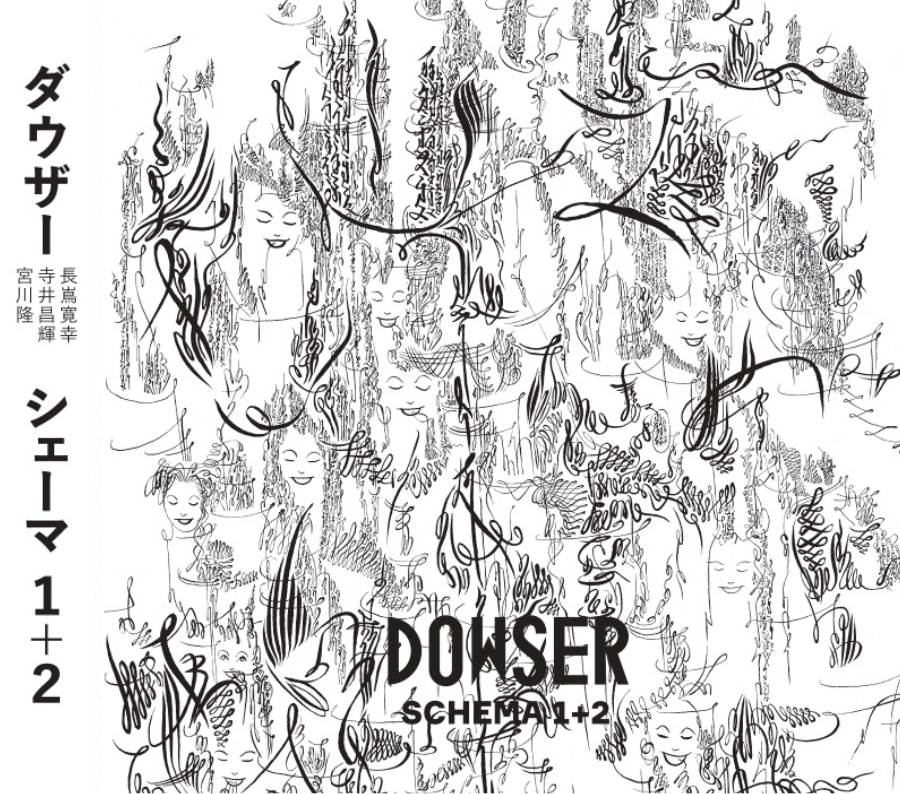
Across its two precisely balanced halves, ‘Schema 1+2’ finds Dowser working with a kind of quiet authority that comes from longevity without complacency. What Hiroyuki Nagashima and his collaborators have assembled here does not read as a return so much as a continuation, one that absorbs decades of electronic experimentation, film scoring, and underground practice into a language that feels at once disciplined and porous.
The first disc, ‘Schema 1,’ carries a sense of internal architecture that reflects Nagashima’s background in sound design. Rather than foregrounding melody, pieces like “Schema 1” and its surrounding movements operate through gradation and spatial suggestion. Vintage synthesizers (particularly the Buchla and EMS systems that have long been part of Dowser’s palette), generate tones that hover just at the edge of recognition, never fully resolving into familiar harmonic structures. What emerges instead is a kind of suspended motion, where timbre becomes the primary narrative device.
Masateru Terai contributes a subtle vocal presence that resists conventional phrasing, functioning less as lyrical delivery than as an additional instrument. His voice appears and recedes within the mix, often processed to the point where its human origin feels ambiguous. This ambiguity becomes central to the album’s emotional character: it is neither coldly mechanical nor overtly expressive, but something more elusive, occupying a space between intention and accident.
By contrast, ‘Schema 2’ leans further into contrast and disruption. The symmetry of duration between the two discs suggests equivalence, yet the second half introduces a more volatile interplay between sound sources. Here, the integration of digital processing with analog synthesis becomes more pronounced, producing textures that feel less stable, more prone to sudden shifts in density and tone. The track “Schema 2” acts as a kind of pivot, where low-frequency pulses and fractured high-end detail begin to challenge the relative restraint of the first disc.
What distinguishes Dowser in this context is not simply their hybridization of electronic, rock, and ambient elements, but the way those categories are quietly dissolved. There are moments where a distorted signal hints at guitar lineage, or where rhythmic fragments suggest a rock framework, yet these references never consolidate into genre. Instead, they remain suspended, as if the music is continually deciding what it might become without ever settling.
Takashi Miyagawa’s visual sensibility, rooted in automatic drawing, finds a parallel in the music’s construction. The pieces often feel as though they emerge from a semi-conscious process, guided but not overly determined. This approach aligns with the group’s self-conception as an “Unconscious Electronic Sound Collective,” and it manifests here in compositions that balance deliberation with unpredictability. The result is not improvisation in a traditional sense, but something closer to guided emergence, where structure is discovered rather than imposed.
Nagashima’s history as a film composer lingers in the background, not through overt cinematic gestures but in the attention to atmosphere and pacing. The music suggests environments rather than narratives, evoking spaces that feel simultaneously intimate and unbounded. This sensibility recalls his work for directors like Gakuryu Ishii and Shinji Aoyama, where sound often functions as an extension of psychological and physical space rather than a mere accompaniment.
What makes ‘Schema 1+2’ compelling is its refusal to announce itself. It does not seek immediacy or overt impact; instead, it operates through accumulation, allowing its details to register gradually. The interplay between analog warmth and digital precision, between human gesture and machine logic, becomes more apparent over time, revealing a carefully considered balance that never tips into rigidity.
For a group long associated with Japan’s underground, this release does not attempt to reintroduce or redefine Dowser. It simply extends their vocabulary, demonstrating how a project rooted in a specific historical moment can continue to evolve without abandoning its core sensibility. In that sense, ‘Schema 1+2’ stands less as a statement of reinvention than as a reaffirmation of process, one that remains open, exploratory, and quietly exacting.
Releases June 1, 2026
For more information or to preorder, please visit All Horned Animals | Bandcamp | Instagram | Tumblr | Twitter