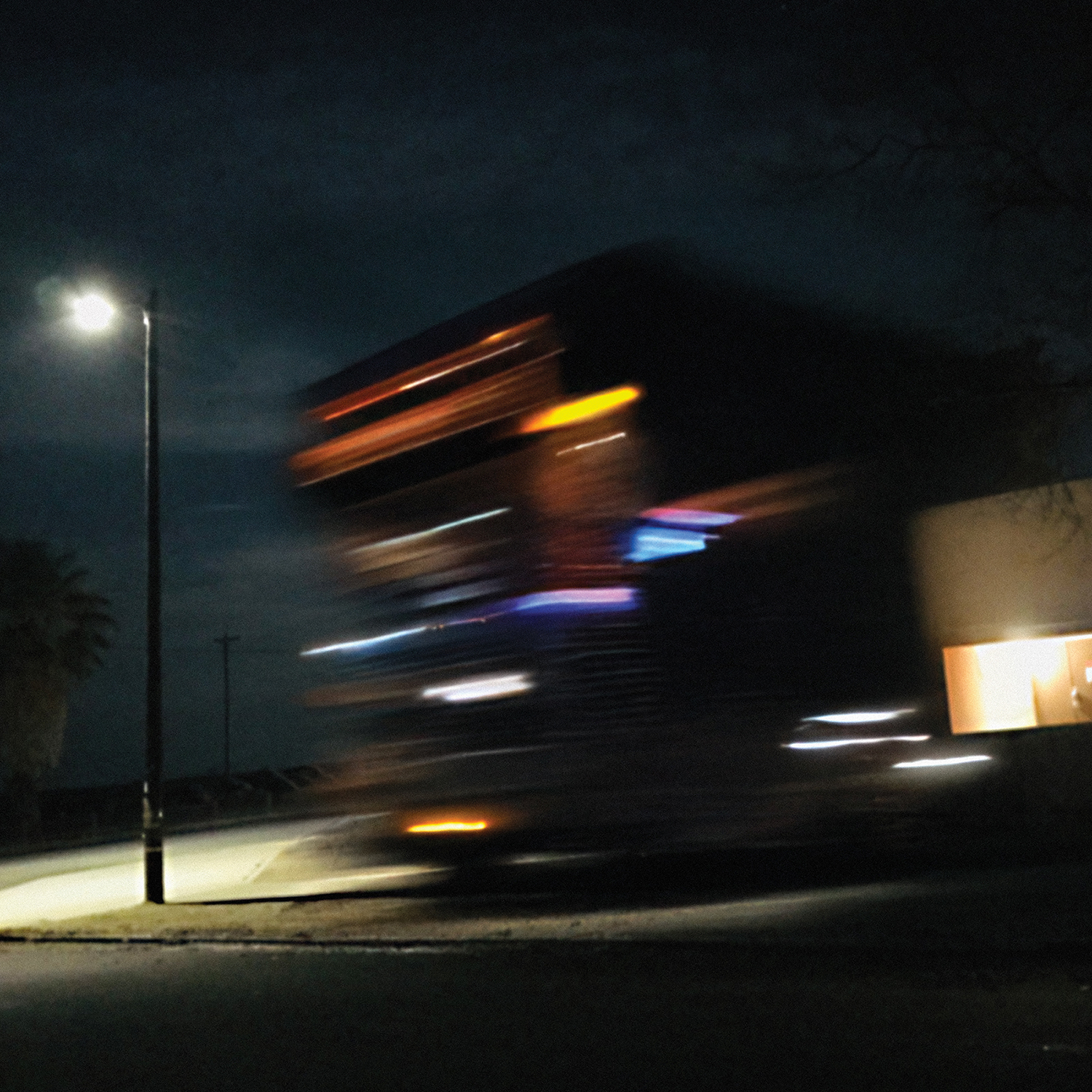
In the way that every morally conscious individual right now is reckoning with mortality in some fashion or another, instrumental duo El Ten Eleven too have cooked that ennui into the title of their eleventh(!) LP Nowhere Faster. Given their classically vocal-less nature, it’s the album and song names that must do the talking. It’s noted that a bewilderment of AI’s omnipresence is the culprit behind leadoff track “Uncanny Valley Girl” and yet despite the uneasy feeling that inspires, guitarist/bassist Kristian Dunn and drummer Tim Fogarty are meeting the discomfort head on with everything in the toolkit. Around its halfway mark, Dunn slowly mounts an arpeggiated assault in the bass register, requiring his trademark innate metronome for building complex loops. His ability to construct a full-bodied rhythm and lead section has never appeared so dexterous. Longtime fans who’ve gobbled up early standards like “My Only Swerving” countless times can almost visualize such a song’s sequence for themselves, piece by piece. By the time Fogarty’s drums rise to a clatter in the second life of “Uncanny Valley Girl”, Dunn’s interlocking system of notes has reached a level of precision that would make Victor Wooten nod in approval. The band is simply playing as hard as they possibly can, as if this is the last record they’ll get to make.
“Björk’s Alarm Clock” takes its name from a jab directed at their style from an early tourmate, and the song’s spritely, chorus-laden arpeggios double down on the claim. They’ve effectively conjured what its titular Icelandic songstress’s alarm call (ha!) would ostensibly sound like, as its fey melodies gracefully match her extraplanar existence, sweeping string sections and all. “Awhile Ago, Alone” bears the heavy reverb and twinkly, cascading guitar that first garnered El Ten Eleven a “post-rock” genre tag. Pretty as it is, Fogarty’s drums take several spotlights here, compiling what may be at least three definitive timbres of percussion in its span.
Bringing side A to a tremendous close is “Last Night in the Kitchen” with its oblique, squawking baritone guitar lines engaged in call-and-response from both sides of the speakers; their textures resemble that of Daniel Christiansen and Monty Munro’s twin guitars in Preoccupations—a likeness one normally wouldn’t expect out of these two! Of course, all of this is—to tether it to their wheelhouse—fed through the funnel of modern day Mogwai with its militaristic shuffle, resulting in a crescendo flanked by the most dramatic string section accompaniment thus far while Fogarty occasionally slips in a stutter step to jostle the impossibly tall Jenga tower of tension they’ve stacked. He does so with a wink: they’ve operated under these conditions for decades.
Organic strings and piano color in nearly every margin on Nowhere Faster in what is reportedly a first for the duo. They’ve taken to the elements affectionately, incorporating them so robustly in certain spots that a piece such as the title track wouldn’t stand on its own without said orchestral flare. Elsewhere on the anthemic highlight “You Against You”, the strings are brought together in a marriage that compliments Dunn’s warbly acoustic bass refrain. The unadorned roots of the song still make for a tried and true El Ten Eleven cut, but the added sheen injects it with a soaring cinematic quality that drives safely within the guardrails of distraction. “Formerly Fresh” and “So It Goes” close out the record, furthering Dunn’s concentration on acoustic fretless bass as a compositional crux for its latter half. The instrument is so exotic and floating in tone that it’s easy to see why Dunn—an experimenter so lasered in on sonic qualities that he employs all manner of pinch harmonics, pitch shifters, delay pedals, and so on to optimize his library of aural possibilities—found himself piqued with it.
Speaking from experience, it’s very difficult to play with a loop station. To see El Ten Eleven perform live is to witness incredible timekeeping and trust between players, assembling each swell and responding to the changes. Play this music for any newbie and they’d be shocked to learn that it’s the work of just two dudes, and each with a regular set of extremities at that. Going the extra mile to distill any notion of staleness in every note being the result of Dunn’s double neck, enough cannot be said about the fastidious mixing work of Sonny DiPerri. The multitracking and subsequent panning for each individual looped output must have taken a mountain of dedication. Nowhere Faster, replete with more of the groovy chaos engineering you’ve come to expect from Dunn and Fogarty, is all the more elevated by its exquisite occupation of stereo.
You may purchase the album here.