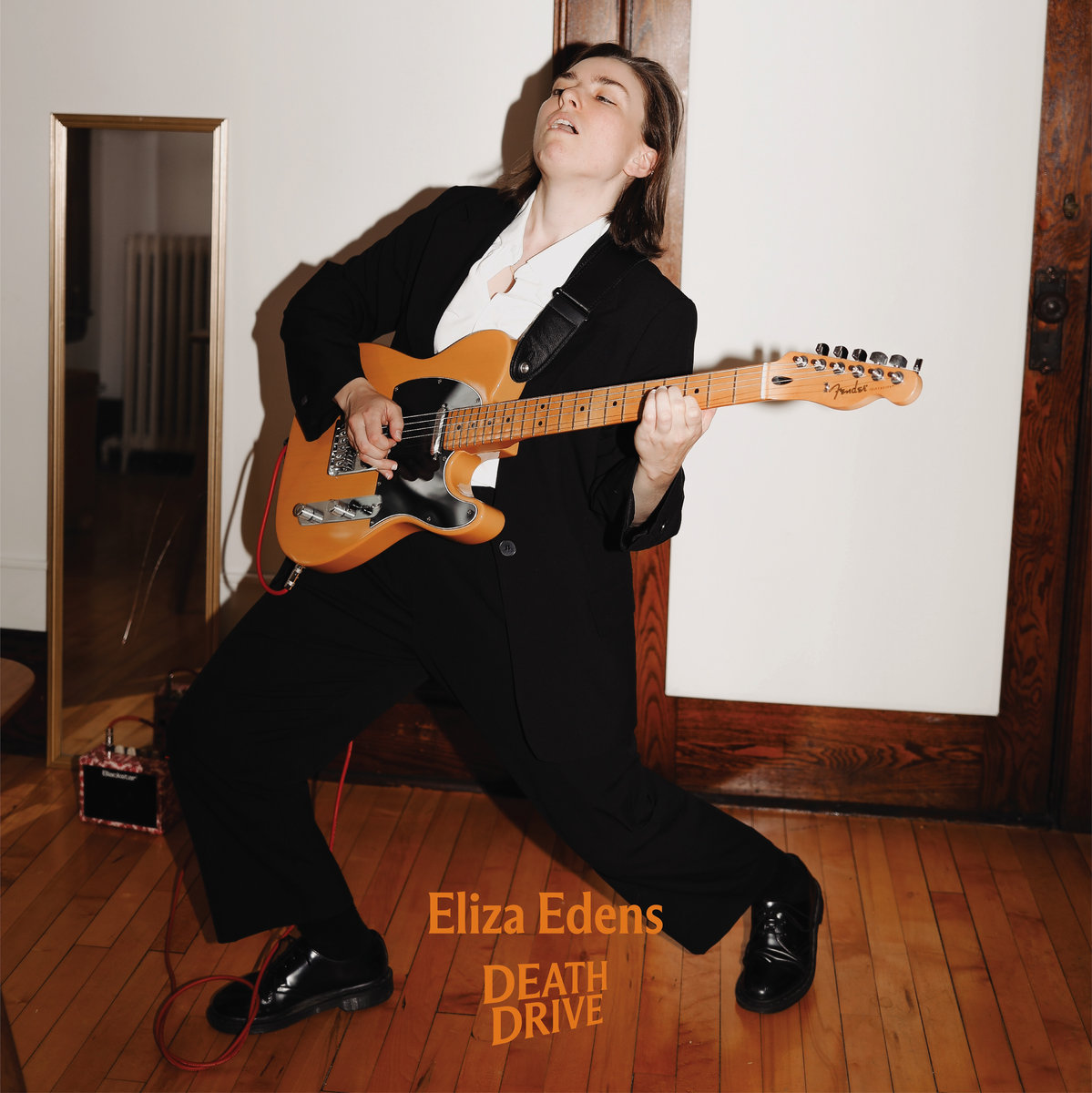
Anyone who has watched a parent slip away to dementia, one small subtraction at a time, knows the mind does strange things to cope. It laughs at the wrong moment. It wants a drink, a stranger’s hands, a faster car. Eliza Edens has built an entire album around that contradiction, and ‘Death Drive’ is the most alive record they have made.
The circumstances matter here. Edens’s mother, Betsy, died in September 2024, with sessions already underway. In those same years, they were stepping into their queerness for the first time in their late twenties. Two earlier projects, the fingerpicked ‘We’ll Become The Flowers’ (self-released, 2022), and the lo-fi voice memo set ‘it’s your birthday & you’re gorgeous’ (self-released, 2025), sat quietly with the loss. This time, Edens got tired of sitting quietly. The title borrows Freud’s idea of a pull toward ruin, but the record argues the opposite side of the coin: that being reckless and being alive often share a pulse.
The sound is wider and louder than anything in their catalog. Edens co-produced with Dexter Wolfe and Pat Keen, (longtime collaborators), and Wolfe also engineered and mixed. They began by tracking live at Spillway Sounds in West Hurley, then spent the following year building the songs out at Wolfe’s home studio in Minneapolis. You hear the extra year in the thick stacks of backing vocals, the bright electric guitars, the soft keys, the saxophone that drifts in and out. Devon Yesberger, Nelson Devereaux, and Katie Martucci contributed additional production on select songs, and Sam Skinner handled extra vocal engineering. Huntley Miller mastered it. Bongos appear on every track, a running joke that never grew old. Good thing, too. A bit of absurdity is exactly what stops this much sorrow from getting too precious.
“All In Sinnin’” opens the album with a wink and a swagger. Its chorus starts with Edens’s voice almost alone, then erupts into a crowd, as if a confession had been overheard and gleefully joined by the whole bar. “Hot & Mean” follows, a song about cheap pleasures (the free-sample kind, the endless-scroll kind) that slows itself down mid-thought and sinks into a warped tape loop. The idea behind it, that chasing small hits of stimulation leaves you emptier, is delivered with a laugh rather than a lecture, which is exactly why it sticks. The title track doesn’t waste a second. Pop structure and plain chords suit Edens well, because the songs were written fast, often during song-a-day exercises with friends, and they carry the bodily urgency of something felt before it was thought.
“Booty Call” brings the city’s after-midnight noise to the front of the room. It’s New York at its least sentimental. “Hand In My Hand” sits in the passenger seat of a car beside a lover, and it’s tender in the way small physical details are tender: dirt under fingernails, a hand moving hair out of your face.
Then the record turns toward the woods of Western Massachusetts, and the whole mood softens. “Hey Mama” is homesick in the plainest, most wrenching way, a child missing a place and a person at the same time. It also carries a small, vivid story about someone carrying her father’s ashes outside to watch the sun rise, a sliver of ceremony that says more about loss than a dozen grand statements could. “Bigger,” co-written with Wolfe and Keen, is the album’s strangest and loveliest room. Piano loops and digital glitches are arranged to resemble a garden, and a clip of Betsy’s voice, bright and affectionate, flickers through the haze. I won’t pretend to stay composed about it. Hearing a mother’s voice reused as texture, as memory, as a kind of weather, feels like being handed something fragile and told to hold it carefully.
The record keeps its rawest corners deliberately small. “Caroline,” fingerpicked and captured on an iPhone, carries the last traces of the original live-tracked plan. “Keep You,” a country-leaning one-take, does the same. Both are built from almost nothing, and both land because of it. Elsewhere, “Nothing Ever Gets In The Way” pairs Edens with singer Alisa Amador, and the two voices braid and brace each other the way people do when they have decided to stand close during a storm. Community is the record’s quiet argument. Edens was reading Francis Weller’s writing on collective mourning during these sessions, and the idea took root: loss is meant to be carried by a group, not by one person alone at home. “Old Home Video” closes the album with fifteen voices, among them Edens’s father and brother. It’s a family gathering in audio form, and it’s impossible to hear without thinking of the one chair that is empty. There’s no grand resolution here, just a lot of people singing the same song at the same time, which turns out to be enough.
Sadness and appetite, goofiness and mourning all get a seat at the table, and Edens doesn’t fuss over who sits next to whom. The songs are short and plainspoken, yet there’s air around every feeling. Few debut-era instincts are as hard to learn as knowing when to stop talking. This album’s staying power is its sense of a person deciding, in the middle of the worst stretch of their life, to keep reaching toward other people, toward pleasure, toward light. That decision is the real subject of the album, and it’s a brave one to document.
Releases October 30, 2026
For more information or to pre-order, please visit Bandcamp