
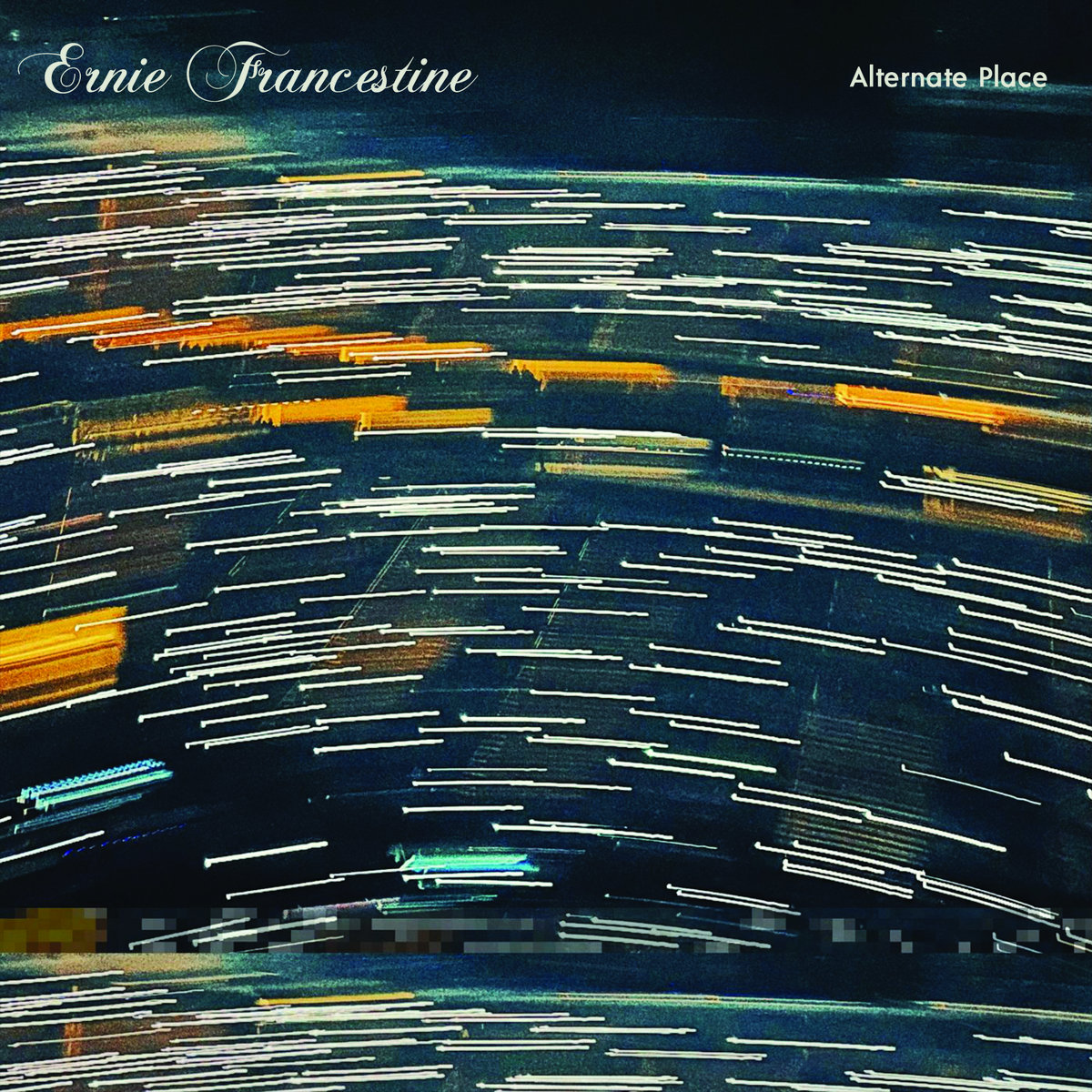
In the ever-expanding universe of solo guitar records, there is always the risk of getting lost in technical excess or dissolving into vague ambience. On ‘Alternate Place,’ Ernie Francestine avoids both pitfalls with quiet confidence, delivering a deeply considered collection of instrumentals that feel less like displays of skill and more like carefully constructed rooms you’re invited to sit inside. Performed entirely by Francestine himself, the record’s intent is clear; where every sound feels placed rather than played, and every silence acts as a deliberate pause rather than an absence.
The record opens with “If It’s A Flower,” a piece that immediately establishes Francestine’s instinct for restraint. The melody blooms slowly, guided by a gentle clarity that favors emotional resonance over flourish. It’s a deceptively simple introduction, but one that signals the album’s central strength: an ability to suggest far more than it states outright. That sensitivity deepens on “The Color of Glass,” where layered guitar tones shimmer and blur, creating the impression of something fragile being examined from multiple angles. Subtle harmonic shifts and textural details give the track a sense of tension, as though the music might splinter if pushed too hard.
“The Stone and The Evergreen Pt. II” expands this approach into a longer, more immersive form. Stretching across eight unhurried minutes, the piece unfolds like a slow walk through changing terrain. Themes emerge, recede, and reappear altered, allowing the listener to feel the passage of time rather than simply hear it. Francestine’s touch remains light throughout, but the cumulative effect is weighty, grounded, and quietly hypnotic.
Elsewhere, Francestine uses overdubbing and tonal contrast to suggest entire ensembles without ever losing the intimacy of a solo performance. “Red Eyes, Blue Skies” glows with layered lines that seem to orbit one another, while its companion piece, “Blue Skies, Red Eyes,” reframes those ideas from a slightly skewed perspective, darker and more inward-looking. Together, they form a reflective diptych, less about melody than mood, inviting repeated listens to catch the subtle differences in phrasing and texture.
The album’s midsection brings a gentle sense of motion with “Raspberry Rock,” whose rhythmic pulse feels playful without breaking the record’s contemplative spell. That momentum carries into the title track; a wide-open composition that feels like the emotional center of the album. Here, Francestine seems less concerned with forward movement than with suspension, creating a space that feels detached from physical location and rooted instead in memory and imagination.
As ‘Alternate Place’ draws to a close, the music turns increasingly hushed and introspective. “Tired of the Sun” drifts with a weary calm, followed by “Pre-Crest,” which feels like a held breath before resolution. The final track, “Crest,” offers a quiet sense of arrival rather than a dramatic conclusion, closing the album not with finality, but with acceptance.
Taken as a whole, ‘Alternate Place’ feels less like a record meant to impress and more like one meant to accompany. It’s music for interior moments, for dusk rather than daylight, and for listeners willing to slow down and meet it on its own terms. In crafting and performing every element himself, Ernie Francestine has created a work that is both deeply personal and generously open—hauntingly familiar, yet entirely its own.
Please visit Bandcamp for more information.