
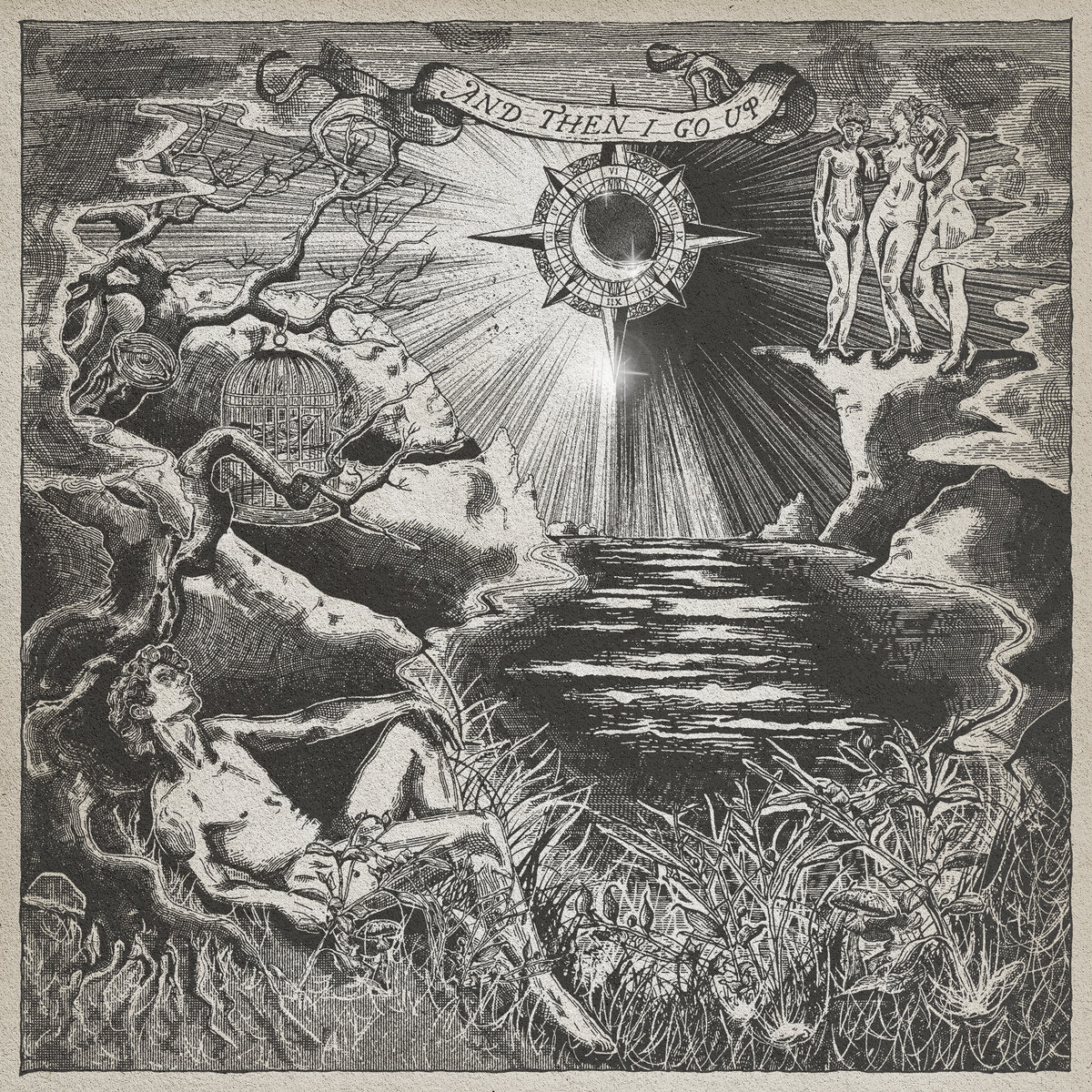
Recollection is rarely a fixed archive. It bends, obscures, embellishes, and erodes, transforming lived experience into something simultaneously personal and elusive. Ev. G.’s ‘And Then I Go Up’ exists within that fragile territory between recollection and reinvention, crafting an intimate meditation on identity, longing, language, and emotional transformation. Across eight carefully constructed songs, the project balances delicate introspection with sophisticated musical architecture, creating a record that explores what remains when certainty dissolves and only feeling persists.
At its core, ‘And Then I Go Up’ is an album preoccupied with perception. Written by Evan Geiger, with music composed and produced by Brock Geiger and Will Maclellan, the record continually examines the ways individuals construct meaning from fragmented experiences. The songs often seem to emerge from partially remembered moments, conversations half-preserved by time, or emotions that resist straightforward articulation. Yet despite this ambiguity, the album never feels inaccessible. Instead, it invites listeners into a deeply human exploration of vulnerability.
The musical palette assembled is essential to the record’s effectiveness. Every arrangement demonstrates remarkable restraint, allowing atmosphere and melody to coexist without excess. Additional performances from Clea Anaïs, Benny Bock, Ethan Gruska, Lyle Molzan, Gabe Noel, Brett Pedersen, Kane Ritchotte, and Alekos Syropoulos enrich the material with subtle layers of texture and color. Rather than drawing attention to individual contributions, the ensemble operates in service of the album’s emotional cohesion, creating a sound world that feels organic, fluid, and quietly immersive.
Opening track “Black Water” immediately establishes the album’s contemplative character. Lasting just over two minutes, it functions as both invitation and warning. The title evokes obscured depths and uncertain reflections, themes that recur throughout the record. Musically, the song possesses a restrained beauty that suggests hidden emotional currents beneath its calm surface. It introduces the listener to an album concerned not with dramatic declarations but with nuanced emotional truths. “Belladonna” expands the record’s scope while maintaining its sense of intimacy. Named after a plant associated with both beauty and toxicity, the song explores attraction and danger as intertwined forces. The arrangement moves with a quiet confidence, allowing the lyrical imagery to resonate without becoming overdetermined. Ev. G. demonstrates a remarkable ability to find complexity within subtle emotional states, and “Belladonna” exemplifies that strength.
One of the album’s most captivating moments arrives with “Allure”. Here, desire becomes something far more intricate than simple romantic longing. The song examines the mechanisms through which people become captivated by ideas, memories, and versions of themselves. The contributions of the supporting musicians add considerable depth, creating a sonic environment that feels expansive while remaining emotionally focused. Every detail appears carefully considered, yet nothing sounds overworked. The beautifully titled “Way We Remember” serves as a thematic centerpiece. Throughout the album, memory functions almost as a living character, shaping perception and influencing emotional responses. This track confronts that phenomenon directly, examining the selective nature of recollection. Rather than presenting memory as a reliable record, Ev. G. portrays it as an active creative force. The song’s gentle melancholy emerges not from loss alone but from the realization that remembrance inevitably alters what it seeks to preserve.
“Kokoro” introduces a fascinating cultural and emotional dimension. Borrowing a Japanese term often associated with the unity of heart, mind, and spirit, the track explores forms of understanding that exist beyond language. The composition possesses a meditative quality, allowing silence and space to become meaningful elements within the arrangement. It is among the album’s most understated achievements, revealing profound emotional depth through minimal means. At under two minutes, “Sight Lines” functions as a transitional reflection. Yet its brevity should not be mistaken for insignificance. The song examines perspective itself—how individuals navigate physical and emotional landscapes, and how perception shapes reality. Its placement within the album proves particularly effective, creating a moment of pause before the record’s emotional climax.
The title track, “And Then I Go Up,” stands as the album’s defining statement. The phrase suggests transcendence, escape, growth, or perhaps surrender. Significantly, the song refuses to limit itself to any single interpretation. Instead, it embraces ambiguity as a source of power. The arrangement gradually accumulates emotional weight, creating a sense of ascent that is psychological rather than literal. It captures the album’s central paradox: genuine transformation often occurs not through certainty but through acceptance of uncertainty. Closing track “Aphasia” provides a remarkable conclusion. Aphasia, a condition affecting language and communication, becomes an apt metaphor for the album’s broader concerns. Throughout ‘And Then I Go Up’, language is portrayed as both essential and insufficient, capable of expressing profound truths while simultaneously failing to capture the full complexity of human experience. The song examines the limits of articulation with extraordinary sensitivity, ending the album on a note that is both unresolved and deeply moving.
One of the record’s greatest strengths lies in its willingness to trust listeners. Rather than providing explicit narratives or predetermined conclusions, Ev. G. creates spaces for interpretation and reflection. The songs function like fragments of larger conversations, inviting participation rather than passive observation. This approach gives the album an unusual emotional durability, as its meanings continue to shift depending upon the listener’s own experiences and state of mind. The production deserves special recognition. Recorded across multiple locations, including Sound City in Van Nuys, Studio B in Calgary, Tall Pines in Temagami, and studios in Pasadena, the album possesses a remarkable sense of cohesion despite its geographically dispersed origins. Will Maclellan’s mix balances intimacy and spaciousness with exceptional skill, while Elisa Pangsaeng’s mastering enhances the music’s subtle dynamics without sacrificing warmth or clarity.
What makes ‘And Then I Go Up’ particularly striking is its refusal to dramatize introspection. Many contemporary records treat vulnerability as spectacle, transforming private emotions into public performance. Ev. G. takes a different approach. These songs are thoughtful without becoming detached, emotional without becoming sentimental, and intellectually engaging without sacrificing accessibility. They acknowledge complexity without demanding resolution.
By the album’s conclusion, one is left with the impression of having encountered not merely a collection of songs but a sustained inquiry into the nature of consciousness itself. Questions of memory, identity, communication, and transformation weave through every composition, creating a work that resonates on multiple levels simultaneously. ‘And Then I Go Up’ is a quietly extraordinary achievement. Through the combined talents of Evan Geiger, Brock Geiger, Will Maclellan, and their collaborators, the album constructs a deeply affecting examination of what it means to navigate an uncertain inner world. It is a record that finds beauty in ambiguity, wisdom in vulnerability, and meaning within the spaces where language begins to fail. Few albums communicate so much while speaking so softly.
Learn more by visiting Bandcamp