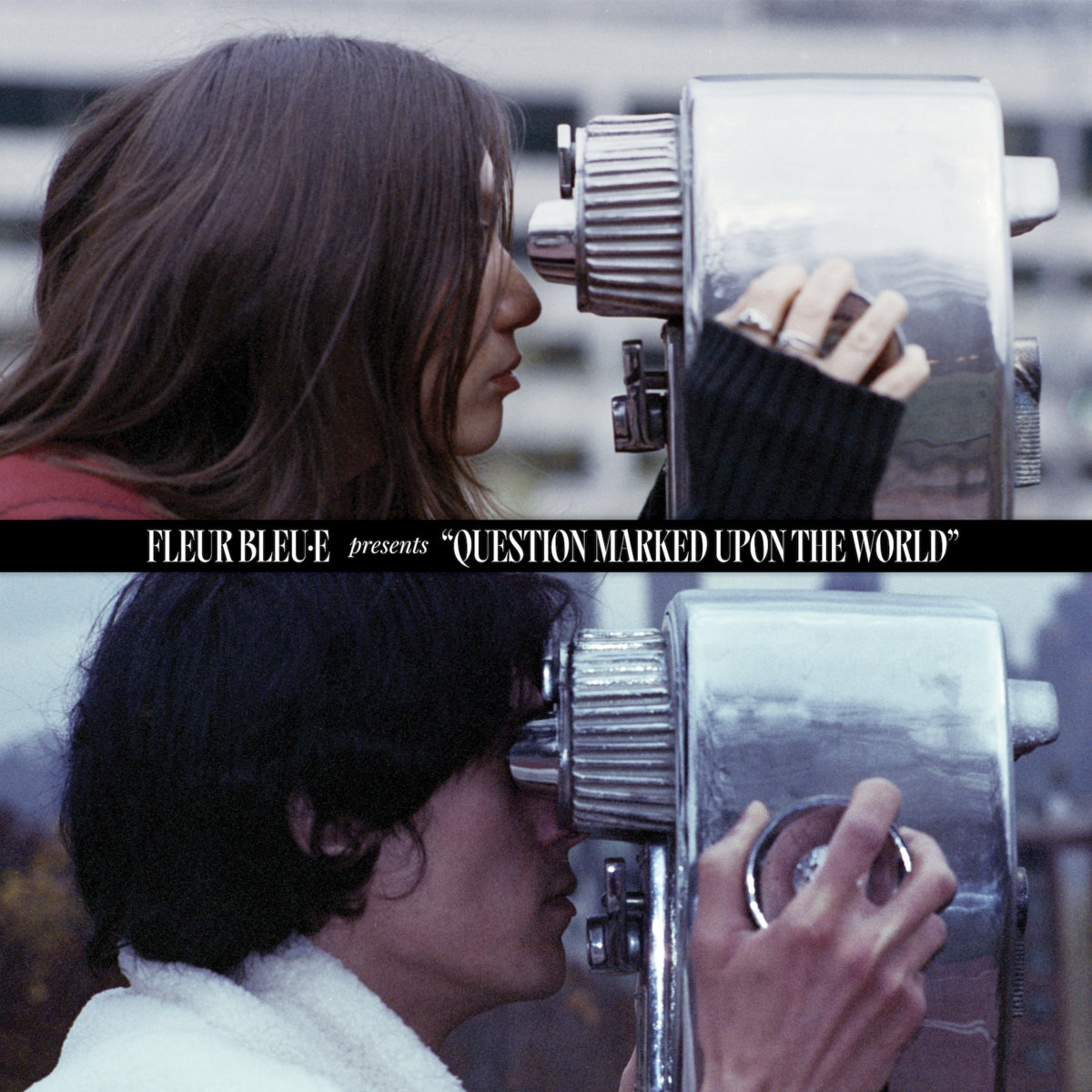
Fleur Bleu·e’s ‘Question Mark Upon The World’ is an album shaped by displacement, but not defined by it. Instead, it transforms the condition of being unmoored into a lens, one that refracts memory, geography, and identity into something both lucid and dreamlike. Delphine Lucy Lam and Vlad Swann operate with a quiet precision here, crafting songs that neither insist nor recede, but hover in that peculiar emotional register where observation becomes a form of intimacy.
The opening track “Surrender” establishes this tone with deceptive softness. What initially reads as a gentle invocation gradually reveals a deeper resolve: surrender not as defeat, but as a deliberate yielding to ambiguity. Lam’s voice, poised between fragility and clarity, threads through Swann’s layered instrumentation, which subtly invokes the spectral glow of analog textures without succumbing to nostalgia. “Qui Manque Dans Ce Pays” deepens the album’s thematic core, confronting absence in a way that feels both personal and collective. The bilingual phrasing underscores a sense of cultural dislocation, while the arrangement, anchored by restrained percussion and drifting guitar lines, suggests a landscape that is emotionally inhabited yet physically distant. It’s here that Fleur Bleu·e’s ability to articulate the invisible becomes most apparent.
On “Le Funambule,” the metaphor of the tightrope walker is rendered with striking elegance. The track balances tension and grace through a melodic structure that feels perpetually suspended, never quite resolving. Swann’s guitar work is particularly notable, sketching fragile arcs that mirror the precariousness of the song’s central image. “All the Little Beings,” one of the album’s emotional anchors, shifts the perspective inward. Its meditation on the unseen life within spaces (walls, objects, remnants), transforms the mundane into something quietly sacred. The interplay between Lam’s layered vocals and the song’s rhythmic undercurrent creates a sense of motion, as though memory itself were alive and circulating.
“Melody (the same)” plays with repetition not as redundancy, but as recognition. It suggests that certain emotional patterns persist, not because they are unresolved, but because they are foundational. The track’s structure mirrors this idea, looping motifs with subtle variations that reveal new contours with each pass. With “Everything Reminds,” the album reaches one of its most poignant moments. Here, memory is no longer abstract; it is invasive, unavoidable. The arrangement grows denser, yet never overwhelming, allowing each element (synths, guitar, voice), to retain its own space while contributing to a shared emotional weight. The title track serves as the album’s philosophical center. It does not attempt to answer the uncertainties it raises; instead, it dignifies them. The composition is expansive, almost cinematic, yet grounded by an intimacy that keeps it from drifting into abstraction. It’s a piece that acknowledges the world’s contradictions without seeking to reconcile them.
“Tes Jours Noirs” introduces a darker tonal palette, though not without tenderness. The song navigates despair with a measured restraint, avoiding dramatization in favor of something more enduring. Lam’s vocal delivery here is particularly affecting, carrying a quiet authority that anchors the track. “Vibrer” reintroduces movement, both musically and emotionally. It pulses with a renewed sense of connection, suggesting that feeling—however fleeting—is itself a form of grounding. The track’s rhythmic vitality contrasts with the album’s more introspective moments, offering a necessary shift in perspective.
“Tentaculaire” expands outward again, its title hinting at something sprawling and multifaceted. The arrangement reflects this, weaving together disparate sonic threads into a cohesive whole. It’s one of the album’s most texturally rich pieces, yet it never loses sight of its melodic core. Closing track “Let the World In” feels less like a conclusion than an opening. It proposes a form of engagement that does not deny the difficulties articulated throughout the album, but chooses connection nonetheless. The song’s gradual build suggests a quiet optimism—not naive, but earned.
Across ‘Question Mark Upon The World,’ Fleur Bleu·e demonstrate a remarkable control of atmosphere and form. Ranging from the nuanced guitar work and textural layering to the subtle rhythmic frameworks, the musicianship serve the songs without ever overshadowing them. Every element feels considered, yet never overdetermined. What distinguishes this album is its refusal to resolve the tensions it explores. Instead, it inhabits them fully, offering a space where uncertainty is not a problem to be solved, but a condition to be understood. In doing so, Fleur Bleu·e create a work that resonates not through grand statements, but through its sustained attention to the fragile, persistent act of perceiving the world and one’s place within it.
Releases May 15, 2026
For more information or to pre-order, please visit Sunday Records | Bandcamp | Fleur Bleu-e | YouTube | Soundcloud | Instagram | Facebook