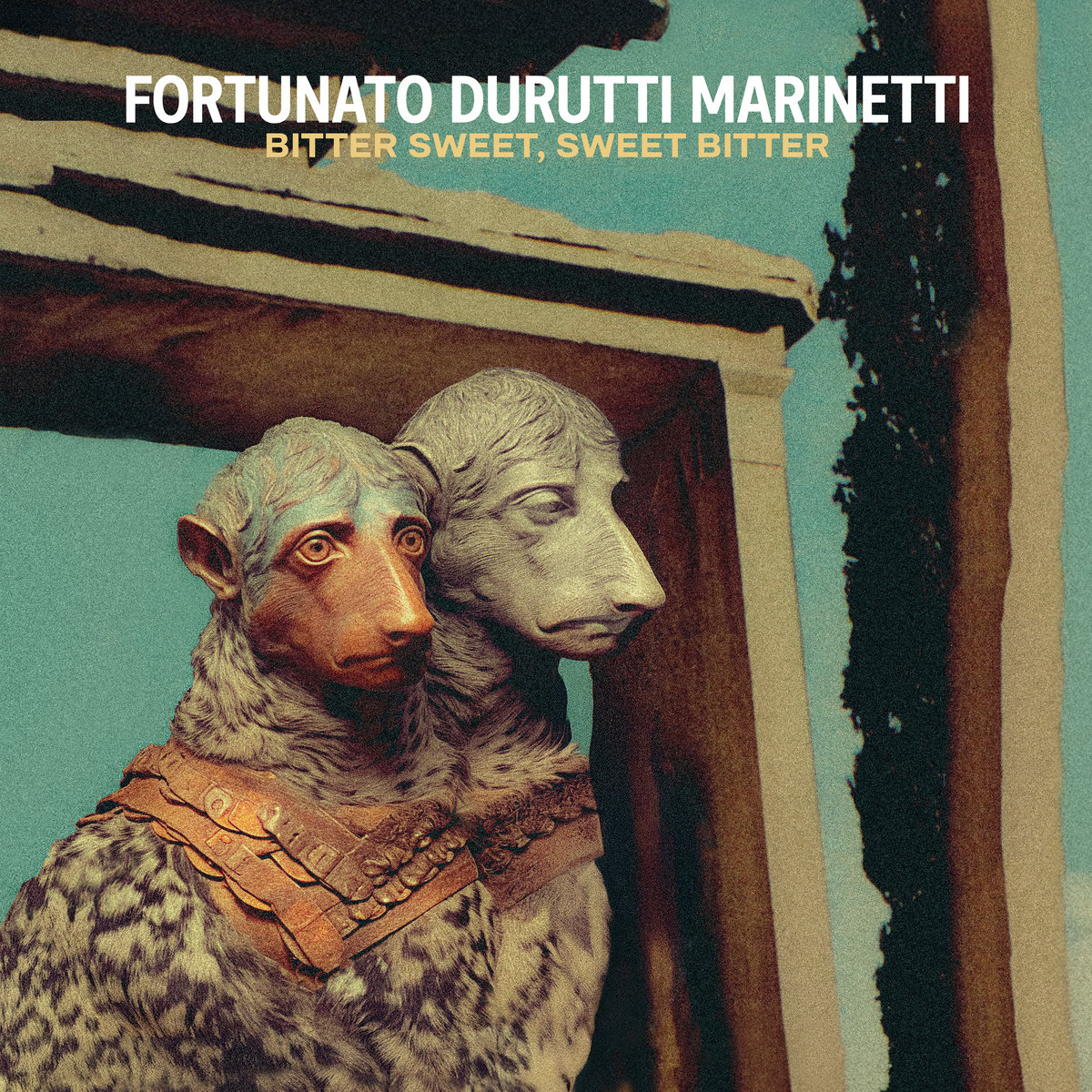
With ‘Bitter Sweet, Sweet Bitter,’ Daniele Colussi achieves something increasingly uncommon in contemporary songwriting: a record that is literary without becoming self-conscious, expansive without losing focus, and emotionally incisive without resorting to confession as spectacle. Released under the Fortunato Durutti Marinetti moniker, the album occupies a fascinating space between chamber-pop grandeur, jazz-inflected sophistication, and the kind of narrative songwriting that treats language as an instrument every bit as expressive as a guitar or trumpet.
Colussi has always demonstrated a gift for densely packed lyricism, but here his writing reaches a new level of confidence. The songs are populated by philosophers, romantics, failures, dreamers, and self-invented characters, yet the record never resembles an exercise in cleverness. Instead, it presents a songwriter wrestling with desire, memory, mortality, art, and self-mythology through a lens that is at once deeply personal and strikingly theatrical. The opening statement, “Full of Fire,” establishes the album’s ambitions immediately. Stefan Hegerat’s drums and Alex Fournier’s bass provide a supple rhythmic foundation, while Brandon Gibson De Groote’s string arrangements lend the composition a cinematic breadth. Colussi sings as though delivering a monologue from the edge of revelation, balancing irony and sincerity with remarkable dexterity. The song introduces one of the album’s central preoccupations: the impossibility of separating longing from self-invention.
“Beware” shifts into more playful territory while retaining an undercurrent of melancholy. Victoria Cheong’s vocal contribution acts as a compelling counterweight to Colussi’s presence, creating a dialogue rather than a simple duet. Jay Arner’s clavinet injects an unexpected rhythmic vitality, while Alex Hamlyn’s saxophone and Tara Kannangara’s trumpet color the arrangement with flashes of vintage sophistication. The result recalls the elegance of classic European pop without descending into nostalgia.
The reflective “Do You Ever Think?” stands among the album’s emotional centerpieces. Eliza Niemi’s cello enriches the song with a quiet gravity, transforming what could have been a straightforward meditation into something far more layered. Colussi’s lyrics examine uncertainty not as a temporary condition but as a permanent feature of consciousness. The song asks questions that remain deliberately unanswered, finding beauty in ambiguity rather than resolution. One of the record’s most intellectually engaging moments arrives with “Call Me the Author.” The title itself functions as a provocation, inviting consideration of authorship, identity, and the stories individuals construct around themselves. Chris Pruden’s piano and Rhodes textures provide an elegant framework for Colussi’s observations, while Luan Phung’s lead guitar adds subtle flourishes that illuminate rather than dominate. The composition demonstrates how effectively Fortunato Durutti Marinetti can merge philosophical inquiry with memorable songwriting.
The instrumental “Theme I (Alex’s Theme)” offers a brief but meaningful pause. Rather than functioning merely as an interlude, it serves as a connective thread within the album’s larger architecture. The musicians display impressive restraint, allowing melody and atmosphere to carry emotional significance without requiring lyrical explanation. “A Perfect Pair” may be the album’s most immediately charming composition, though its charm conceals a sophisticated emotional complexity. Maddee Ritter’s vocal contribution introduces warmth and contrast, while Louie Short’s recording and mixing work helps create a sense of intimacy that complements the song’s themes. Beneath its graceful surface lies an exploration of companionship, projection, and the fragile boundary between genuine connection and idealization.
The sprawling “A Rambling Prayer” represents the album at its most ambitious. Lasting nearly eight minutes, the piece justifies every second through careful development and remarkable narrative control. The title suggests digression, yet the song possesses an internal logic that steadily accumulates emotional force. The ensemble performs with extraordinary sensitivity, particularly Brandon Gibson De Groote’s strings and John Jowett’s euphonium and trombone, which deepen the composition’s dramatic character. Colussi emerges here not merely as a songwriter but as a storyteller capable of transforming abstract reflection into compelling musical drama.
“Theme II” echoes the earlier instrumental passage while subtly altering its emotional perspective. Positioned late in the sequence, it functions almost like a memory of something previously encountered, familiar yet transformed by experience. Such structural decisions reveal the album’s careful construction and reinforce its thematic coherence. The closing track, “My Funeral,” could easily have descended into morbidity, yet Colussi approaches mortality with curiosity, wit, and surprising tenderness. The arrangement gathers many of the album’s sonic elements (strings, horns, piano, and understated rhythm), into a final statement that feels both grand and intimate. Rather than dwelling on endings, the song examines how people narrate their lives, how they imagine their legacy, and how memory reshapes experience after the fact.
Much of the album’s success stems from the exceptional ensemble assembled around Colussi. Brandon Gibson De Groote’s string arrangements provide a recurring sense of elegance and emotional depth. Hamlyn’s saxophone, Kannangara’s trumpet, and Jowett’s brass contributions enrich the music with subtle shades of jazz and soundtrack music. Pruden’s piano, synthesizer, and Rhodes work add harmonic sophistication, while Hegerat and Blake Howard establish rhythms that remain dynamic without becoming intrusive. Alex Fournier’s bass serves as a crucial anchor throughout, allowing the more elaborate arrangements to retain coherence and momentum.
Equally important is the album’s sonic presentation. Recorded, produced, and mixed at Dining Room Sound in Toronto, the record benefits from a clarity that allows every instrumental detail to emerge naturally. Jay Arner’s mixing and post-production contributions preserve the richness of the arrangements without sacrificing immediacy, while Heather Kirby’s mastering provides consistency and depth across the album’s varied emotional terrain. What makes ‘Bitter Sweet, Sweet Bitter’ so compelling is its refusal to simplify human experience. Colussi approaches love, art, faith, identity, and mortality not as subjects to be resolved but as mysteries worthy of sustained contemplation. His songs function simultaneously as narratives, essays, character studies, and emotional documents. Few contemporary songwriters possess the confidence to embrace such complexity while maintaining accessibility, and fewer still can accomplish it with this degree of elegance.
Fortunato Durutti Marinetti has created a work that is intellectually stimulating without becoming academic, emotionally resonant without sentimentality, and musically adventurous without abandoning melody. ‘Bitter Sweet, Sweet Bitter’ stands as a richly imagined song cycle, one that invites listeners into a world of reflection, contradiction, beauty, and wonder. It is not merely a collection of songs but a fully realized artistic statement, confirming Daniele Colussi as one of the most distinctive and thoughtful voices operating within modern art-pop.
Learn more by visiting Bandcamp | We Are Time Records | Quindi Records