
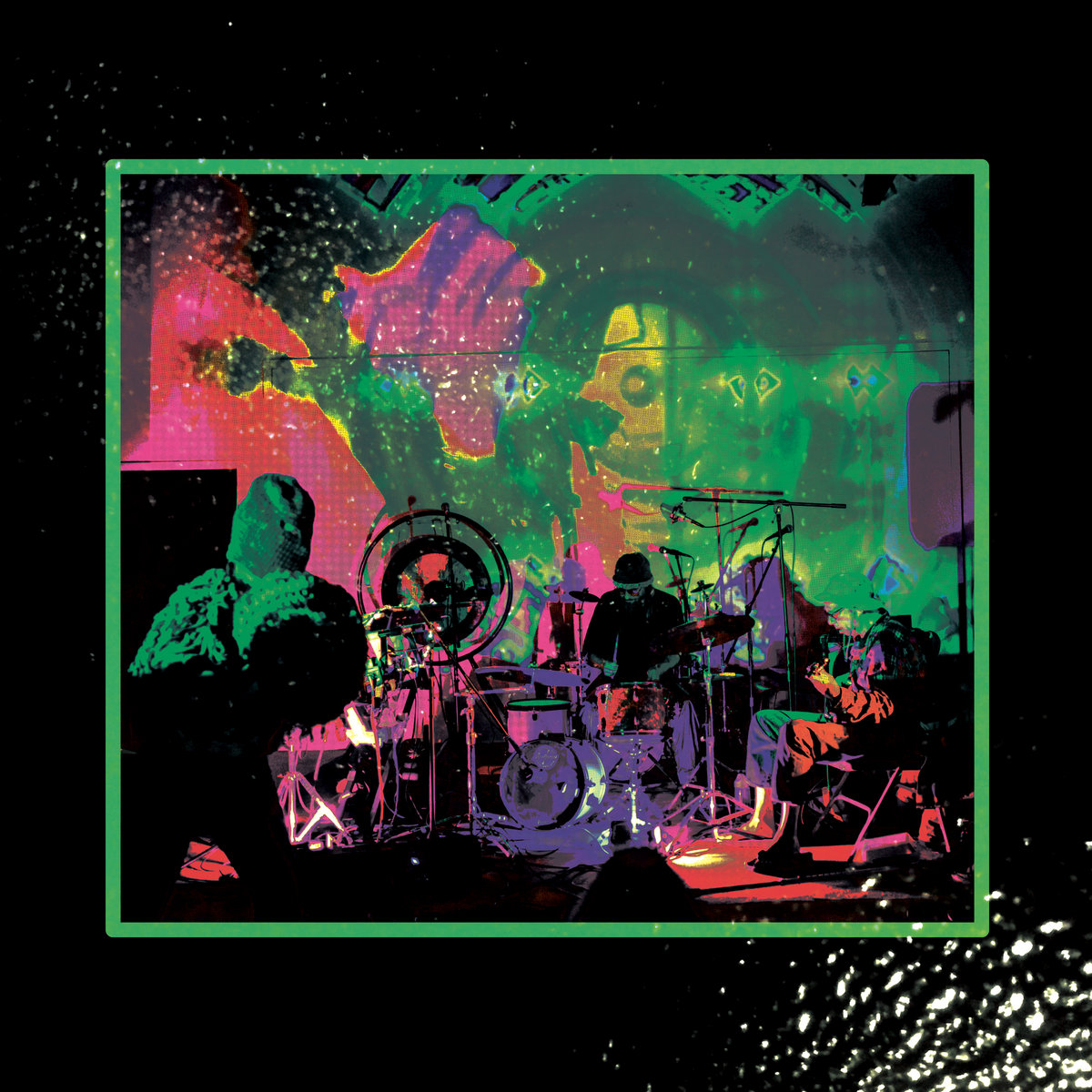
Improvisation is often described as freedom, but freedom in music can be a demanding discipline. Remove the safety of predetermined songs, a bandleader, or even an agreed-upon direction, and musicians are left with the more difficult task of listening to one another closely enough to create a shared language in real time. ‘Wattzotica’, the remarkable collaboration between Galecstasy and the Mike Watt Trio, embraces precisely that uncertainty. Recorded in Joshua Tree in June 2022 by Mike Watt on bass, Raquel Bell on synthesizer, percussion, and vocals, and Jared Marshall on drums and additional synthesizers, the album is an extended act of musical trust. Its nine tracks were carved from a session in which nothing had been decided beforehand, and that absence of preparation becomes the source of its extraordinary vitality.
The opening “Wattzotica” makes no attempt to ease the listener into the proceedings. Bell’s synthesizers establish an environment that is simultaneously electronic, psychedelic, and strangely organic, while Watt’s bass provides a physical center around which Marshall’s drumming can continually rearrange the music. Watt is a foundational figure in American punk, but his playing here is far removed from any expectation that he should simply reproduce the vocabulary associated with his past. He listens, responds, interrupts, anchors, and wanders. The bass is not merely the bottom end; it is a melodic and conversational instrument, capable of steering the trio into unexpected territory.
“Neon Mermaid” expands the atmosphere considerably. At more than six minutes, the trio has enough room to let ideas emerge without forcing them toward a conventional climax. Bell’s synthesizer work is especially evocative, creating tones that can sound luminous one moment and vaguely alien the next. Marshall understands that free improvisation does not require constant activity. His drumming provides shifts in emphasis, changes of velocity, and carefully judged openings through which Watt and Bell can move. The musicians seem to be discovering the composition at the same time the listener is hearing it. “Walk the Talk” introduces a more assertive rhythmic presence. Marshall’s drums give the piece momentum, while Watt’s bass pushes against that momentum rather than simply supporting it. Their relationship is one of the album’s great pleasures. Watt has spent decades developing an instinct for making bass lines function as structural arguments, and here that instinct is liberated from conventional song forms. He can answer a drum phrase with a melodic figure, challenge it with repetition, or suddenly redirect the music. Bell’s electronics provide a third voice capable of altering the entire atmosphere with a change in texture.
“Divers” is one of the album’s most immersive passages. Its title suggests descent, exploration, and movement into an unfamiliar environment, and the music carries a corresponding sense of depth. Bell’s synthesizers create broad sonic spaces while Marshall and Watt operate within them, sometimes appearing to move independently and sometimes locking together with startling precision. The absence of a predetermined structure gives the piece a quality of discovery. It does not sound like three musicians trying to prove that they can improvise; it sounds like three musicians genuinely curious about what might happen if they stop controlling the outcome. “Wander In”, barely two minutes long, functions as a miniature study in restraint. Its brevity is revealing because the album does not depend upon extended duration to establish its ideas. A free improvisation can be concise without becoming incomplete. Bell, Watt, and Marshall understand that a fragment can have its own architecture, and the track provides a moment of recalibration before the extraordinary scale of “Shaba.”
At more than eight minutes, “Shaba” is the album’s largest canvas. Here the trio’s willingness to remain inside an idea becomes particularly compelling. Watt’s bass can rumble, chatter, or rise into melodic territory; Marshall treats percussion as both rhythm and color; Bell moves between synthesizer textures that range from almost vocal sounds to more abrasive electronic tones. The musicians do not appear to be searching for a predetermined destination. Their attention remains fixed on the present interaction, and that concentration gives the piece its intensity. “Imitation Squid” brings a sly sense of humor into the album’s strange marine vocabulary. The title fits a record whose sounds often seem to have acquired physical personalities of their own. Bell’s synthesizer can suggest bubbles, currents, electrical pulses, or distant mechanical life, while Watt’s bass gives those impressions a muscular underside. Marshall’s playing keeps the whole affair grounded without reducing its eccentricity. The music is experimental, but it is never humorless.
“Black Glove” is darker and more imposing. The trio’s sound becomes denser, with Bell’s electronics creating shadows around Watt’s bass and Marshall’s increasingly forceful percussion. Yet even at its most intense, the album retains an unusual sense of space. That quality is partly attributable to Primary Mystical Experience, who engineered, edited, and mixed the recording. Rather than disguising the spontaneous origins of the material, the production gives the three musicians enough separation for their individual decisions to remain audible. The closing “Swirl Pools” is an apt final image. Its relatively short duration allows the album to end without artificially resolving the questions raised by its improvisational method. There is no grand conclusion because the central idea has already been established: music can become meaningful through attention rather than premeditation. The final track leaves the listener with movement still occurring, as though the sonic environment continues beyond the record’s endpoint.
The history behind ‘Wattzotica’ adds another dimension to its sense of possibility. Bell first encountered Watt through his Watt From Pedro Show after releasing a solo record, eventually bringing Marshall into that musical conversation. Their paths crossed again when Watt’s Secondmen Trio performed at Galecstasy’s residency in Los Angeles in 2019. A planned 2020 recording session was postponed by the pandemic, giving the eventual 2022 meeting the accumulated anticipation of several years. By then, the musicians had already established a genuine connection, but they still entered the studio without predetermined material. That decision is crucial. ‘Wattzotica’ does not sound like a collaboration assembled around the reputations of its participants. It sounds like a meeting. Watt’s history with the Minutemen and countless other projects gives the bass a remarkable authority, but he never dominates the trio. Bell’s synthesizers provide the album’s most distinctive colors, while Marshall’s drums and additional electronics keep the music in constant motion. Each musician leaves room for the others to surprise them.
The desert setting also seems appropriate to the album’s character. Recorded after extensive preparation of microphones, amplifiers, compressors, and synthesizer settings, the session combined meticulous technical planning with complete musical unpredictability. That contrast is central to the record’s appeal. The musicians prepared carefully so they could surrender control once the recording began. ‘Wattzotica’ is therefore not merely an experimental album; it is a document of trust. Its most impressive quality is not virtuosity, though all three musicians possess plenty, but their willingness to treat uncertainty as a creative resource. The album asks what can happen when experienced players stop trying to demonstrate what they already know and instead listen for what they have not yet heard.
Across “Wattzotica,” “Neon Mermaid,” “Divers,” “Shaba,” and the rest of this wonderfully unpredictable sequence, Galecstasy and Mike Watt Trio create a world that feels discovered rather than constructed. The music can be strange, funny, atmospheric, forceful, and beautiful within the same extended breath, refusing to settle into any one category. ‘Wattzotica’ makes improvisation sound not like the absence of structure, but like another way of finding it.
Learn more links:
Mystery Circles
Galecstasy
Bandcamp
Bluesky
Instagram
Twitter