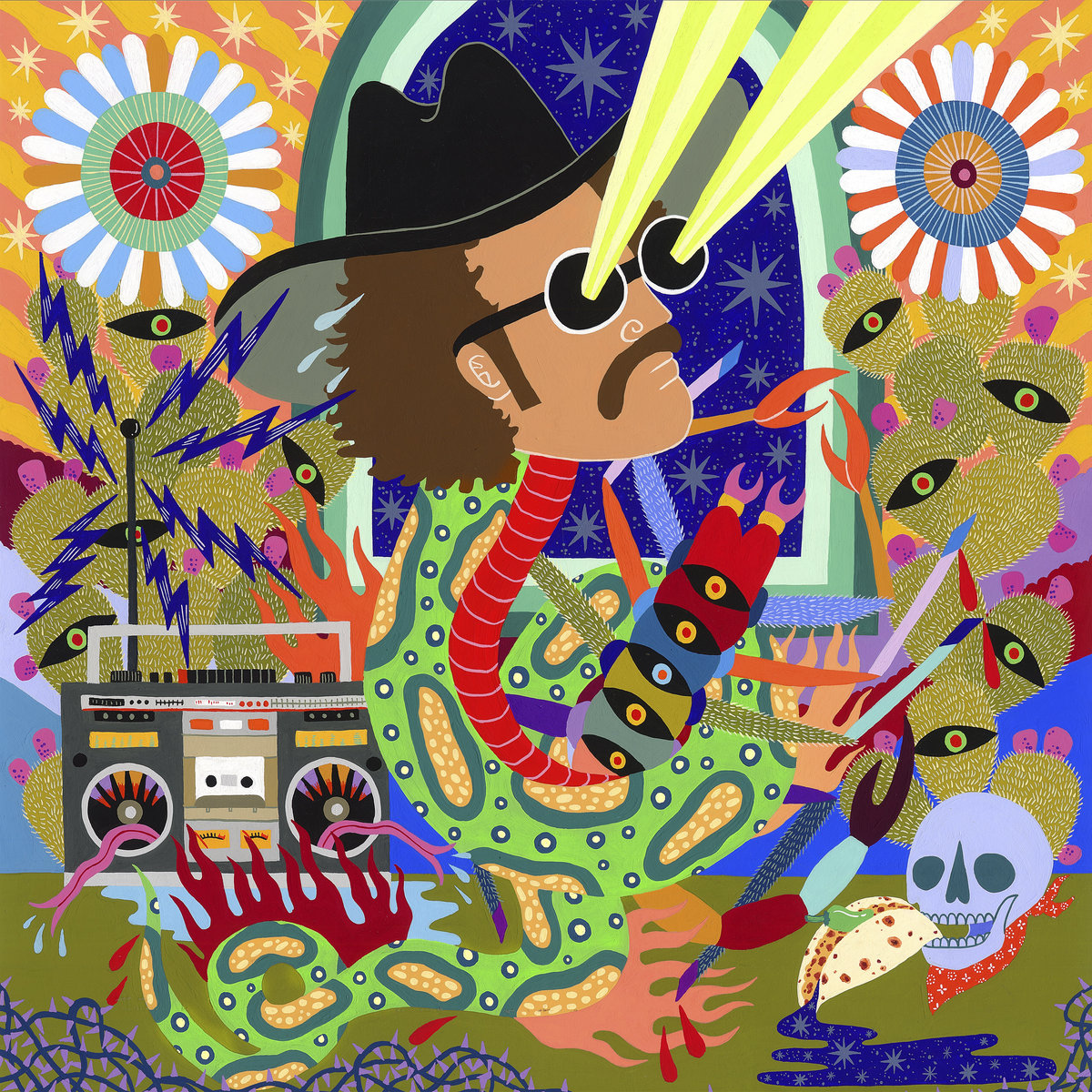
Garrett T. Capps treats geography as both archive and amplifier on ‘I Still Love San Antone,’ a sprawling, affectionate, and occasionally mischievous portrait of San Antonio’s sonic identity. Rather than framing the city as backdrop, he constructs it as active participant; part myth, part infrastructure, part ongoing broadcast signal. Across brief interludes, full-band detonations, and densely populated collaborations, the album moves like a guided transmission through local lore, cultural memory, and lived-in absurdity.
“The Journey Begins” is less an introduction than a signal flare, a 23-second orientation that functions like a cracked radio dial settling briefly on frequency before drifting onward. From there, “Breakfast Tacos with Satan” arrives as the album’s first fully realized statement of intent. Featuring Joe “King” Carrasco, Peter Rowan, and Augie Meyers, the track collides spiritual satire with regional iconography, its instrumentation leaning into Tex-Mex exuberance while Steven Pizzini’s voice-as-Satan injects theatrical disruption. Capps’ vocal presence remains central, steering the ensemble through a space where humor and reverence are deliberately indistinguishable.
“S.O.S. H.E.B.” with Combo Loco distills local culture into rhythmic shorthand, transforming the city’s beloved grocery institution into a communal refrain. The track’s economy is striking, its brevity sharpened by percussion that feels both celebratory and coded. “Bongo Joe” follows in similar spirit, a compact tribute that foregrounds rhythm and oral tradition, with Rodolfo Smith-Villarreal’s percussion anchoring the piece in lived street-level energy.
“Fiesta Eterno,” features Kevin Russell, Carrasco, and Meyers, and expands the palette considerably. Horns, keys, and layered vocals create a dense celebratory field, yet the arrangement remains carefully controlled beneath its apparent exuberance. The track captures Fiesta not as event but as cultural condition; ongoing, cyclical, and embedded in civic identity. “El Chief,” with Santiago Jiménez Jr., shifts toward a more grounded conjunto sensibility, allowing accordion textures to shape the emotional contour while Lindsey Verrill’s cello adds subtle harmonic weight beneath the surface.
Brief interlude “1604 Joyride” acts as a transitional blur, its 47 seconds evoking motion rather than destination. “De Zavala” extends this sense of place-based storytelling, naming infrastructure as narrative framework. Brian Duarte’s electric guitar work and Verrill’s multi-instrumental contributions provide a flexible harmonic bed for Capps’ vocal delivery, which oscillates between observation and invocation.
“Joe Anthony Kicks Things Off” functions as a meta-commentary on radio culture, compressing personality and broadcast mythology into a fleeting burst. From there, “¡Viva Metal!” introduces a stylistic pivot, merging heavy sonic gestures with regional identity markers. Thor Harris’ presence across the record is felt most clearly in this track’s expanded percussive vocabulary, where tubular bells, gong, and vibraphone add a ceremonial edge to the band’s otherwise grounded approach.
“Sorry Shamu,” featuring Rosie Flores, introduces a more reflective tone. Flores’ vocal and guitar work intertwines with Capps’ phrasing, while Beth Chrisman’s fiddle adds an additional layer of melodic commentary. The track’s emotional register is more subdued, though never static, suggesting a quieter form of civic memory tied to place and loss.
“Alamodome Sales Pitch” and “Remember the Alamodome” operate as conceptual pairings, the former a brief satirical sketch featuring Not David Robinson, the latter a more expansive reflection on civic architecture and collective memory. Paul Leary’s mixing influence is particularly evident here, balancing clarity with controlled density. The ensemble, including horn contributions from The Munoz Brothers and pedal steel from Geoff Queen, constructs a sonic image of infrastructure as both spectacle and lived environment.
“Home in San Antone,” a Bob Wills composition reinterpreted with Leary’s guitar work, serves as a hinge between tradition and reinterpretation. The band approaches the material with restraint, allowing its historical weight to remain intact while subtly reframing its sonic framing. Finally, “Yanaguana” closes the album with a sense of circular return, its title referencing indigenous roots while its arrangement, featuring Joey Reyes on cello and Mari Rubio on fiddle, evokes continuity rather than closure.
Across ‘I Still Love San Antone,’ Capps assembles an unusually large and deeply interconnected ensemble, yet the record never collapses under its own scale. Instead, these contributions function as nodes within a larger cultural network. The core band, Capps, Smith-Villarreal, Verrill, and Duarte, provides structural coherence, ensuring that even the most expansive moments retain directional clarity.
What emerges is not a conventional city portrait but a layered acoustic map of San Antonio as it is remembered, mythologized, and continuously reinterpreted. Capps does not attempt to simplify this complexity; he amplifies it, allowing contradiction, humor, devotion, and noise to coexist without resolution.
For more information, please visit Garrett T. Capps | Nudie Records | Bandcamp.