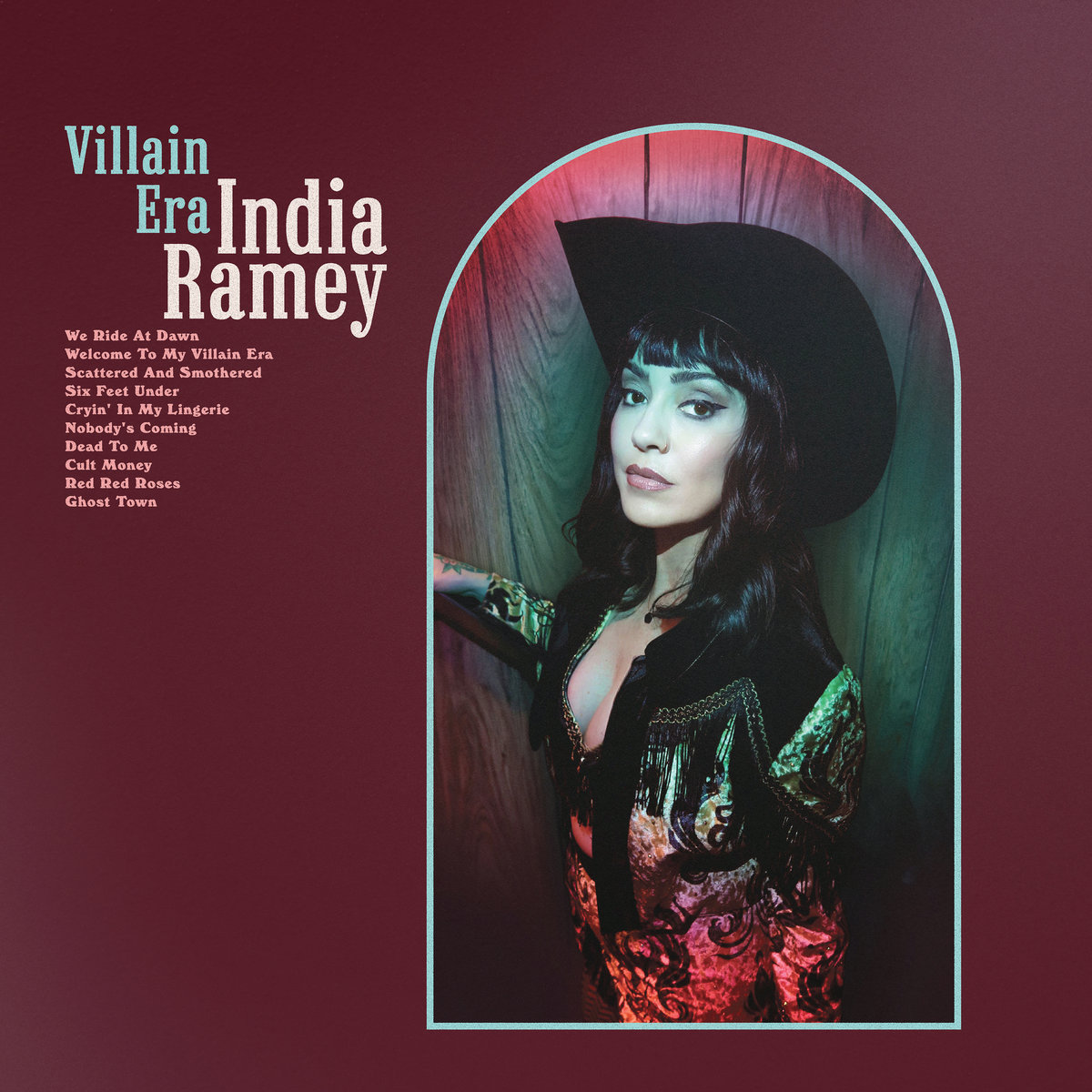
India Ramey has spent years carving out a singular place within outlaw country, but ‘Villain Era’ marks the point where conviction eclipses convention. Rather than asking for acceptance, the record revels in the liberation that comes from abandoning the exhausting pursuit of approval. Produced by Eric Corne and written entirely by Ramey, these ten songs transform survival into spectacle, channeling revenge fantasies, black comedy, bruised introspection, and hard-earned resilience through a cinematic lens that borrows equally from classic honky-tonk, Spaghetti Westerns, and modern Americana. ‘Villain Era’ is not merely a statement of identity but a bold reimagining of what contemporary country songwriting can accomplish when authenticity is driven by emotional truth instead of genre expectations.
The opening declaration, “We Ride At Dawn,” arrives like the soundtrack to an imagined frontier uprising. Driven by a rumbling rhythm section, ominous slide guitar, and sweeping arrangements, the song paints an unforgettable picture of women rising against those who once terrorized them. On its surface, it functions as a revenge tale worthy of an old Western film, yet Ramey layers the narrative with unmistakable contemporary resonance. Her commanding vocal refuses victimhood, replacing it with purpose, while the band’s muscular performance gives every lyric a sense of unstoppable momentum.
That confidence carries directly into “Welcome To My Villain Era,” where Ramey embraces the label traditionally assigned to women who stop accommodating everyone else’s expectations. The song bristles with wit and swagger, turning the concept of becoming the villain into an act of self-preservation rather than moral decline. Instead of offering apologies, she celebrates personal autonomy with razor-sharp writing that balances playful sarcasm against genuine emotional release. The melody is infectious without sacrificing substance, making it one of the album’s defining moments.
Humor emerges as one of Ramey’s sharpest songwriting tools throughout the record. “Scattered And Smothered” transforms late-night Waffle House therapy into an unexpectedly moving meditation on exhaustion, companionship, and finding small comforts after emotional devastation. It is both funny and deeply human, demonstrating how ordinary rituals often become lifelines after extraordinary hardship. That same balance of vulnerability and irreverence fuels “Cryin’ In My Lingerie,” a wonderfully self-aware composition that refuses to romanticize heartbreak while simultaneously refusing to surrender to it. Rather than wallowing, Ramey allows embarrassment, resilience, and laughter to coexist, creating one of the album’s most memorable character studies.
The emotional center of ‘Villain Era’ arrives with “Nobody’s Coming,” an unflinching examination of PTSD-related depression and the painful realization that healing cannot always be outsourced. Without descending into melodrama, Ramey captures isolation with remarkable precision, delivering one of her most affecting vocal performances. The arrangement remains restrained, allowing every phrase to resonate with devastating clarity. It is the rare song that acknowledges despair without surrendering to hopelessness, offering quiet strength instead of easy reassurance.
Elsewhere, “Six Feet Under” explores emotional burial as much as mortality itself, wrapping regret and determination around a slow-burning country framework that steadily accumulates dramatic weight. “Dead To Me” trims emotional severance down to its essentials, delivering its message with concise precision and unwavering resolve. “Cult Money” widens the album’s scope, using biting social commentary to expose manipulation, blind allegiance, and the seductive influence of power without ever sounding preachy. Ramey’s gift lies in allowing vivid storytelling to carry ideas that might otherwise become heavy-handed. By the time “Red Red Roses” appears, tenderness briefly interrupts the record’s defiant posture. Even here, however, beauty remains complicated, with affection shadowed by caution and experience. The closing “Ghost Town” leaves listeners with an image of emotional landscapes emptied by betrayal yet still capable of echoing with memory. Rather than providing neat closure, it leaves lingering questions about what survives after transformation, making the ending feel appropriately unresolved.
Corne’s production deserves enormous credit for maintaining cohesion across such varied emotional territory. Every arrangement serves the songs instead of overwhelming them, allowing cinematic flourishes to enhance rather than distract. The musicians respond with performances that consistently elevate the material. Chris Masterson’s acoustic guitar provides the album’s constant foundation, while his electric guitar work shapes the textures of “Six Feet Under,” “Cryin’ In My Lingerie,” “Dead To Me,” “Cult Money,” “Red Red Roses,” and “Ghost Town.” Eugene Edwards supplies the electric guitar firepower on “We Ride At Dawn,” “Welcome To My Villain Era,” “Scattered And Smothered,” and “Nobody’s Coming,” complementing Masterson’s acoustic playing with grit and bite. Ted Russell Kamp anchors every track with warm, authoritative bass, while Kevin Brown’s drums and percussion provide a dynamic rhythmic backbone that shifts effortlessly between cinematic drama and intimate restraint. Bob “Boo” Bernstein’s expressive pedal steel enriches seven songs with evocative atmosphere, Eleanor Whitmore’s fiddle adds distinctive color to “Welcome To My Villain Era” and “Six Feet Under,” and Jordan Katz’s trumpet lends “Nobody’s Coming” an especially haunting flourish. Haley Spence Brown’s harmonies bring added warmth and depth across much of the album, while producer Eric Corne contributes backing vocals to the closing “Ghost Town,” helping bring the record to a poignant conclusion.
Ramey’s greatest achievement lies in refusing to present empowerment as uncomplicated triumph. The confidence expressed throughout ‘Villain Era’ has been earned through disappointment, trauma, self-examination, and difficult choices. Her so-called villain is not a theatrical persona adopted for attention but the inevitable consequence of someone deciding that perpetual accommodation is no longer sustainable. That distinction gives every song uncommon credibility. Even at its funniest, the record never loses sight of the emotional cost behind its defiance.
Country music has always wrestled with the complicated relationship between image and sincerity. Ramey understands that contradiction better than most, using familiar outlaw iconography not as costume but as metaphor. She reshapes those traditions into something fiercely contemporary without abandoning their storytelling foundations. The album is rich with memorable hooks, sharply observed characters, cinematic atmosphere, and fearless lyricism, but its lasting impact comes from its unwavering honesty. ‘Villain Era’ stands as one of the year’s most compelling Americana releases because it refuses to soften its perspective or dilute its convictions, presenting an artist who has discovered that the greatest act of rebellion is not revenge itself, but the freedom to define one’s own story.
Learn more links:
Blue Élan Records
Bandcamp