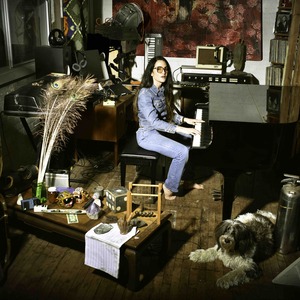
Joan Wasser has never needed genre to make her music universally legible, ever since forging her own path following her time with The Dambuilders. As Joan As Police Woman, she writes songs that move through soul, art rock, chamber pop, funk, and torch song without ever sounding like they are trying on styles for effect. The through line is her phrasing, the way her voice can make elegance feel unstable, or make a graceful arrangement suddenly feel too close to the skin. Her music often seems polished at first contact, then reveals its sharper intelligence in the small turns: a rhythm that leans sideways, a vocal phrase that tightens instead of opens, a melody that refuses the most expected emotional landing.
That is what makes Real Life Evolution more than an anniversary release. The album returns to all ten songs from Real Life with a new group of collaborators, but the point is not nostalgia or correction. These songs already had room inside them. Here, that room becomes easier to hear. The duet voices, looser grooves, rippling piano lines, theatrical drums, and warmer instrumental details do not replace the original feeling. They bring out what was already waiting there: the sensuality, the ache, the stubbornness, the humor, the intelligence, and the deep strangeness of wanting to be understood by another person.
“Anyone” opens slowly, almost like a story already halfway into its telling. It is an unusual first track because it does not introduce the album from the outside. It pulls the listener straight into recognition, into that charged space where seeing someone and being seen back can feel both intimate and invasive. The drums move with a patient, *Fleetwood Mac*-like steadiness, but the song never settles into familiar nostalgia. Joan’s voice keeps it more exposed than that. She sings as if understanding is not only comfort, but pressure, because being known too clearly can feel like losing the last private corner of yourself.
“Flushed Chest” brings that pressure into the body. The opening drums have a staged, almost storybook motion, the kind of rhythm that feels playful until you notice how much tension it is carrying. The song moves through atmosphere rather than direct release, and Joan keeps the vocal close to the arrangement, letting the heat of the track build through rhythm, repetition, and physical suggestion. It works best when heard as a song about feeling before explanation. A flushed chest gives the body away before the mouth can organize itself, and the music stays in that charged moment where sensation has already arrived, but confession has not fully caught up.
“The Ride” turns that bodily tension into motion. Joan sings it with the calm of someone who knows that starting something is rarely as clean as the word “beginning” makes it sound. The ride could be love, performance, ambition, grief, or any experience that begins as a choice and then becomes its own momentum. When the song insists that the ride never stops, the line lands less like a warning than a recognition of how life actually moves. There is encouragement in it, but no cheap lift. The track makes bravery sound uncertain, which is why it feels honest.
“I Defy”, featuring Krystle Warren, gives the album its most electric turn. The beat has an immediate pull, while the guitar lines bring a sleek, bright charge against Joan’s more earthbound vocal grain. The drum loop gives the song a modern body without sanding away its roughness. Warren’s voice is crucial here because she does not simply decorate Joan’s. The two voices wrap, scrape, and rise around each other, both raspy and full of character, both carrying enough texture to make the defiance feel physical. The song moves like refusal before it becomes language. Its power comes from that restlessness, from the sense that resistance is not always orderly, but still knows exactly what it is pushing against.
“Feed The Light” is the album’s most beautiful transformation. The piano ripples through the track with a quiet, liquid precision, while Joan’s layered vocals make the song feel held from several directions at once. The higher background voices lift it into something almost lullaby-like, though there is too much depth in the arrangement for it to feel simply soft. It has the feeling of being led through a luminous maze, beautiful because it is delicate, and more beautiful because it is not completely safe. The intimacy brushes against the closeness of contemporary bedroom pop, but Joan’s construction is more intricate, more strange, and more deliberate. Every layer seems to understand where the light is coming from.
“Christobel” is where the album’s instrumental language becomes especially striking. The piano has a formal, almost ballroom elegance, and the later guitar and violin deepen that elegance into something more pleading and unsettled. The arrangement rises slowly, letting the instruments tell the story before the lyric fully exposes it. When Joan sings, “why won’t you just fall in love with me”, the directness of the line is what makes it hurt. It is not only yearning. It is the humiliation of desire failing to become mutual, the stunned quality of wanting someone so intensely that their refusal starts to feel almost impossible to understand. The music gives that feeling scale without making it theatrical in the wrong way.
“Save Me”, with Iggy Pop, brings a rougher art-rock charge into the record. Their voices meet with tension rather than easy blend, and that tension suits the song’s emotional shape. Joan holds the line with control and pressure, while Iggy brings a weathered theatricality that makes the track feel more exposed at the edges. “I don’t want to live for another” sits at the center of the song, carrying exhaustion, dependence, and refusal in the same breath. The collaboration has impact because it does not smooth over the discomfort of need. It lets the voices press against each other, and that friction gives the song its force.
“We Don’t Own It” loosens the album into a reggae-touched sway, giving Joan’s voice room to bend around the groove. Some of her vocal strains carry an *Erykah Badu*-like elasticity, especially in the way she lets phrasing carry feeling instead of reaching for display. The track keeps the vocal close to the rhythm, which makes its sense of release feel embodied rather than declared. The title becomes the emotional center. The song sounds like a letting go of possession, of the need to claim love, memory, or meaning too tightly. The groove does not explain that surrender. It lets the body understand it first.
“Eternal Flame” works through repetition, looped motion, and layered vocals. Joan’s stacked voice creates a quiet internal chorus, as if the same feeling is being heard from different distances. The track does not force itself into a dramatic shape, which is part of its patience. It circles and returns, letting the loop become a kind of devotion. The flame in the song feels less like spectacle than continuity, something kept alive through repetition, attention, and the refusal to let feeling disappear just because it has become familiar.
“Real Life” closes the album by gathering the record back into its name. After the earlier tracks move through recognition, physical heat, motion, refusal, softness, pleading, need, release, and repetition, the title track arrives with a calm gravity. Joan does not overstate it. She lets the song carry its own weight, and by this point, “real life” feels less like a phrase than the condition the whole album has been circling: the difficulty of staying open, the strangeness of being known, the ache of wanting, and the grace of still being able to hear old feelings differently.
Real Life Evolution works because it understands how elastic these songs were from the beginning. Joan As Police Woman does not treat them as relics, and she does not force them into dramatic reinvention for the sake of proving change. She lets the new arrangements reveal more space inside them. The album is generous in that way. It gives the songs more breath, more body, more friction, and more light, while keeping their original intelligence intact. Twenty years later, Joan does not sound like she is explaining the past. She sounds like she is still listening closely enough to hear what the songs are becoming.
Real Life Evolution is out June 12th on CD, limited edition red vinyl, and digitally via Reveal Records.
Joan As Police Woman online:
Website
Bandcamp
Facebook
Instagram
YouTube
Spotify
Apple Music