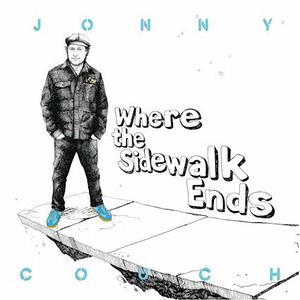
Jonny Couch’s “Where The Sidewalk Ends” has the kind of hook that does not need a spotless studio shine to work. The title track from his first full-length album in seven years moves with a slightly rough, live-wire confidence, and that is part of its charm. Couch is not smoothing the song into something polite. He gives it the bite and movement of a track that wants to be played loud, learned quickly, and sung back before the first listen is fully over.
That looseness is not the same as carelessness. The song knows exactly where its pleasure points are, and Couch keeps hitting them without making the track feel overworked. There is a directness to the way it moves, a sense that the melody, guitars, drums, and synths were built to push forward rather than sit around looking tasteful. It has the same kind of instant want-to-sing-along pull that made early 2000s indie rock feel so easy to enter, but Couch keeps enough grit in the frame for the song to feel lived in instead of merely styled after something.
The verses do a lot of the early work. The guitar plucks are tight and catchy without feeling cleaned to death, giving the song a cool, restless edge before the chorus opens it up. There is a noir idea in the background, drawn from the 1950 film “Where the Sidewalk Ends”, but Couch does not turn that influence into a costume. He uses it more as a pulse. The verses feel like someone moving through the city with something unresolved behind them, while the rhythm keeps the song alert instead of heavy.
That balance between shadow and motion is what keeps the track from becoming too straightforward. Couch is writing about damaged connection and the hope of finding some place where repair is still possible, but the song does not drag that feeling into a slow confession. It moves through it. The hurt is there in the search, in the forward motion, in the sense of someone trying to get somewhere before the chance disappears. That gives the song emotional weight without slowing down its cool, catchy surface.
The chorus does not arrive as a simple burst of brightness. Couch and producer Jonas Wilson build toward it with synths that thicken the track at exactly the right moment, giving the song a flash of dance-floor lift without pulling it away from its rock centre. The synth does not feel pasted on for retro colour. It gives the chorus its upward push, the part that makes the song feel bigger, cooler, and easier to grab onto.
The guitar movement before the chorus is one of the best details. The song shifts from those sharper verse plucks into a softer, stranger strum, then pulls back just enough to make the release hit harder. That little stop gives the chorus room to arrive with more force. Underneath, there is a slight dissonant feeling that keeps the track from becoming too sweet. Couch knows the song is catchy, but he does not let the catchiness flatten it. The edge stays there, moving under the surface.
The video, written and directed by Richard Jordan, gives that search for connection a simple visual frame. Starring Alexander Saris as “Guy” alongside Couch, it follows the song’s sense of movement without overexplaining it. The track already has enough character in its guitars, synths, and melodic drive, so the video works best when it lets the performance and the wandering mood carry the story. It gives the song a face without closing off its feeling.
Couch’s background as a drummer comes through in how directly the song moves. Even with the synths and noir colouring, “Where The Sidewalk Ends” still feels rhythm-first, built around momentum rather than atmosphere alone. The beat keeps the track from sinking too deeply into its own shadow, and that choice matters. A slower, cleaner version of this song might have made the hurt more obvious, but it would have lost the thing that makes it addictive. Couch lets the ache ride inside the movement instead.
That is what makes the single feel like a strong first signal for the album. It has enough immediacy to work as a standalone track, but it also suggests a larger world around it: damaged bonds, city movement, romantic tension, synth colour, guitars that still have dirt under them, and choruses that arrive with real lift. It does not feel like Couch is trying to announce a comeback with something overly grand. He sounds sharper than that, more interested in making a song that actually moves.
As the first title-track look at Where The Sidewalk Ends, the single does exactly what it should. It gives a sharp, addictive opening signal: Couch has returned with a song that feels cool, melodic, slightly shadowed, and fully alive. “Where The Sidewalk Ends” works because it lets its rougher edges stay in the frame, then turns them into part of the rush.
“Where The Sidewalk Ends” is out now. Where The Sidewalk Ends arrives July 24 via Damaged Sofa Music.
Get the single
Bandcamp
Spotify
Apple Music
Album pre-order
Album pre-save
Jonny Couch online:
Website
Bandcamp
Facebook
Instagram
YouTube
Spotify
Apple Music
Songkick