
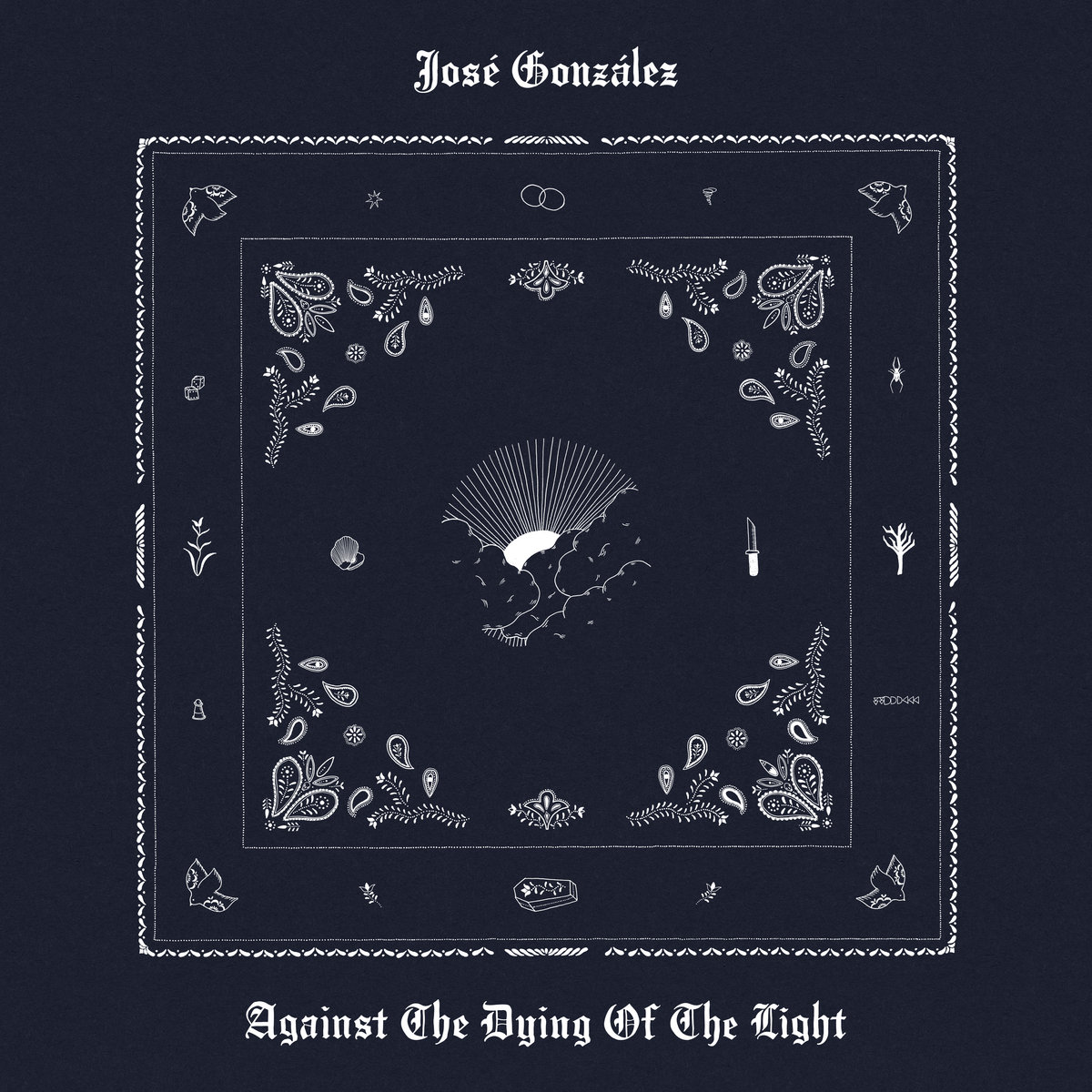
On ‘Against the Dying of the Light’, José González extends the contemplative ethos of ‘Local Valley’ (Imperial Recordings / City Slang, 2021) into something more outward-facing, more philosophically urgent, and ultimately more disquieting. What once felt like an inward cartography of self and place now becomes a meditation on collective fragility, on the erosion of attention and empathy in a world increasingly mediated by abstraction. The record is not strident in its critique, but it is unwavering, carried by González’s precise fingerpicking and a voice that communicates gravity without resorting to excess.
“A Perfect Storm” opens the album with a quiet sense of inevitability, its cyclical guitar patterns suggesting forces already set in motion. The arrangement is spare yet subtly layered, with percussion that feels less like a rhythmic anchor and more like a distant pulse, hinting at the album’s central preoccupation: how modern systems gather momentum beyond our control. “Etyd” follows as a meditation, its title nodding to the étude form while gently subverting it. Rather than showcasing virtuosity, González uses the piece to explore restraint, allowing silence and resonance to carry as much weight as the notes themselves. It serves as a bridge into the brief but pivotal title track where his voice enters with a clarity that feels almost admonitory. The song’s brevity sharpens its impact; it reads like a distilled thesis statement, urging preservation not through grand gestures but through conscious attention to the human scale.
“For Every Dusk” expands the sonic field, stretching past six minutes without ever feeling indulgent. The track breathes, guided by a patient rhythm by González whose playing introduces an organic elasticity. González’s lyrics here are among the album’s most evocative, contemplating cycles of decline and renewal without offering easy consolation. The dusk is not merely an ending but a condition to be understood, perhaps even accepted. “Sheet” and “Pajarito” operate as complementary miniatures. The former is structured and deliberate, its melodic lines neatly folded into one another, while the latter feels almost ephemeral, like a fleeting observation captured quickly before it disappears. Together, they reinforce González’s gift for economy, his ability to suggest entire emotional landscapes within the span of a few minutes or less.
“Losing Game (Sick)” introduces a subtle shift in tone, its title hinting at both resignation and critique. The arrangement carries a slightly heavier rhythmic emphasis, and González’s vocal delivery adopts a sharper edge, as though the cumulative weight of the album’s concerns is beginning to surface more explicitly. Yet even here, he resists overt dramatization, allowing the song’s unease to emerge through implication rather than declaration. “Ay Querida” reconnects with the multilingual sensibility that has become a hallmark of González’s work. Sung in Spanish, it carries an intimacy that transcends linguistic boundaries, its gentle melodic contours underscored by nuanced guitar work. The track feels like a moment of human connection amid the broader existential questioning, a reminder of what is at stake.
“U / Rawls Slöja” stands as one of the album’s most conceptually intriguing pieces, its title invoking the philosophical framework of John Rawls while grounding it in González’s characteristic minimalism. The song grapples with ideas of fairness and perception, its shifting dynamics mirroring the instability of the systems it interrogates. “Gymnasten” and “Just a Rock” continue the album’s oscillation between the personal and the abstract. The former carries a rhythmic buoyancy that contrasts with its introspective, spoken word undercurrent, while the latter strips things back once more, presenting a meditation on permanence and insignificance. González’s guitar remains the central voice, each plucked string articulating a thought with precision.
“You & We” emerges as a quiet standout, its title encapsulating the album’s central dialectic. The song navigates the space between individuality and collective responsibility, its arrangement gradually expanding to accommodate a richer sonic texture. Bodin’s percussion and the subtle layering of vocals create a sense of communal presence, as though the solitary voice has begun to multiply. The closing track, “Joy (Can’t Help But Sing),” offers a resolution that is neither naive nor defeatist. Its gentle uplift feels earned, grounded in the preceding exploration rather than imposed upon it. González does not propose a solution so much as a stance: a commitment to maintaining humanity’s capacity for wonder and connection, even in the face of forces that threaten to diminish it.
Throughout ‘Against the Dying of the Light’, González demonstrates a remarkable ability to balance intimacy with intellectual rigor. What lingers most is the album’s insistence on attention as an ethical act. In González’s hands, music becomes a form of resistance, not through volume or spectacle, but through clarity, patience, and care. It is an album that asks difficult questions without presuming to answer them, and in doing so, it affirms the very qualities it seeks to defend.
Learn more by visiting Mute Records | City Slang Records | Bandcamp.