
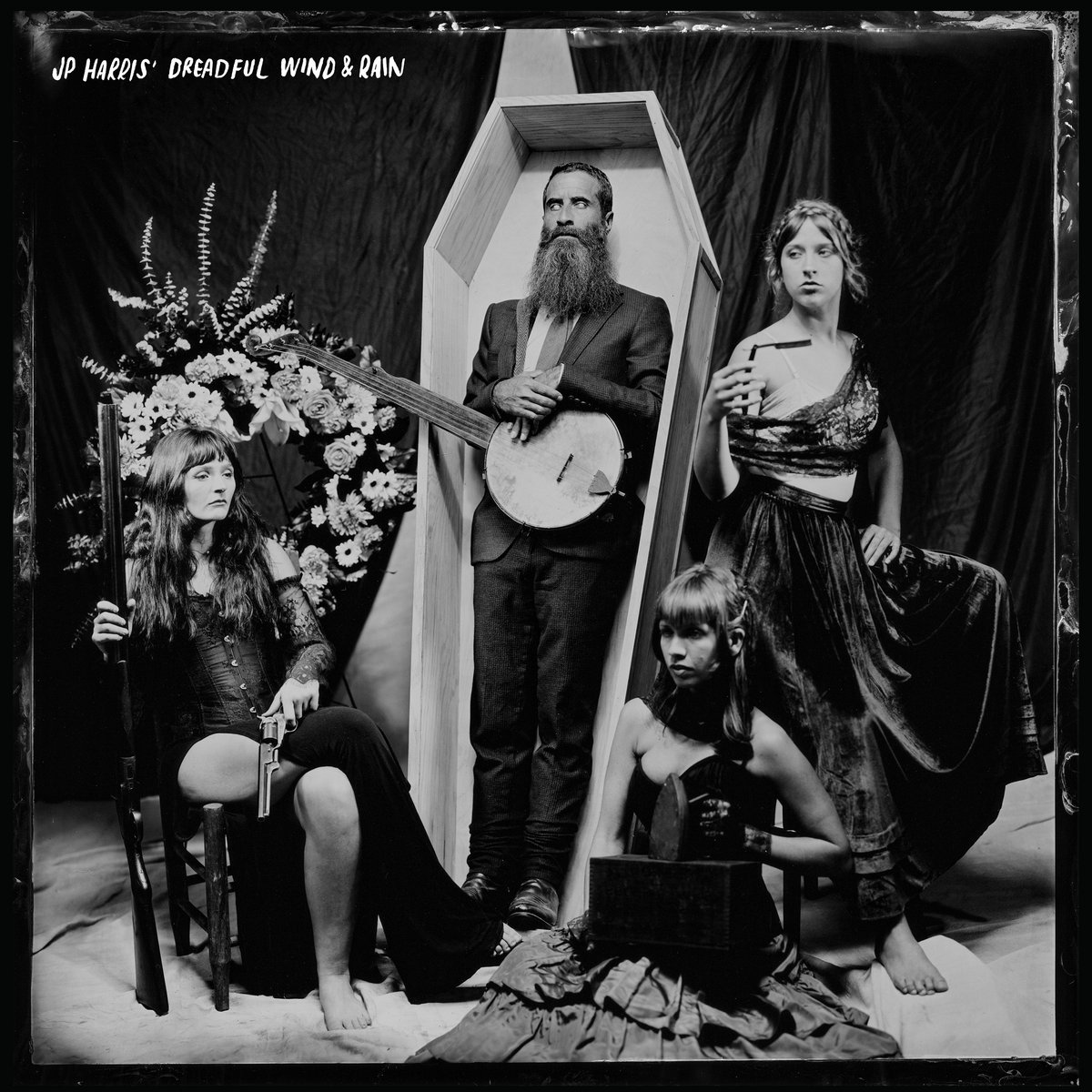
JP Harris has always understood that old songs are not relics or something to be appreciated from afar. They are passed down from one generation to another by people who alter them simply by singing them. On ‘Shaving A Dead Man’, Harris approaches traditional American material with that understanding intact, stripping away the distance that can accumulate around songs that have survived for decades or centuries. ‘Shaving A Dead Man’ is intimate without sounding delicate and is steeped in tradition without reconstructing the past. With Harris on lead vocals and banjo and Chance McCoy contributing fiddle and vocal harmony, the record places two musicians in close conversation with a musical heritage that has endured because of its ability to speak to personal emotions and experiences: desire, betrayal, mortality, wandering, labor, faith, and peculiarly the humor people muster to relate to all of them.
“Say Darling Say” immediately establishes Harris’s preference for directness. His banjo playing does not accent the song so much as carry its momentum, while his vocal performance carries the command of someone who has spent years studying the old forms. The performance is of a candid quality, but there is considerable sophistication in its delivery. Nothing has been exaggerated for effect. Instead, the song arrives with the feel of music made for a contemporary audience without being reminded that it is hearing something historically significant. “The Three Babes” solidifies the album’s curiosity with storytelling. Traditional songs are uncanny in their ability to compress moral viewpoints into a handful of verses, and Harris understands how much importance resides in those succinct narratives. His vocal delivery leaves room for the strange details to emerge, resisting the contemporary preference to smooth eccentricity out of folk heritage. McCoy’s fiddle provides an equally weighted counterbalance, giving the arrangements a sense of motion while preserving their old-time charm.
With “Hog Eyed Man,” Harris leans into the earthy humor typically embedded in traditional repertoire. The song has the quality of a tale that has been passed around long enough to acquire mythos. Harris does not overplay that quality. Harris allows the language and rhythm to carry the joke of treating the material as a chance for theatrical caricature. That method becomes one of the album’s defining strengths. The songs are allowed to be peculiar, sensual, mournful, comic and occasionally unsettling. “The Boatman” pivots the mood into something more reflective. The sound of the banjo and fiddle becomes very evocative suggesting movement across water without using flair. Harris’s voice stays grounded. Mccoy’s harmonies add another presence to the arrangement. The song seems to turn into a meditation, on passage in a sense. The boat works as both an object and a metaphor letting the listener find any meaning they wish.
“Poor Robin” is of similar economy, its melancholy surfaces from the song’s candid construction rather than an imposed sense of sorrow. As a traditional singer, Harris possesses a valuable quality: he does not come across as overeager to demonstrate authenticity. He sings these songs as music rather than artifacts, and that distinction matters. The performances feel lived-in rather than studied. “I Truly Understand” introduces a more personal register, even within the album’s traditional framework. The sentiment could easily invite overstatement, but Harris keeps the performance grounded. His banjo playing and McCoy’s fiddle create a spare rhythmic foundation that accentuates the vocal performance. That simplicity becomes affecting precisely because nothing is added to manufacture importance.
“Pretty Saro” is perhaps the album’s most crisp performance. Its age-old legacy and recurrences of separation and unattainable love have made it one of the enduring jewels of Anglo-American folk tradition, yet Harris again avoids presenting it as a sacred artifact. He sings with vulnerability while maintaining the conversational quality that is consistent throughout the album. McCoy’s fiddle and harmony vocals broaden the emotional field without crowding Harris, creating the sensation of memory being shared between two people. “Roustabout” restores some of the album’s kinetic energy. The title evokes itinerant labor and rough movement, and Harris’s banjo gives the performance a rolling cadence. The track demonstrates how effectively he can move between solemnity and liveliness without making the record feel siloed into separate moods.
“Sweet Talk” is the album’s one explicitly contemporary composition with a revealing presence. Rather than disrupting the heritage canon, the track validates how naturally Harris can inhabit the same musical vocabulary as the songs that precede it. It does not merely suggest that tradition is something he needs to maintain; it is a language he can still use to convey his own perspective. That makes its inclusion more significant than a simple change of authorship. The closing “Hang Me” brings the record toward its darkest territory. Harris sings with a grave simplicity that refuses melodrama, while McCoy’s fiddle seems to exist somewhere between accompaniment and lament. The song leaves behind the rowdy humor of “Hog Eyed Man” and the buoyancy of “Roustabout,” but it does not feel like an artificially constructed finale. Mortality has been present throughout ‘Shaving A Dead Man’, lurking beneath songs about love, labor, departure, and misfortune. Here, it simply steps into the foreground.
Finally, the album’s title carries an equally provocative duality. ‘Shaving A Dead Man’ sounds macabre, absurd, and faintly comic, which makes for an apt representation of a collection that repeatedly places death beside desire, sorrow beside humor, and hardship beside pleasure. Harris recognizes that traditional music rarely separates those experiences as neatly as most present day genres often do. Life arrives as a mixture, and these songs retain that complexity. Chance McCoy’s role is crucial throughout. His fiddle and vocals enhance the music without taking over the simple two-person feeling of the songs. McCoy’s production leaves enough space around Harris’s banjo and voice. This space makes every single rhythmic move feel important and vital. Mastered by John Baldwin in Nashville, the record has a sense of being right there, in the room, which fits the songs that were passed down through stories, speech and community. ‘Shaving A Dead Man’ stands as a persuasive reminder that tradition remains most vital when musicians treat it as ever evolving and never stagnant. JP Harris seems not interested in modernizing these songs for the sake of reputation, nor does he lapse into imitation. He embodies them through performance. By doing so, he underscores something enduring about American folk music: its survival depends not on stewardship alone, but also to make inherited songs sound necessary again through each new voice.
Releases October 23, 2026
For more information or to pre-order, please visit:
Bloodshot Records
Bandcamp
Facebook
Twitter