
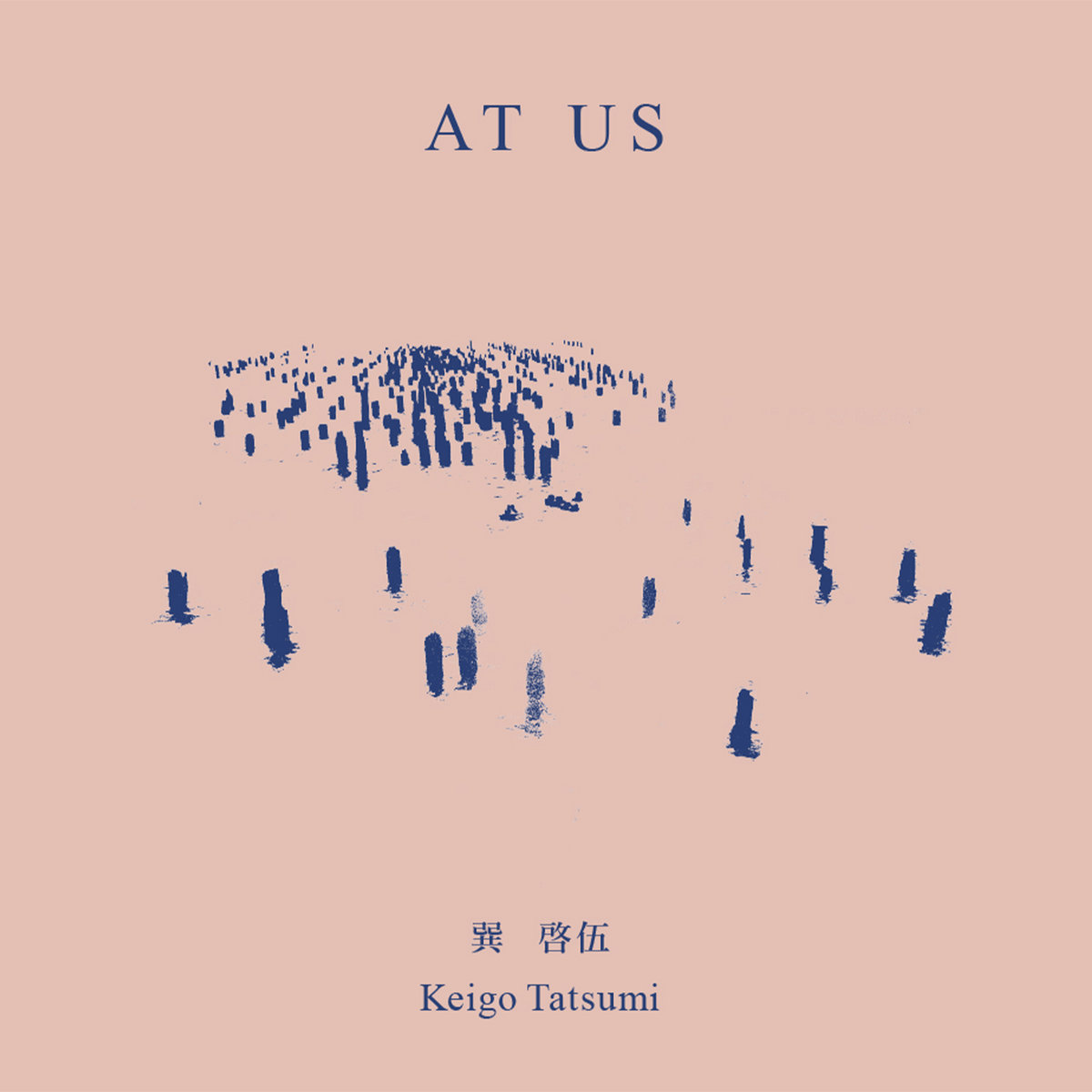
Keigo Tatsumi’s ‘AT US’ is a record about distance, but not distance in the conventional sense. It does not document a journey through landmarks, encounters, or grand revelations. Instead, it captures the peculiar solitude of moving through an unfamiliar country when the world around you is vivid yet somehow inaccessible: roads passing beneath a car window, voices without context, rooms temporarily occupied, weather changing across a landscape that refuses to become entirely familiar. Composed as a soundtrack companion to Tomohiro Takeshita’s photographic exhibition ‘Across the United States’, Tatsumi’s first solo release transforms travel into an inward experience, using field recordings and experimental ambient music to create something closer to a psychological travelogue than a conventional soundtrack.
For listeners who know Tatsumi as the bassist of Japanese indie-pop group never young beach, the record may initially seem like a radical departure. Yet his background as a bassist remains quietly important. He understands repetition, space, resonance, and the expressive potential of restraint. On ‘AT US’, those instincts are transferred from songcraft into atmosphere. Tatsumi plays electric bass alongside Omnichord, Minilogue, bell and glass percussion, singing bowl, and other carefully chosen sounds, while Kazuhiko Masumura contributes percussion. Takuro Okada handles mixing and mastering, giving the album a finely balanced sonic architecture in which environmental sounds and musical tones coexist without one swallowing the other.
The four-minute “barely” establishes this language with remarkable economy. Rather than announcing itself with a conventional opening gesture, it places the listener inside a shifting sonic environment. The music seems to hover between composition and observation, as if Tatsumi is deliberately resisting the temptation to tell us what we should feel. “ma” is just over a minute yet deepens that impression. Its brevity is significant: the piece functions almost like a visual cut, a small aperture through which another mood enters before disappearing.
“conversation” expands the palette considerably. The title suggests human exchange, yet the music is more interested in the spaces surrounding communication than in communication itself. Sounds appear to approach one another, coexist, and drift apart without forming an obvious narrative. That ambiguity is one of the album’s great strengths. Tatsumi does not attempt to translate the American landscape into musical clichés. There are no obvious gestures toward Americana, no postcard melodies designed to signify open highways or expansive skies. Instead, he reconstructs the sensation of being somewhere else.
“Siblings” is an especially intriguing miniature because its title introduces a relationship into an album otherwise preoccupied with solitary movement. The piece seems to imply proximity without erasing individuality, suggesting two things existing alongside one another while retaining their separate identities. That idea resonates throughout ‘AT US’, where field recordings and instruments are rarely fused into an indistinguishable mass. They remain perceptible as separate presences, much as individual memories remain distinct even after they have been absorbed into a larger recollection.
The six-minute “us” provides the album with its most direct statement of collective identity. Yet Tatsumi treats the word with caution. “Us” can mean companionship, belonging, shared experience, or simply the recognition that another person occupies the same world. Here it becomes an open-ended proposition rather than a declaration. The music creates an unusual intimacy without becoming sentimental, allowing warmth to emerge from the arrangement rather than forcing it through melody. “still water” is the album’s longest composition and perhaps its most immersive passage. Tatsumi’s use of sustained tones and subtle environmental detail gives the piece an almost suspended quality. Time appears to become less measurable. Small sonic changes acquire importance because there are no dramatic transitions demanding attention. The track invites concentration on duration itself, on how perception alters when nothing is insisting that it move forward.
That atmosphere carries naturally into “WATER”, whose capitalization gives the title an almost elemental force. If “still water” suggests observation, “WATER” suggests recognition: the thing itself, stripped of metaphor. Tatsumi’s sound world is particularly effective here because it never treats nature as mere decoration. Water becomes part of the album’s broader meditation on movement and permanence, capable of reflecting a changing world while remaining fundamentally itself.
“font” closes the record with a characteristically understated sense of mystery. The title evokes language, typography, and the visual construction of meaning, an apt conclusion for an album born from a photographic exhibition. Photography freezes a moment; music allows that moment to continue changing in the listener’s mind. Tatsumi’s compositions occupy the space between those two forms. His sounds do not simply accompany images; they suggest everything an image cannot contain; the temperature of a place, its acoustic character, the distance between strangers, the thoughts that arise when one is left alone with unfamiliar surroundings.
‘AT US’ refuses to over-explain itself. Tatsumi understands that travel can be both expansive and isolating, and that the most powerful memories are often made from fragments rather than milestones. His field recordings provide documentary texture, while his instruments give those fragments an interior life. The album therefore occupies an unusual territory between ambient composition, sound art, and personal reflection. Across eight concise pieces, Tatsumi creates music that asks the listener to pay attention not only to what is heard, but to the spaces between sounds. ‘AT US’ is quiet without being slight, experimental without becoming mannered, and contemplative without drifting into abstraction for its own sake. It captures the strangeness of looking outward while, almost inevitably, listening inward. In that sense, Tatsumi’s first solo statement is less a portrait of the United States than a portrait of consciousness in motion: a record about unfamiliar places, private perceptions, and the fragile ways in which the world becomes memory.
Learn more links:
Mystery Circles
Bandcamp
Bluesky
Instagram
Twitter