
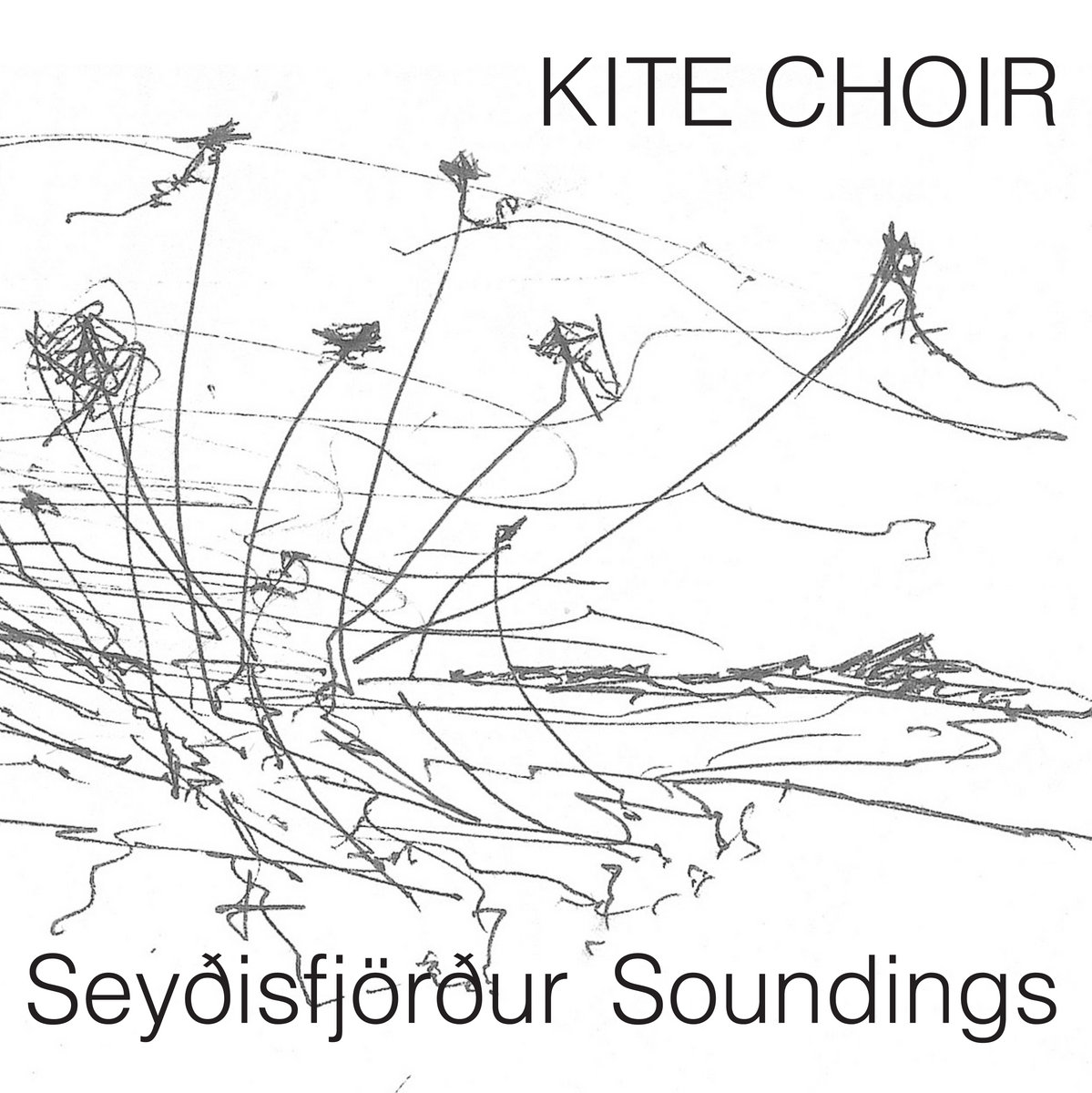
Firat Erdim’s Kite Choir occupies a peculiar territory in contemporary experimental music, where composition, weather, sculpture, improvisation, and attentive listening cease to behave as separate disciplines. On ‘Seyðisfjörður Soundings’, the distinction between instrument and environment becomes wonderfully unstable. Recorded during a two-month residency in the Icelandic town of Seyðisfjörður, the album consists of two extended pieces, “Side A” and “Side B,” each lasting more than twenty minutes. Yet describing them simply as compositions risks missing their most radical proposition: the music is not imposed upon the landscape so much as coaxed from it.
Erdim’s central invention is the Kite Choir itself, a family of wind-powered instruments in which the kite’s reel and tow line become part of the sound-producing apparatus. Rather than placing a conventional instrument in front of a microphone and asking the environment to provide atmosphere, Erdim makes atmospheric conditions active participants. A rosined nylon tow line bows a set of strings as the kite rises and falls; wind vibrates the line independently; the length, curvature, speed, and position of the apparatus continually alter the sound. Human intention remains essential, but it cannot command the entire performance. The musician enters into an arrangement with weather.
That idea gives “Side A” its extraordinary sense of suspended duration. The opening sounds can be almost elusive, hovering at the threshold between environmental noise and deliberate musical action. Gradually, tones acquire weight. A low drone may appear to be generated by some distant mechanical apparatus before its harmonic character becomes clearer; high overtones shimmer above it, while the wind itself seems to take possession of the recording. Erdim’s electric hurdy-gurdy reel does not produce melody in the conventional sense. It generates a field of related pitches whose development depends upon physical circumstances. The listener is consequently encouraged to hear change at a microscopic level: a shift in pressure, a change in the kite’s elevation, a slight alteration in the tow line’s curve.
This is music that takes patience seriously without turning patience into a virtue for its own sake. The long duration allows insignificant-seeming events to become perceptually important. A tone that might disappear unnoticed inside a conventional composition can become the central event here because there is no conventional hierarchy telling the ear where it should look. “Side A” asks the listener to surrender the expectation that something dramatic must happen every few minutes. Instead, its drama resides in the gradual realization that the air itself has become an instrument.
The project’s conceptual foundation owes much to composer and electroacoustic musician Paula Matthusen, whose score for Kite Choir provides variable instructions responsive to aeolian, climatic, temporal, and less easily defined conditions. Matthusen’s contribution is important because the project does not simply abandon composition in favor of chance. It creates a framework in which chance can become musically meaningful. Erdim operates inside a system, but the system is deliberately porous. Weather enters. Place enters. Time enters. Human control remains present but incomplete.
That philosophy becomes even more compelling on “Side B,” where the sound world seems to acquire greater density without becoming conventionally busy. The drone can shift from an almost gentle resonance into something more forceful, even ominous, as the tow line begins to sing with greater intensity. Yet the music never feels as though it is attempting to manufacture suspense. Its changing character comes from the physical behavior of the instrument. What might be an expressive gesture in another form of improvisation is here a negotiation with gravity, wind speed, altitude, friction, and material resistance.
Seyðisfjörður is therefore not a backdrop to these recordings. It is part of their instrumentation. The steep cliffs surrounding the fjord channel the wind; fog alters visibility and perception; the sea contributes a distant sense of scale. Erdim’s walks along the water, carrying kites and recording equipment in search of favorable conditions, become part of the composition’s hidden architecture. The album asks us to reconsider the conventional notion of place in recorded music. A location is not merely where musicians happen to perform. Under the right circumstances, it can determine what performance is possible.
That proposition also changes the role of the listener. Conventional recordings often encourage us to distinguish between intentional sound and incidental sound, between music and whatever happens to exist around it. Kite Choir makes such distinctions increasingly difficult. Wind-generated noise is not an unwanted intrusion into “Side A” or “Side B”; it is among their principal voices. The movement of the kite is not merely a means of activating the instrument; it is part of the musical process. Even silence takes on a different character because it is never entirely empty. The atmosphere remains active.
There is something quietly radical about this relinquishing of control. Experimental music has frequently celebrated chance, but chance can become another kind of aesthetic posture, carefully framed and therefore surprisingly predictable. Kite Choir approaches unpredictability through material necessity. Erdim cannot simply decide what the wind will do. He can prepare the apparatus, tune the strings, choose a location, respond to changing conditions, and determine when to act. The rest belongs to a larger system.
‘Seyðisfjörður Soundings’ consequently operates somewhere between ambient music, sound art, improvisation, and environmental composition, while fitting comfortably into none of them. Its most striking quality is not simply its unusual instrumentation but its redefinition of musical agency. Erdim is neither conventional performer nor passive observer. He is a participant in a temporary ecosystem whose sonic character emerges through reciprocity.
The album also offers a subtle corrective to the contemporary obsession with precision. Digital technology allows musicians to manipulate sound with astonishing exactness, yet Kite Choir finds expressive power in materials that remain stubbornly resistant to complete control. The kite rises too high, the wind changes direction, the line vibrates unexpectedly, and a tone acquires a character no musician could have summoned through technique alone. Those contingencies are not defects. They are the substance.
By the time “Side B” reaches its conclusion, the listener has spent more than forty minutes inside a world in which sound seems inseparable from atmosphere. ‘Seyðisfjörður Soundings’ does not ask to be decoded so much as inhabited. Its achievement lies in making an ancient phenomenon (the wind moving through a vibrating line), feel newly strange and newly musical. Erdim has built an instrument that cannot exist apart from the sky, then recorded what happens when human intention meets that immense, indifferent collaborator. The music is quiet in its demands but expansive in its implications: a reminder that listening can be an action, that place can be an instrument, and that sometimes the most compelling music begins precisely where control ends.
Learn more links: