
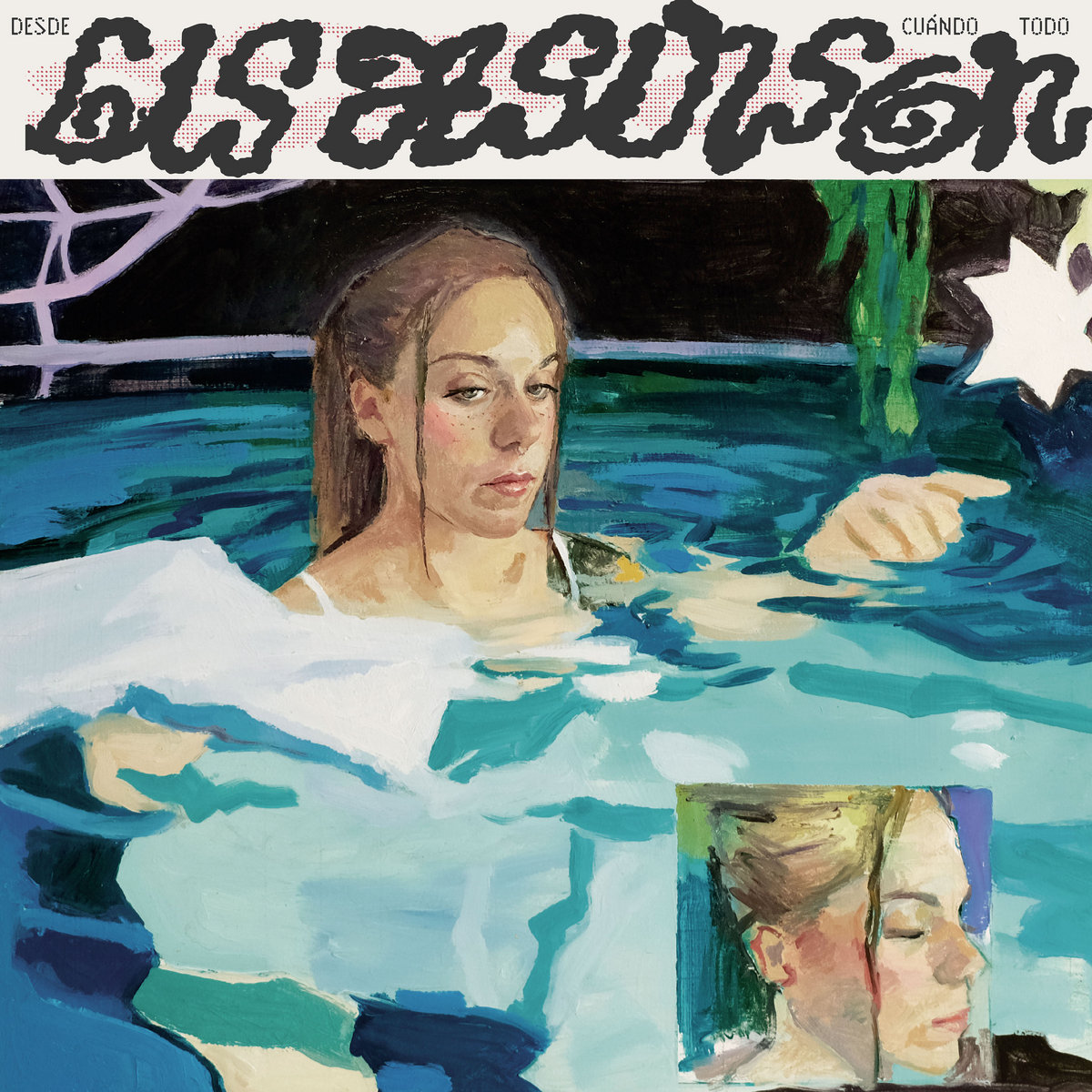
‘Desde Cuándo Todo’ does not behave like an album eager to be understood quickly. It resists summary, avoids spectacle, and seems more interested in staying with questions than resolving them. In a musical landscape that often equates growth with reinvention, LISASINSON choose another path: persistence. Not stubbornness, but a careful, almost philosophical insistence on continuity; on remaining attentive to what survives repeated change.
The context matters, but it does not dominate. After ‘Un Año De Cambios’ (Elefant, 2023), documented a moment of reconstruction following a lineup shift, and after yet another destabilizing departure shortly thereafter, ‘Desde Cuándo Todo’ arrives without dramatizing its own backstory. There is no narrative of collapse or rebirth imposed on the listener. Instead, the album proceeds as if change were not an event but a condition, something to be inhabited rather than overcome. This subtle repositioning marks a decisive step in Míriam’s evolution as a creator: authorship here is not asserted, it is assumed.
What distinguishes this record is not novelty but attitude. The songs demonstrate a growing trust in duration, in the expressive capacity of restraint. Mid-tempos, long underutilized in LISASINSON’s earlier work, become sites of emotional density rather than compromise. “Desde Cuándo”, “Lanzarote” and “Me Acostumbré” move with deliberate patience, allowing melodic motifs and production details to accumulate meaning gradually. Urgency, in these songs, is not tied to velocity but to attention. They create tension by refusing to rush, by letting feeling sediment rather than combust.
This recalibration of intensity gives the album its quiet authority. ‘Desde Cuándo Todo’ seems uninterested in catharsis as a goal. Instead, it cultivates clarity, sometimes fragile, sometimes provisional, as a form of strength. Doubt is not framed as something to be escaped but as a legitimate emotional state, one worthy of articulation. The songs breathe because they are permitted to hesitate. They leave space for reflection, for afterthoughts, for the discomfort of not knowing.
Yet this reflective posture does not erase LISASINSON’s foundational relationship with immediacy. On tracks like “Decidí Desaparecer”, “Si Me Pierdo” and “No Quiero Envejecer”, the band reconnects with a more physical, impulsive energy. What has changed is not the force of these songs but their orientation. They feel less like reflexes and more like decisions, expressions sharpened by time rather than dulled by it. The sweetness still cuts; the grit still lands. But the gestures feel intentional, situated within a broader emotional architecture.
Melancholy threads through the album without ever solidifying into inertia. Songs such as “Salgo A La Calle”, “Deberíamos Vernos Más” or “Quiero Que Perdamos La Cabeza (Otra Vez)” carry a sense of weariness that is neither ornamental nor self-indulgent. Míriam Ferrero Gramage’s voice, at once tender and resilient, functions as a stabilizing force, holding together vulnerability and momentum. Fatigue is present, but it becomes material rather than conclusion. The music transforms exhaustion into light, however faint, suggesting that fragility and endurance are not opposites but collaborators.
The album’s conceptual frame deepens this reading. Its title, borrowed from the book ‘(h)amor 9 amigas,’ and its visual dialogue with Millais’ Ophelia situate Desde Cuándo Todo within a wider reflection on care, intimacy, and emotional saturation. The literary and philosophical influences that accompany the record are not decorative references; they echo its central preoccupation: the impossibility of fully grasping what happens to us as it unfolds. Meaning, the album suggests, is always partial, always retrospective.
Songs, like books, films, or friendships, do not explain life so much as help us remain inside it. In this sense, ‘Desde Cuándo Todo’ may be LISASINSON’s most complete work precisely because it embraces its incompleteness. It documents doubts, accidents, and emotional detours without smoothing them into a narrative of triumph. Growth here does not sound like acceleration or expansion. It sounds like attentiveness. Like learning when to hold back. Like understanding that maturity does not require louder statements, only truer ones.
To find out more, please visit: Bandcamp | Elefant Records | Instagram | Youtube