
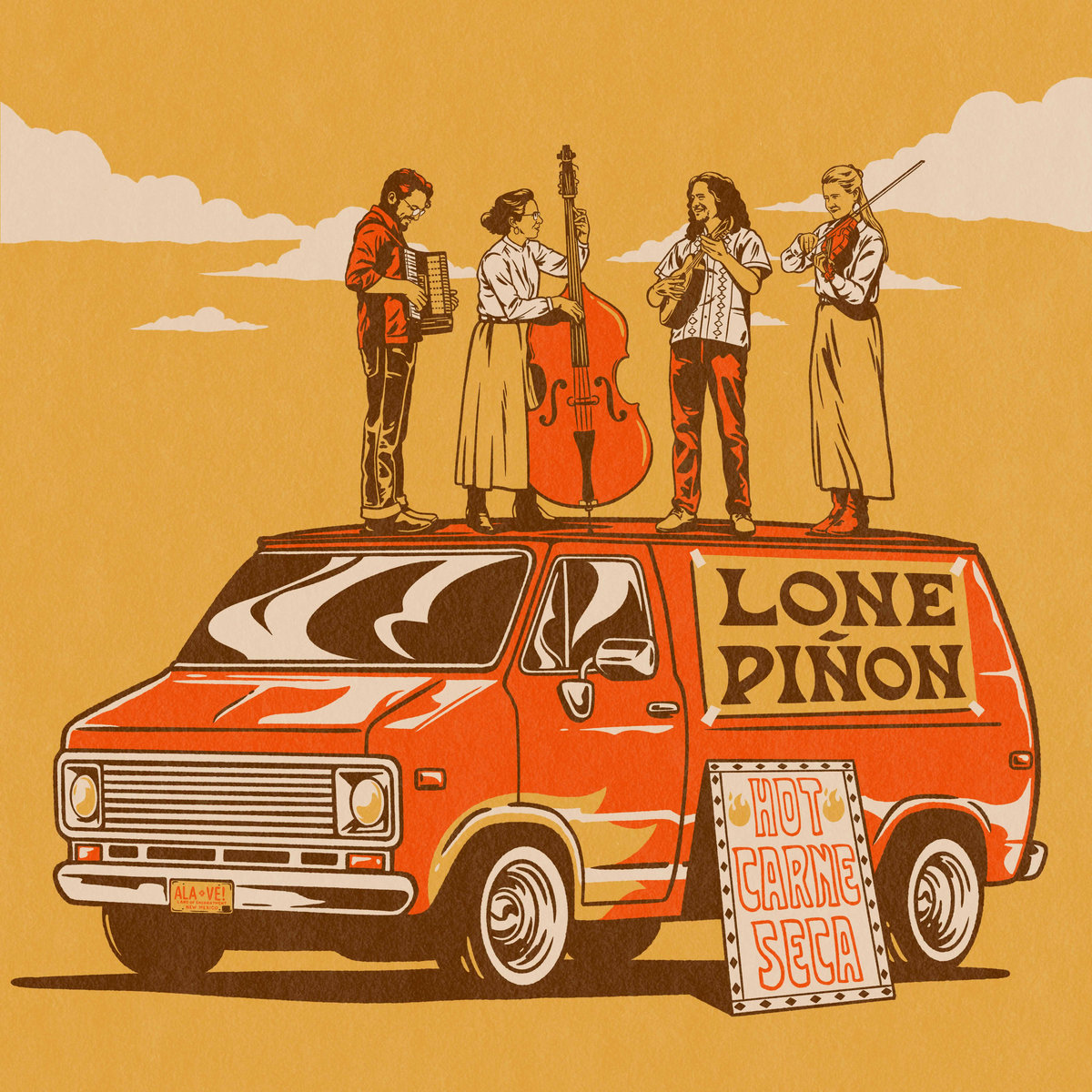
Few contemporary ensembles engage with tradition as a living, evolving language rather than a museum exhibit, and Lone Piñon has steadily built a reputation on precisely that philosophy. With ‘Hot Carne Seca’, the New Mexico orquesta típica broadens its artistic vocabulary while remaining firmly rooted in the sounds handed down through generations of musicians whose repertoires have survived migration, cultural exchange, and changing fashions. The album is not an exercise in historical reconstruction but an affirmation that heritage continues to flourish when artists approach it with curiosity, humility, and imagination. Every performance reflects an understanding that regional music gains strength through dialogue across communities, eras, and experiences.
Recorded in rural Louisiana with Joel Savoy producing, the album carries an inviting immediacy that allows every instrument to occupy its own natural space. Rather than polishing away the character of the performances, the production preserves the warmth of musicians playing together in real time. That sense of conversation becomes one of the defining pleasures of the record, where every melodic phrase seems to encourage another response from elsewhere in the ensemble. The lively instrumental opener, “Polka en Fa,” establishes the ensemble’s remarkable chemistry within moments. Jordan Wax’s accordion and fiddle lines glide effortlessly alongside Karina Wilson’s violin, creating intertwined melodies that sound both celebratory and deeply familiar. Tanya Nuñez anchors the performance with an upright bass pulse that never becomes merely functional, while Santiago Romero’s guitar provides rhythmic assurance without crowding the arrangement. It is concise yet remarkably expressive, serving as a succinct declaration of the band’s musical identity.
“El Tecolote” expands that conversation with buoyant confidence, allowing the group’s string work to sparkle while the accordion lends rhythmic lift. Every phrase appears carefully considered without sacrificing spontaneity. The ensemble avoids unnecessary ornamentation, trusting the enduring strength of the melody itself, an approach that reflects the traditions from which these pieces emerge. One of the album’s most memorable qualities is its embrace of vocal performance. Earlier Lone Piñon recordings often placed greater emphasis on instrumental dance music, but ‘Hot Carne Seca’ gives its singers room to illuminate the emotional depth of the repertoire. “Quiero Ver” balances lyrical intimacy with graceful accompaniment, its bilingual sensibility embodying the cultural richness that has shaped Northern New Mexico for centuries. The vocals never dominate the arrangement but instead become another instrument within the larger musical dialogue.
That philosophy reaches exceptional maturity during “Los Ojos de Pancha.” Stretching beyond six minutes, the piece evolves through subtle shifts in instrumental color rather than dramatic structural changes. Wax’s accordion and Romero’s guitar continuously exchange ideas while Wilson’s violin introduces lyrical responses that deepen the emotional atmosphere. Nuñez’s bass remains understated yet indispensable, holding everything together with quiet authority. The result possesses remarkable patience, allowing listeners to settle into its graceful cadence. “Cataclismo” introduces sharper rhythmic energy without abandoning the group’s characteristic elegance. Here the interaction between accordion, fiddle and guitar becomes especially animated, revealing how deeply these musicians understand one another’s instincts. Every instrumental voice contributes to the collective expression rather than seeking individual prominence.
The brief but infectious “Viva Albuquerque” celebrates place with infectious spirit. It serves almost as a musical postcard, acknowledging the city’s importance within New Mexico’s cultural landscape while demonstrating how effectively Lone Piñon can communicate joy through economy. “No Eras Para Mi” with its generous running time allows the narrative and melody to develop naturally, supported by expressive vocal performances that avoid melodrama in favor of sincerity. Romero’s guitar accompaniment displays remarkable sensitivity, while Wilson’s violin gently amplifies the song’s emotional contours. The arrangement values silence and restraint as much as melody, producing a moving meditation on love and separation.
Similarly expansive, “El Preso Numero 9” offers one of the album’s most compelling dramatic performances. The familiar ranchera classic receives an interpretation rooted in respect rather than imitation. Every instrumental contribution strengthens the storytelling, particularly the subtle exchanges between accordion and violin, which mirror the emotional complexity embedded within the lyrics. The ensemble succeeds because it understands that conviction arises through careful phrasing rather than exaggerated expression.
Following these emotionally substantial performances, “Sunset Waltz” introduces welcome lyrical elegance. The waltz rhythm carries a quiet nobility, with the string section producing beautifully balanced harmonies while Nuñez’s bass lends graceful momentum. The composition evokes expansive Southwestern landscapes without resorting to musical cliché, allowing atmosphere to emerge naturally from the interplay between performers. “Pecos Polka” restores exuberant dance energy through crisp ensemble playing and infectious rhythmic drive. Every instrument appears to smile through the melody, reaffirming that this music has always belonged as much to community celebrations as concert stages.
The closing “Nochecita” provides an ideal conclusion. Gentle, reflective and beautifully proportioned, it gathers together many of the album’s recurring qualities: lyrical vocals, refined ensemble interaction, and profound respect for tradition paired with artistic confidence. Rather than ending with dramatic flourish, Lone Piñon chooses quiet assurance, allowing the final notes to linger with understated grace. Throughout ‘Hot Carne Seca’, Jordan Wax’s mastery of violin, accordion, mandolin, guitar and vocals demonstrates extraordinary versatility without ever drawing attention away from the ensemble. Tanya Nuñez’s upright bass, guitar and vocals provide both rhythmic stability and emotional warmth. Karina Wilson enriches the performances with expressive violin, viola and vocal harmonies, while Santiago Romero’s guitar, vihuela and vocals contribute deep knowledge of New Mexico’s musical inheritance. Their collective musicianship embodies the collaborative values that have sustained these traditions across generations.
More than a collection of beautifully performed songs, ‘Hot Carne Seca’ serves as a vibrant portrait of a regional musical culture whose richness lies in its openness to continual renewal. Lone Piñon honors the voices of elders while speaking confidently to the present, demonstrating that preservation and creativity are not opposing impulses but complementary ones. The album stands as both an artistic accomplishment and a cultural affirmation, celebrating the enduring vitality of New Mexico’s remarkably diverse musical heritage with intelligence, generosity, and unmistakable affection.
Learn more links:
Lone Piñon
Jalopy Records
Bandcamp