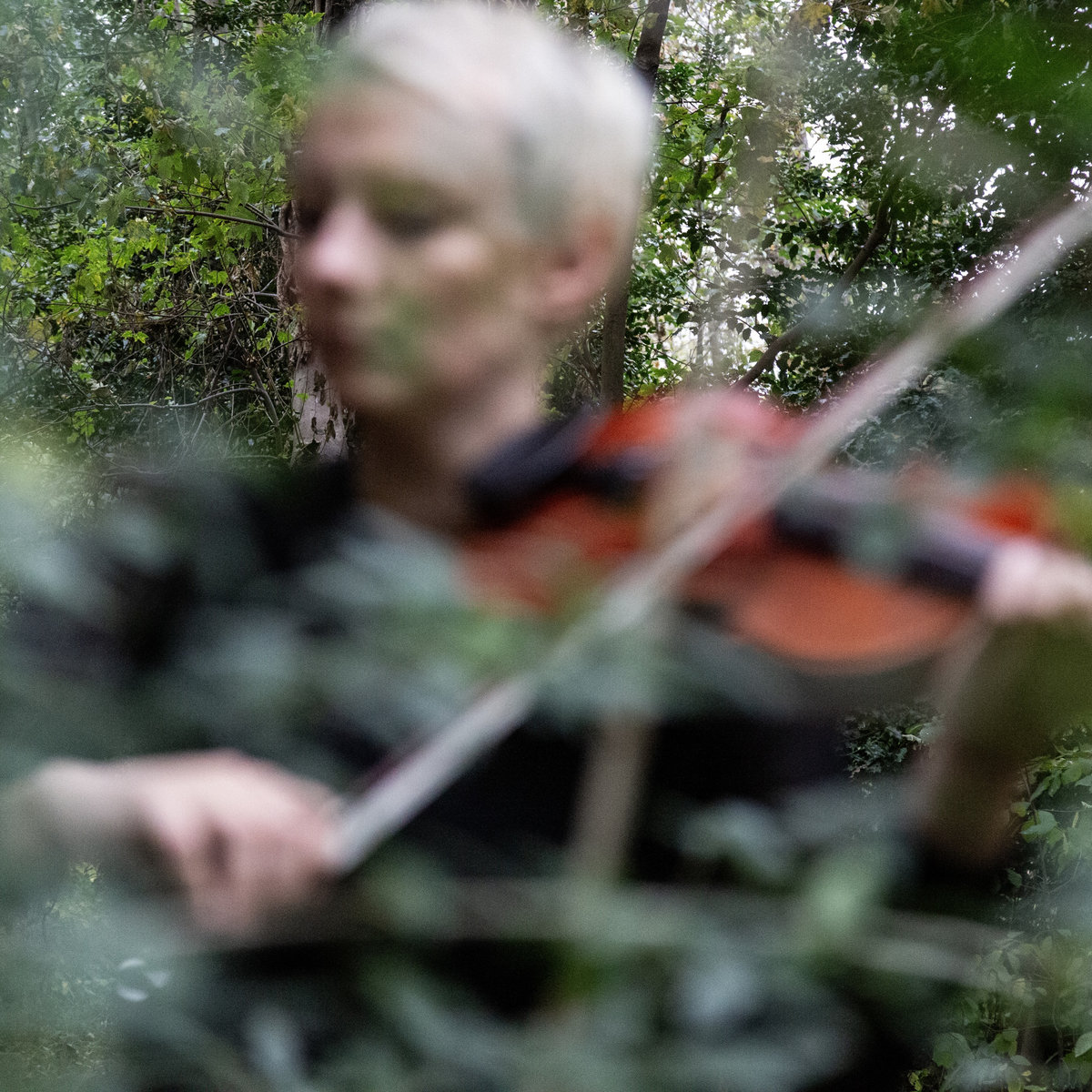
Twilight has long occupied a privileged place in artistic imagination, a threshold where certainty loosens its grip and older, less rational forms of knowledge seem to emerge from the edges of perception. On ‘Divided By Dusk’, Magda Drozd inhabits that fleeting territory with remarkable conviction, creating an album that examines memory, folklore, geography, and identity not as fixed subjects but as living currents that continue to shape the present. Drawing inspiration from time spent in Japan while simultaneously reconnecting with her Polish heritage, Drozd constructs a body of work that is neither ethnographic document nor nostalgic reconstruction. Instead, it is an act of transformation, turning inherited cultural fragments into something vividly contemporary and deeply personal.
The opening piece, “Eclipse”, establishes the album’s atmosphere with an extraordinary sense of restraint. Field recordings, spectral electronics, and Drozd’s violin coexist in a carefully balanced environment where silence is as significant as sound. Rather than announcing itself dramatically, the composition arrives like a change in light, subtly altering the listener’s relationship to space. The effect is immersive without becoming decorative, suggesting hidden narratives rather than illustrating them. The title track, “Divided by Dusk”, expands this language into something more architecturally ambitious. Built upon layers of Lyra-8 synthesis, violin textures, and distant vocal traces, the piece explores the album’s central idea of liminality. Additional compositional contributions from Nicola Genovese enrich the work’s structural complexity, allowing motifs to emerge and recede with a dreamlike logic. The music seems suspended between states: ancient and modern, intimate and expansive, earthly and ceremonial. It is a composition concerned less with destination than with the instability of transition itself.
“Contrasts” provides one of the record’s most revealing statements. The title suggests opposition, yet Drozd appears more interested in demonstrating how seemingly disparate elements coexist. Folk-inflected melodic figures drift through abstract electronic environments, creating a dialogue between tradition and experimentation that never feels forced. The composition refuses simplistic binaries, finding continuity where one might expect division. The album reaches a fascinating point of cultural exchange with “Rounds,” featuring Japanese flutist Rai Tateishi. His contributions on shinobue and khenan introduce timbres that deepen the record’s sense of geographic and historical fluidity. Rather than functioning as an exotic embellishment, Tateishi’s presence becomes integral to the piece’s identity. Additional recording and mixing by Koshiro Hino further enhance its dimensionality, allowing instrumental voices to circulate through the composition with remarkable clarity. “Rounds” captures the album’s broader ambition: to treat cultural traditions not as museum artifacts but as active forces capable of generating new forms.
With “Piosenka Ludowa”, Drozd turns more directly toward folk sources, though she avoids the obvious pitfalls of revivalism. The piece feels less concerned with preserving a song than with examining what remains after generations of transmission. Fragments of melody surface like archaeological discoveries, carrying traces of lives and histories that can no longer be fully recovered. The result possesses a quiet emotional power rooted in absence as much as presence. The bluntly titled “Hungry Nightmares” introduces one of the album’s darkest moods. Here, ambient textures acquire a more psychological dimension, producing an atmosphere of unease that never descends into melodrama. Drozd demonstrates an impressive understanding of sonic pacing, allowing disquiet to emerge gradually through accumulation rather than shock. The composition functions almost as a study of subconscious memory, where forgotten images return in altered forms.
At under three minutes, “Vertigo” is among the album’s briefest works, yet it leaves a disproportionately strong impression. Its swirling layers and destabilized melodic gestures create a sensation of disorientation that perfectly reflects its title. What distinguishes the piece is its refusal to resolve that instability; uncertainty remains embedded within the music itself, becoming a source of fascination rather than discomfort. The closing track, “From The Depths”, serves as both culmination and descent. Featuring additional lyrics by Arkadiusz Drozd, the piece gathers many of the album’s recurring concerns into a final meditation on inheritance and remembrance. Voices emerge from dense electronic surroundings like messages transmitted across generations, while violin and ambient textures intertwine with a sense of solemnity that never becomes heavy-handed. The composition leaves the listener not with closure but with a heightened awareness of the unseen histories that persist beneath contemporary experience.
Throughout ‘Divided By Dusk’, Magda Drozd demonstrates exceptional skill as both composer and sonic storyteller. Her performances on violin, electronics, Lyra-8, and voice form the foundation of a sound world that is meticulously crafted yet emotionally open. The production reveals equal attention to detail, while the mixing work by Glyn Maier and Nick Klein preserves the music’s delicate balance between intimacy and scale. Lawrence English’s mastering provides the final cohesion, ensuring that every subtle gesture retains its presence within the album’s expansive sonic landscape.
What makes ‘Divided By Dusk’ particularly compelling is its understanding that folklore is not merely a collection of stories from the past but a living mechanism through which cultures remember themselves. Drozd approaches this idea with intellectual curiosity and artistic sensitivity, creating music that acknowledges historical depth without becoming trapped by it. The album exists in a perpetual state of twilight, where identities blur, traditions evolve, and forgotten voices continue to resonate. In doing so, it offers one of the most thoughtful and evocative explorations of cultural memory and place to emerge from contemporary experimental music in recent years.
Find out more by visiting Präsens Editionen | Bandcamp