
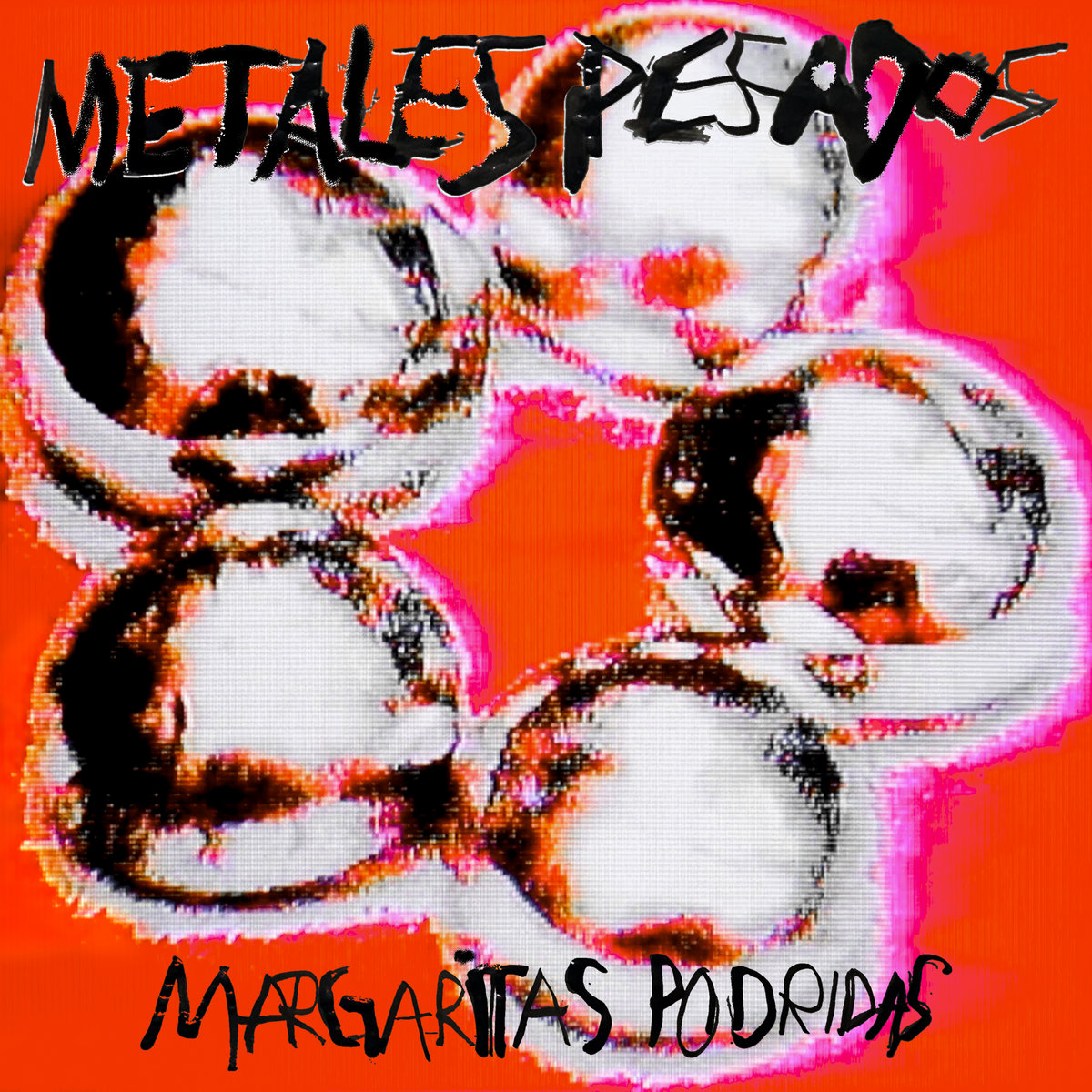
On their third album, ‘Metales Pesados’, Margaritas Podridas sharpen their identity to a dangerous edge. The quartet from Hermosillo, Sonora has long drawn from the well of 90s shoegaze and grunge, but here they sound less like revivalists and more like architects of a private storm. The title translates to heavy metals, and while this is no exercise in genre cosplay, the phrase captures the album’s density and sheen: guitars that glint like blades, rhythms that land with industrial force, melodies that gleam through the distortion like light off a corrugated roof.
The record opens with “Tornillo”, a song that lives up to its name by screwing itself tightly into the listener’s consciousness. Carolina Enríquez’s bass rumbles beneath a lattice of feedback shaped by the guitar of Esli Meuly, while Rafael Armenta’s drumming feels impatient, almost volatile. Enríquez sings as if she’s pressing her voice against a locked door, testing its hinges. There is urgency here, but also control; the band never loses sight of form even as they push their sound toward abrasion.
“Mugre Morada” follows with a bruised kind of grandeur. Its verses hover in a narcotic haze before the chorus detonates, Meuly adds layers of guitars that feel both corrosive and strangely luminous. The song embodies one of the album’s central fascinations: how beauty can grow out of emotional wreckage. Enríquez’s vocal performance suggests someone cataloguing betrayal in real time, refusing to sanitize it.
On “Torreta”, the band leans into propulsion. Armenta’s drumming is all forward motion, snapping the song into a tight coil while the guitars oscillate between shimmer and assault. The track hints at their punk lineage, but the production adds a thickness that makes every chord feel weighted. It is music that seems to lean toward confrontation without ever collapsing into chaos.
“Pólvora” lives up to its combustible title. The interplay between bass and drums becomes almost militaristic, giving Enríquez room to stretch her phrasing into something more incantatory. The chorus blooms in distortion, yet the melody cuts cleanly through, proof of the band’s instinct for hooks even when buried under layers of noise. That instinct becomes even more pronounced on “Quema Los Recuerdos”, a song that transforms personal exorcism into communal chant. The guitars swell and recede like sirens, and when Enríquez’s voice cracks at the top of her register, it feels less like a flaw than a deliberate tear in the fabric.
“Agujas” is among the most unsettling pieces here. Its central riff feels needled, twitching at the edges, while the rhythm section keeps everything pinned down. There is a sense of claustrophobia in its structure, as though the walls are inching closer with every bar. “Cabeza De Metal” answers with brute force, its opening moments hammering down a thesis for the entire album: heaviness is not about speed but about emotional mass. The guitars grind, yet there’s a strange elegance in Meuly’s playing.
“Enemigo Público” channels the band’s defiant streak. Margaritas Podridas have long resisted the pressures of language and industry expectations, and here that refusal becomes thematic. The song feels like a raised fist, but it also carries an undercurrent of vulnerability. Enríquez does not present invincibility; she presents survival.
“Hola?” is deceptively slight at first, built around a motif that feels almost playful. Yet beneath its surface lies a pointed commentary on alienation, as if the question mark in the title is less greeting than accusation. “Máquina Robot” expands that idea, introducing mechanical rhythms that mirror the dehumanizing structures the band implicitly critiques. Armenta’s drumming becomes precise to the point of menace, while the guitars buzz like overworked circuitry.
“Rompecabezas”, the album’s lead single, stands as its emotional axis. The song balances abrasion with clarity, its chorus arriving like a revelation. Enríquez’s voice carries both exhaustion and resolve, embodying the album’s origin as a lifeline during a period of personal darkness. The band sounds utterly assured here, as though they have distilled their influences into something unmistakably their own.
“Rompecabezas” bleeds into “Sierra”, the closing track, with a sense of finality. “Sierra” does not offer easy catharsis; instead, it carves its way toward a hard-earned calm. The guitars feel less like weapons now and more like tools, shaping space rather than attacking it. When the final notes fade, what lingers is not despair but resilience.
‘Metales Pesados’ is not an album that hides its scars. It is direct, confrontational, and emotionally candid. Yet it is also carefully constructed, the product of a band that understands the architecture of noise. With Carolina Enríquez anchoring the songs in lived experience, Esli Meuly sculpting walls of sound that shimmer and slash, and Rafael Armenta driving everything forward with relentless precision, Margaritas Podridas have delivered a work that feels both ferocious and necessary. In forging their own alloy of shoegaze, punk, and grunge, they have made heaviness feel not just sonic but existential. By the time the final note fades, “Metales Pesados” leaves the listener in a state of productive exhaustion. Margaritas Podridas have not just made an album; they have constructed a challenging environment where the rust of the physical world meets the electricity of the human spirit.
Releases March 6, 2026
Learn more by visiting: Hopeless Records | Bandcamp | Youtube Facebook | Beacons.