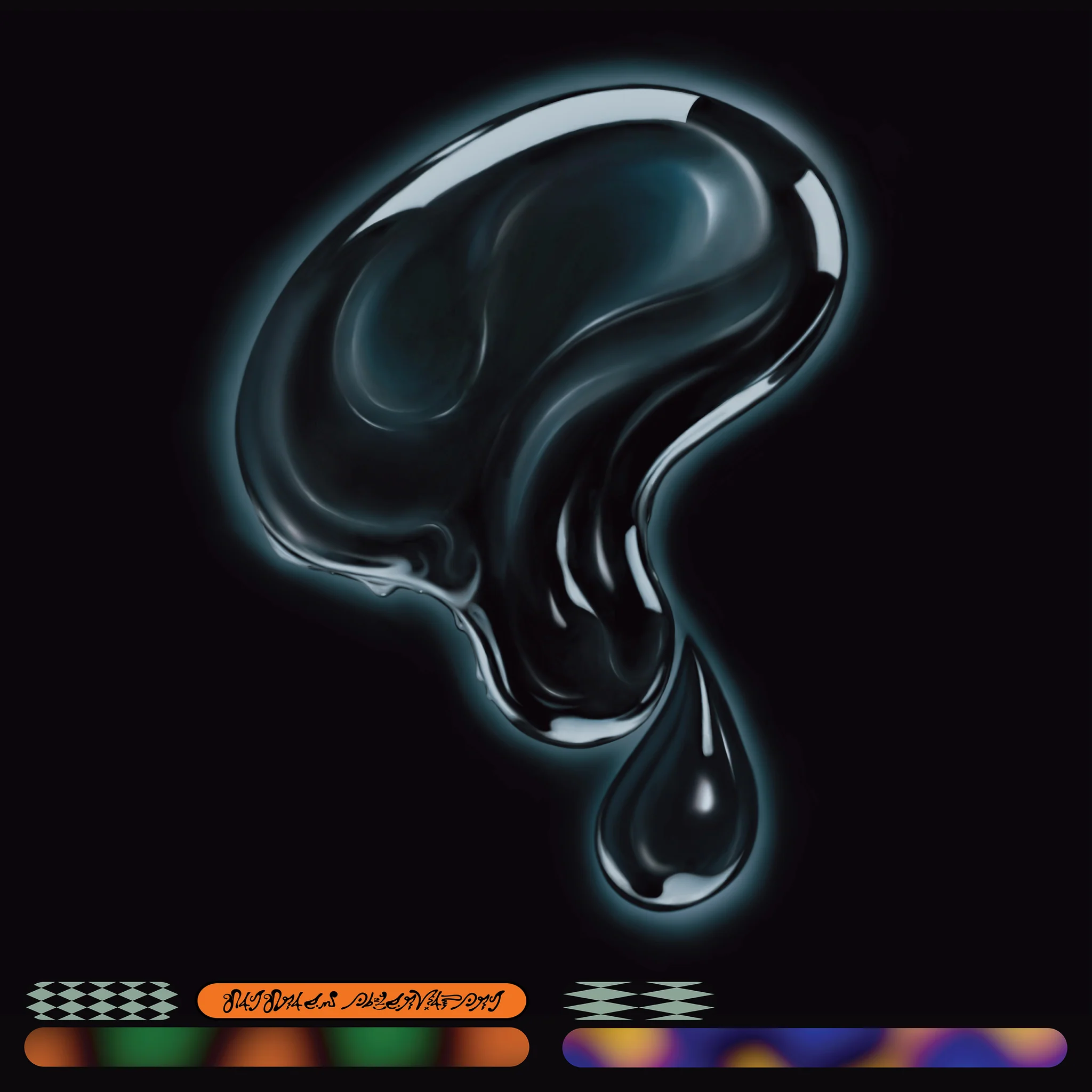
‘Daydream Observatory’ extends Matt Evans’ ongoing fascination with interior mapping, though this time the terrain feels less cartographic and more associative; an imaginative system built from fragments, gestures, and collisions. Across ten pieces, Evans treats sound as both material and metaphor, assembling what he calls “zone poems” that operate somewhere between composition and collage, guided as much by intuition as by design.
“For Oyster” introduces this approach with deceptive modesty. A voice memo from Jennae Santos flickers at the edges, accompanied by small, almost incidental percussive textures of a water bottle, ambient traces, environmental residue. These elements do not announce themselves as novelty; instead, they establish a vocabulary where the boundary between intention and accident is deliberately blurred. The track suggests an observational stance, as if Evans is tuning the listener’s ear before the larger structures emerge.
“Wine Shop Discount RPG” shifts toward rhythmic insistence, its drum programming anchoring a swirl of synthesizer lines drawn from Evans’ arsenal of analog and digital instruments. The Moog Grandmother and Juno 60 tones carry a certain familiarity, yet they are arranged in ways that resist nostalgia, constantly redirecting the ear through abrupt tonal pivots and unexpected harmonic turns. What could have been playful pastiche becomes something more unstable, reflecting the album’s preoccupation with shifting emotional registers.
The presence of Chris Ryan Williams becomes central on “Sword of the Sun,” where trumpet lines cut through the synthetic environment with a clarity that feels almost architectural. Evans does not simply layer Williams’ performance on top; he reshapes it, fragments it, and re-contextualizes it, creating a dialogue between the organic and the processed. This method continues into “Stone Eater,” where Williams’ contributions intertwine with the flute of Domenica Fossati and the noise textures of Lia Ohyang Rusli. The result is dense but not impenetrable, a carefully pruned arrangement that maintains detail without collapsing under its own weight.
“Gaia” offers a moment of relative clarity, with Fossati’s flute providing a melodic anchor that grounds the surrounding electronics. Yet even here, Evans resists stability. The melodic lines are subtly destabilized by shifting rhythmic patterns and spectral processing, suggesting a world in which coherence is always provisional. “Dirt Fish” revisits the trumpet-electronics interplay, but with a more fragmented logic, as if the material itself is being reassembled in real time.
“Analemma” stands apart through its temporal layering, incorporating recordings that date back several years. The drums, tracked earlier than much of the album’s material, create a sense of temporal dislocation, as though past and present are coexisting within the same frame. This temporal elasticity becomes a defining feature of the record, reinforcing its conceptual grounding in interior rather than geographic space.
On “Dreamreader,” Nyokabi Kariũki’s kalimba introduces a delicate, percussive clarity that contrasts with the surrounding electronic haze. Evans responds by carving out space within the arrangement, allowing the instrument’s resonance to guide the track’s pacing. It is one of the album’s more intimate moments, though it never retreats into simplicity.
“A Nautiloid Spiral Shell” brings Marta Tiesenga’s tenor saxophone into focus, its lines looping and curling in patterns that mirror the title’s imagery. Evans’ treatment of the saxophone emphasizes its physicality while simultaneously abstracting it, creating a sound that feels both immediate and distant. The piece exemplifies the album’s central strategy: to take recognizable elements and reframe them until they occupy a new conceptual space.
The closing track, “In Parched Light,” featuring guitar work from Anthony Vine, draws the album toward a quieter resolution. The guitar introduces a more linear sense of progression, yet it remains embedded within Evans’ broader sonic environment, never fully escaping the gravitational pull of the surrounding textures. The piece does not resolve the album’s contrasts so much as hold them in suspension, allowing lightness and density, clarity and obscurity, to coexist without hierarchy.
Throughout ‘Daydream Observatory,’ Evans demonstrates a meticulous attention to detail that never feels rigid. His editing and mixing practices (cutting, rearranging, and reshaping performances), result in compositions that retain a sense of spontaneity despite their intricate construction. The presence of guest musicians is not ornamental; each contribution is absorbed into the album’s evolving language, becoming part of a larger system rather than a discrete feature.
What emerges is a work that resists easy categorization. It draws from electronic music, improvisation, and sound art, yet it is defined less by genre than by method. Evans approaches composition as a process of continual reconfiguration, where meaning arises through juxtaposition and transformation. ‘Daydream Observatory’ invites the listener into a space where perception itself becomes the subject, a shifting field of impressions that reflects the complexities of interior life without attempting to simplify them.
Learn more by visiting Matt Evans | AKP Recordings | Bandcamp